People often ask what kind of rope and belaying device should be used to climb. And the answer is not simple but it really depends on the types of climbing that equipment will be used for.
Here are three examples with my favorite ropes used for scrambling, glacier crossing, traditional climbing and mountaineering:
Beal Rando 8mm (Twin) 30m
At just 37 grams per meter, it takes up little room, but it takes the impact! On snowfields and steep passages, during mountain walking or skiing, its properties ensure your security.
- STRONG POINTS: Available in 20 and 30 m lengths, also 48 m, with markings each 12 meters to assist tying-in.
- USES: High level walking and glacier crossing.
- ATTENTION: Used singly, climbing & mountaineering forbidden.
Easy snow routes, glacier travel, ski-touring. A snow route is called easy if it has no difficult passages such as the crossing of a bergschrund, requiring a belay.
It will be possible to progress with any type of dynamic rope:
- One strand of single rope.
- One strand of double rope.
- One strand of twin rope.
The roping of the party is practiced in different ways. BEAL’s choice is to use one strand of twin rope. In order to make the dynamic results for this rope more realistic BEAL has decided to indicate the performance more closely related to this use than a twin rope tested on two strands.
That is with a fall limited to factor 0.8, but with 80 kg on one strand, and the impact force measured with the same parameters. Even though we forbid the use of RANDO rope on one strand for climbing and mountaineering, these two activities are nevertheless practicable if you use 2 strands of RANDO rope.
- Impact force used on one/two strands: 4.2 kN / 8.5 kN
- Number of falls used on one/two strands: 5 / 12
- Sharp edge resistance on two strands only
- Sheath percentage 40 %
- Weight per meter 37 g
- Water Absorption 0,9 %
With lower impact force and higher number of falls held, the security is better. The more the impact force is lowered:
– The more your fall is cushioned.
– The more you protect your anchor point (particularly important if it is questionable).
– The easier it is for your second to hold you.
Dry Cover sheath treatment, for better abrasion resistance. A Dry Cover protected rope is:
– More resistant to dust and to the wet.
– More resistant to abrasion.
– Better long-term running of ropes through belay devices.
Dry Cover added to Golden Dry treatment of the core gives:
– More resistance to ice and to water.
– Reduced weight gain in wet conditions.
Beal Cobra II 8.6mm (Half) 50m
The great classic for adventure climbing. Light and free-running for ease of use on long routes, on the crag and in the Alps. Technical and robust enough to sustain the most difficult loadings.
This is the multi-use rope par excellence if you don’t want to own more than one double rope. It has a low impact force (5,1 kN) to minimize anchor-point loading, and a sheath of sufficient thickness to withstand the most aggressive rock, all for only 48 g and a record number of falls = 16.
- STRONGS POINTS :
- Excellent compromise between strength and lightness.
- Low impact force and raised number of falls sustained.
- The rope doesn’t bunch up and remains supple for the long term.
- Allows escape by abseil even if the sheath is cut.
- USES: All sorts of mountaineering and adventure climbing use.
Roca Kio 10.2mm Rope (60m)
Possibly the longest-lasting 10.2 mm rope manufactured today. Combines pleasant handling, lightness and durability. Excellent for multi-pitch equipped routes.
Weight (g/m): 69
Dynamic elongation (%): 35.1
Impact force (kN): 8
Falls (UIAA): 9
Diameter (mm): 10.2
Climbing rope types explained
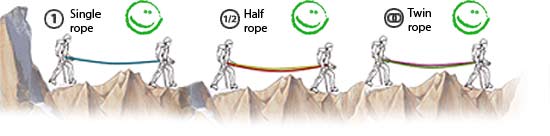
Twin rope

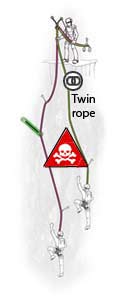
This rope is always used with the two strands together, remaining parallel: each climber ties into both strands, and these are always clipped together. Its advantage over single rope is that it allows for abseils as long as the rope. It is lighter than half rope but does not allow for separate strand clipping.
USES: High level walking and glacier crossing.
STRONGS POINTS: Available in 20 and 30m lengths, also 48m, with markings each 12 metres to assist tieing-in.
Half rope
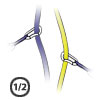
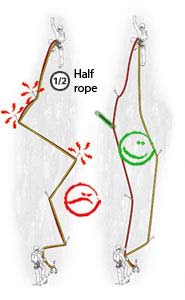
A “rope” formed of 2 strands which the leader is tied into but, unlike twin ropes, two seconds may each be tied into just one of the strands. The leader clips only one strand into each runner so as to reduce drag. Half rope is recommended for mountaineering and long ascents where abseil descent is necessary. It is equally preferable whenever belays are less than perfect, notably when ice climbing, because with just one strand clipped, you reduce the shock load in case of a fall. In addition they offer better protection against stone fall or falling on an arete; to limit the drag, and thus the fall factor, you can clip the strands separately.
Single rope
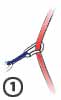
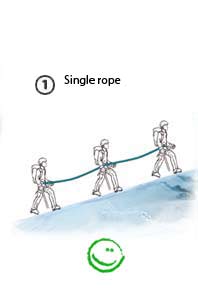
This rope is used as a single strand. It is best adapted to difficult routes which are fairly straight-line, to easy routes without change-over belays, and where descent is not by abseil. It is in particular the rope for sport climbing.
Progression on glaciers

Progression on rock ridges

Single pitch sport climbs

Via Ferrata
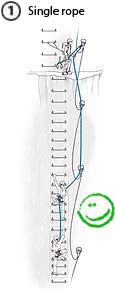
Multi-pitch climbs (classic routes, mountain, icefalls)



 Unlimited Potential, Up to 8000m