Author Archives: Javi Clayton

What if I get sick up there? – The high altitude aid kit

We can discuss for hours how to prevent of sickness from appearing during our expeditions. From allergic reactions, to gastric infections and diarrhea, constipation, cold, Khumbu cough, blocked nose, eye dryness and infections, ear infections, gynecological problems, insect bites, blisters, cuts and small traumas. These are the most common heath issues you are most likely to experience during the course of any expedition, but on high altitude climbing the real challenge is how to prevent and fight altitude related illnesses, such as Acute Mountain Sickness (AMS).

There is a long list of places in the Internet where to find information on how to build a first aid kit, but I found quite difficult to find a comprehensive list of what to include in the kit for high altitude expeditions. During most of the big climbs I’ve done, I relied on my basic first aid kit for generic health issues such as most of the things mentioned in my previous line. For my biggest challenge ever, Khan Tengri 2012 Expedition, I had the same kit with extra medicines, and for high altitude sickness I relied on the big medical kit we carried as a team during the expedition. This, when I see it retrospectively, is a mistake for two reasons. A communal medical kit might not have enough supplies for several climbers falling ill during the course of the same expedition. And secondly, you might have unexpected reaction to some of the drugs included in the kit. During that expedition we were lucky to have two doctors in the climbing team, but most of the times you have to rely in your or someone else’s knowledge when fighting sickness. In big and complex commercial expeditions, such as the ones carried out to the eight thousanders, medical consultancy is included or available as basecamp service. However you should not expect the yaks to carry up a whole pharmacy. In places like the Khumbu Valley in Nepal is not difficult to find doctors climbing or working in some of the most transited villages. However they are not always are fully stocked with drugs and they must charge you accordingly. Bring your own kit and you’ll be better prepared to fight illness and make it to the summit and back home safe and happy.

This post contains a list of things to include in your personal medical kit / first aid kit. It is highly advisable to go through the list with your doctor and make sure none of the medicines are contraindicated considering your medical history and current condition. You should get guidance on how to administer each medicine and carry instruction written in a piece of paper stored in the kit. In certain circumstances you might be unable to think clearly, and these instructions should be easy to read and understand by you or your climbing partners. Some directions on the dose are included here, but all this information is to be carefully reviewed and discussed with your doctor. This list is designed for someone very healthy like me (thanks god!), and it does not consider certain pre-existing conditions such as diabetes, asthma, epilepsy, allergies, high blood pressure, etc.

For certain destinations some of the medicines can get you into legal issues, so it worth investigating that in advance, and carrying a letter from the doctor if necessary.

I have divided the list in two sections. The first one contains things that must be included in the kit as bare minimum, it’s the kit you must carry with you at all times to cope with emergencies. The second contains a list of extra things that will help you fighting other common illnesses and will make your trip more pleasant by helping with minor issues.

Basic high altitude aid kit:

  • Plasters, Elastic band, Gauze pads, Adhesive dressings, Burn and Blister dressings, Antiseptic Gauze pads, Antiseptic cream, Tweezers and Needles – cuts and small traumas
  • Diamox (Acetozolamide) – 250mg tablets, 2 times a day, 30 per person – Cerebral and Pulmonary Edema (HACE, HAPE). 125 mg about an hour before bedtime ­- Periodic breathing
  • Nifedipine – 10mg tablets, 3 times a day, 12 per person – Pulmonary Edema (HAPE)
  • Dexamethasone – 4mg tablets, 6 times a day, 20 per person – Cerebral Edema (HACE)
  • Ciprofloxacin Antibiotic – 750mg tablets, 2 times a day for 3 days, 10 per person – Diarrhea caused by bacterial infections
  • Loperamide – 2mg capsules taken up to 8 times normally after defecating, 10 per person – Relieving effects of diarrhea
  • Azithromycin Antibiotic 500mg daily for 3 days, 5 per person – To treat many different types of infections caused by bacteria, such as respiratory infections, skin infections, ear infections as well as diarrhea
  • Paracetamol – 500mg tablets, two every 4-6h, 20 per person – To treat many conditions such as headache, muscle aches, backache, toothaches, colds, and fevers.
  • Ibuprofen – 600mg tablets, dose depends on the condition to treat, must be taken with food, 20 per person – To reduce fever and treat pain or inflammation caused by many conditions such as headache, toothache, back pain, menstrual cramps, or minor injury
  • Micropur Forte water sanitizer – 1 tablet per liter of water, 50 per person

Extra kit:

  • Aspirin – Used as an analgesic to relieve minor aches and pains, as an antipyretic to reduce fever, and as an anti-inflammatory medication.
  • Diphen (diphenhydramine) – 25mg tablets, one or two every 4-6h – To treat sneezing, runny nose, itching, watery eyes, itching throat, and other symptoms of allergies and the common cold. Is also used to suppress coughs, to treat motion sickness and to induce sleep. Used with epinephrine in the treatment of severe allergic sock
  • Amoxycillin 250mg and Metronidazole 200mg – Additional antibiotics to be used under medical supervision
  • Calmatel (Piketoprofen) – 60g ointment tube – Analgesic, antipyretic and anti-inflammatory preparation. Ideal to treat small traumas.
  • Blastoestimulina – 50g ointment tube – Cicatrizant and antibiotic preparation. Ideal for cracked skin on hands, and the typical infections around the nails, or skin irritation between legs.
  • Liposic ophthalmologic gel – To treat eye dryness and ophthalmological issues at night
  • Artelac eye drops (hypromellose) – To treat eye dryness and ophthalmological issues during the day
  • Panadol Hot Lemon and Honey – Cold and flu relief
  • Pseudoephedrine 60mg 3 times a day or Xylometazoline Nasal spray – Blocked nose
  • Strepsils – Sore Throat Lozenges with anesthetic. Also useful for mouth sores
  • Cough Lozenges, e.g Doctor Andreu
  • Mouth sore gel
  • Supralax Senna constipation tablets – To be taken in the evening, prior going to bed – A natural herb laxative, helpful in treating constipation.
  • Afterbite wet tissues – Relief from insect bites
  • Thermomether (must not brake under extreme temperatures)
  • Depending on your skills you may want to include other items such as scalpel, synthetic suture and vinyl globes.

Other important things to bring and make sure we are protected against external factors that produce health issues are

  • Sunscreen and moisturizer, to protect the skin from the sun and prevent the dry skin from developing cracks that can get infected
  • Lip balm & sunscreen
  • Mosquito repellent wet tissues

You can also purchase one First Aid Kit designed for outdoor activities, such us the Lifesystems Mountain First Aid Kit and complement it with some of the things listed in this post.

IMG_1553

Basic Lifesystems First Aid Kit with some additions and the extra kit with essential things such as the emergency condom.

Lifesystems products are distributed in UAE by Global Climbing, the main distributor of outdoor adventure brands in the Middle East. Global Climbing is also the regional representative of Walltopia climbing walls and HRT, two of the worlds largest and most innovative companies working with artificial climbing structures.

All products distributed by Global Climbing can be found in many places in Dubai, but the one shop stop for outdoor enthusiast is Adventure HQ. Located at Dubai’s Times Square Centre, it is the ultimate destination for outdoor adventure gear.

Before you go

Visit your doctor at least six months before you leave for your expedition, get a blood test done to make sure you are doing fine with things like glucose and iron levels, which can seriously affect hemoglobin saturation and oxygen delivery at high altitude. Have a full dental check and cleaning done before departure, a minor dental problem at sea level can become a serious issue in a long high altitude expedition. If you suffer from eye dryness like I do, I recommend you to visit your ophthalmologist one week before departure to have you eye lids and tear ducts cleaned. That prevents the awkward dryness and ophthalmological issues from appearing. I did that before my last expedition and I climbed with fresh eyes and no bothering during the whole trip.

Make everybody aware of your medical conditions, the symptom and treatment. Your illness could become a risk for everyone in your group. If you need especial medication make clear labels and instructions, have spare supplies and split the kit to lower the chance of losing it all. Ask your doctor to prepare an official letter, explaining your condition, treatment and contact details.

Get first aid training for you and your climbing partners. Make sure they know about AMS and how to treat it. Think about what you will do if things go wrong

Consult with you travel nurse about vaccinations and make sure these are not contraindicated for high altitude climbing.

During the course of the expedition

BE HONEST WITH EVERYONE ABOUT CHANGES IN YOUR MEDICAL CONDITION.

If you get sick, make an effort not to spread viruses and bacteria among all expedition members. You should observe strict hygiene using sop and hand disinfectors regularly, especially when entering in mess tents and other communal areas, and when leaving the toilet.

If you take medicines, write down everything and changes in you condition.
IMG_2369

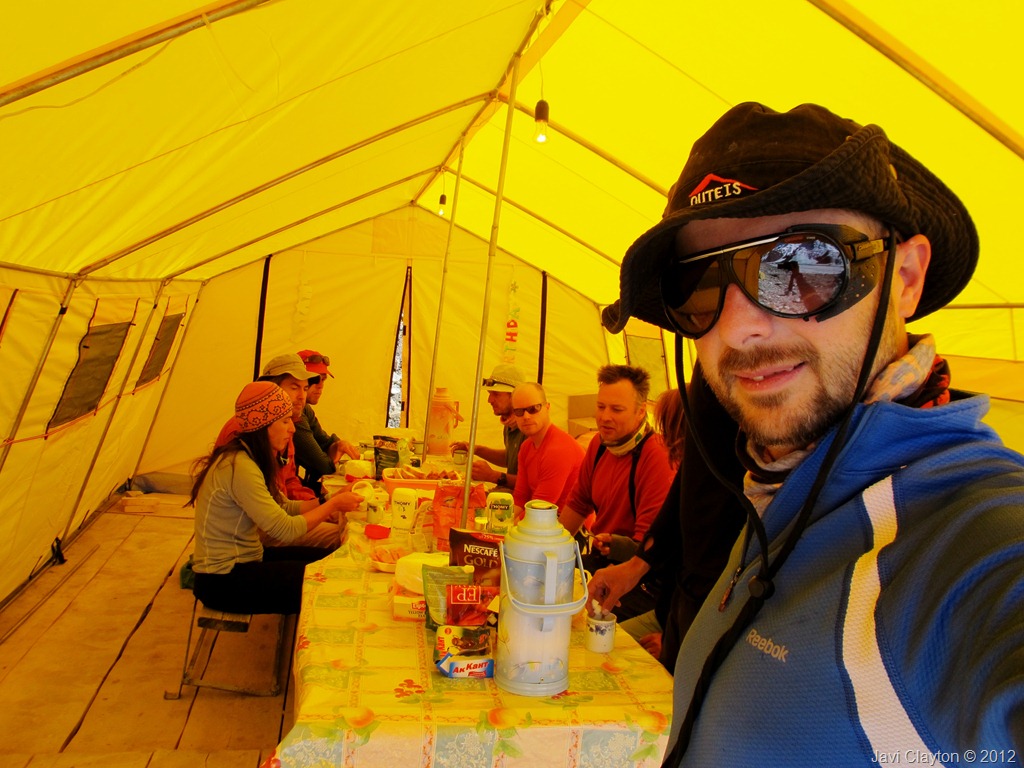
Our mess tent in Khan Tengri basecamp, a festival for viruses and bacteria. Entry was prohibited without washing hands.

Acetazolamide – Myths, Use & Dosage

Acetazolamide (Diamox®) is a medication that forces the kidneys to excrete bicarbonate, this re-acidifies the blood, balancing the effects of the hyperventilation that occurs at altitude in an attempt to get oxygen. This re-acidification acts as a respiratory stimulant, particularly at night, reducing or eliminating the periodic breathing pattern common at altitude. Its net effect is to accelerate acclimatization, it makes a process that might normally take about 24-48 hours speed up to about 12-24 hours.

Common side effects include numbness, tingling, or vibrating sensations in hands, feet, and lips. Also, taste alterations, and ringing in the ears. These go away when the medicine is stopped. Since acetazolamide works by forcing a bicarbonate diuresis, you will urinate more on this medication. Uncommon side effects include nausea and headache. A few climbers have had extreme visual blurring after taking only one or two doses of acetazolamide.

It is highly advisable to consult with your doctor and test the medication if possible.

For treatment of AMS:The recommend a dosage is 250 mg every 12 hours. The medicine can be discontinued once symptoms resolve

For Periodic Breathing: 125 mg about an hour before bedtime. The medicine should be continued until you are below the altitude where symptoms became bothersome

MYTHS

If acetazolamide is stopped, symptoms will worsen: There is no rebound effect. If acetazolamide is stopped, acclimatization slows down to your own intrinsic rate. If AMS is still present, it will take somewhat longer to resolve; if not – well, you don’t need to accelerate acclimatization if you ARE acclimatized. You won’t become ill simply by stopping acetazolamide

Acetazolamide hides symptoms: Acetazolamide accelerates acclimatization. As acclimatization occurs, symptoms resolve, directly reflecting improving health. Acetazolamide does not cover up anything – if you are still sick, you will still have symptoms. If you feel well, you are well.

Acetazolamide will prevent AMS from worsening during ascent: Acetazolamide DOES NOT PROTECT AGAINST WORSENING AMS WITH CONTINUED ASCENT. Plenty of people have developed HAPE and HACE who believed this myth.

Acetazolamide will prevent AMS during rapid ascent: This is actually not a myth, but rather a misused partial truth. Acetazolamide does lessen the risk of AMS, that’s why we recommend it for people on forced ascents. This protection is not absolute, however, and it is foolish to believe that a rapid ascent on acetazolamide is without serious risk. Even on acetazolamide, it is still possible to ascend so rapidly that when illness strikes, it may be sudden, severe, and possibly fatal.

http://www.ismmed.org/

Treating Acute Mountain Sickness (AMS)

The mainstay of treatment of AMS is rest, fluids, and mild analgesics: paracetamol, aspirin, or ibuprofen. These medications will not cover up worsening symptoms. The natural progression for AMS is to get better, and often simply resting at the altitude at which you became ill is adequate treatment. Improvement usually occurs in one or two days, but may take as long as three or four days. Descent is also an option, and recovery will be quite rapid.

A frequent question is how to tell if a headache is due to altitude. Altitude headaches are usually nasty, persistent, and frequently there are other symptoms of AMS; they tend to be frontal (but may be anywhere), and may worsen with bending over. However, there are other causes of headaches, and you can try a simple diagnostic/therapeutic test. Dehydration is a common cause of headache at altitude. Drink one liter of fluid, and take some paracetamol or one of the other analgesics listed above. If the headache resolves quickly and totally (and you have no other symptoms of AMS) it is very unlikely to have been due to AMS.

http://www.ismmed.org/

IMG_2631

We had to use it the last night in basecamp…



clip_image0086.png

Processing, disinfecting and transporting water – tips & tricks

Most of the people involved in regular sports do not realize about the difficulties that we mountaineers find along the way to the summit when it comes to having drinking water available at all times. During approach is normally easy to obtain water from rivers or springs, and in some civilized areas you’ll be able to get it in teahouses or similar places. Most of the time, these water sources are contaminated with various bacteria, viruses and protozoans. This becomes a real risk on areas where there is a prominence of farms and domestic animals, such us cows or yaks. Even in virgin mountain ranges like Jemtin Bel in Kyrgyzstan, where I was doing several unclimbed peaks this year, you might find the rotten body of a wild horse contaminating the pristine water sources. Microorganisms generally come from human and animal waste and are spread by rain and run-off.

Boiling is one of the oldest and most effective methods for sterilizing water, but it requires sufficient time and energy in the form of fuel. Boiling only eliminates micro-organisms. It will not cause the water to become clear, and chemical substances will remain inside. The various pathogens in water have different heat sensitivities, not all of them will be destroyed within the same time. At sea level the boiling point of water is 100°C. Boiling it for five minutes is adequate. At 4000 meters above sea level the boiling point drops to 86.8°C. At this altitude water must boil for 20 minutes. Therefore boiling water is normally not a completely safe option on high altitude expeditions. At Jemtin Bel basecamp I was provided with boiling water that was stored in barrels after treatment. These barrels were exposed to high temperatures and constant handling by expedition members that showed episodes of diarrhea. I felt like drinking water from the river was even safer than from these barrels…

Disinfectants destroy micro-organisms and thereby prevent the transmission of pathogens. The following substances and processes are allowed in the treatment of water: chlorine, chlorine gas, chlorine dioxide, iodine, ozone, silver and ultraviolet (UV) sanitizing. There are different products available in the market, but the one I found more effective and convenient is Micropur Forte disinfection tablets produced by Katadyn. These can be found in many places, but my favorite megastores are Decathlon and Globetrotter.

Decathlon is a major French-based sporting goods retailer operating hundreds of stores worldwide and serving 100 million customers every year. The start in France was with a shop in 1976. In the 90s, Decathlon expansion covered the rest of Europe and almost two years ago, in December 2010, the first Decathlon store in the Middle East was opened at the Mirdif City Centre in Dubai. Decathlon in Dubai is managed by the Azadea Group, a leading fashion and retail company present in the Middle East and North Africa, managing more than 45 international brands.

After few years using it, I find Micropur Forte the best water disinfection solution for the following reasons:

Silver ions combined with chlorine.Its technology is based on silver ions combined with chlorine, but it also contains Sodium dichloroisocyanurate wich is more expensive but more efficient than formerly used halazone water disinfectant. Mechanism of action is the release of chlorine in low concentrations by constant rate Chlorine disinfects water quickly and safely, and silver ions preserves water for up to 6 months.

Silver ion/chlorine dioxide based disinfecting agents will kill Cryptosporidum and Giardia, which neither chlorine nor iodine alone can be considered completely effective against. Boling will kill these microorganisms but with Micropur Forte there is no need to boil before treating.

It’s fast compared with other products and has a very long lasting effect. Eliminates bacteria and viruses in 30 minutes, amoebas and giardia in 120 minutes. Conserves drinking water for up to 6 months

It is very simple to use with high degree of user safety. Use one tablet for one litre of clear water, wait 10 minutes until the tablet has dissolved, shake well and wait another 20 minutes before using the water.

Small and handy packaging that fits everywhere. The tables are tiny and they come packed in two small blisters of 50 each, allowing for treatment of 100l

The light taste of chlorine is almost unnoticeable, and can be completely neutralized with Antichlorine produced by Katadyn other manufactures. I personally find it tasteless when using plastic bottles, metallic ones can become an issue after long periods of time due to the silver ions.

It is also ideal for conserving water free of micro-organisms in water tanks, water baths, air conditioning systems, heating systems, humidifiers, etc.

Micropur Forte has however some drawbacks:

The size of the tablets is so small that sometimes is impossible to handle them with globes. Many times I’ unsure I’ve actually dropped one tablet in the bottle or it got lost in between my fingers. Once in the water they are difficult to see. In most scenarios is quite handy to have very small size tablets, but when conditions harden, having big tablets will make things easier. I’d advise Katadyn to produce an alternative version in bigger sizes.

If the water is very cold the disinfectant effect slows down noticeably and then it’s important to wait up to two hours.

On non-clear water, suspended matter can weaken the effect of chlorine and silver ions. Therefore it’s advisable to use a microfilter like the one produced by Katadyn to treat cloudy water, which is the one commonly found around glaciers.

The cost of chlorine dioxide treatment is about four times higher than the cost of iodine treatment.

The use of metal container such us the classic aluminum bottles is not recommended since it can interact with the active components altering their properties. I used brand new aluminum bottles with Micropur Forte during my Island Peak expedition, and I noticed changes in the taste and smell of the water after couple of weeks. I used plastic bottles for my Khan Tengri expedition and I see difference, with none of these effects being noticed in four weeks or usage.

The maximum amount of silver in drinking water is 0.1mg/l. When this one is exceeded there is a risk of deposition and accumulation of silver compounds in various body tissues leading to a rare condition called argyria

IMG_9185
Winter climb of Korma Kooh in Iran


At high elevations the water is normally found only on it solid forms. This for obvious reasons becomes a serious challenge when we need to drink big quantities but we don’t have liquid water sources for quick refill, disinfect and drink. Under these circumstances we have to be quite meticulous when calculating the amount of fuel plus treated water to take in our backpacks. Carrying an insufficient amount of water will lead to dehydration and all risks derived of it, as I explained in a previous post. Carrying a large amount of water will go to the detriment of food and fuel to be carried up the hill. Not enough fuel means little possibilities to prepare water and food, which by all means will have disastrous consequences. There are different factors that can be considered on our attempts to resolve the equation:

  • Using a light system to prepare water will allow you to carry more fuel and drinking water.
  • Using an energy efficient system to prepare water will allow you to carry less fuel and more drinking water
  • Improving the water rehydrating characteristics by adding electrolytes will allow you to carry more fuel and less drinking water

During my last few expeditions where we climb alpine style, we used gas cylinders and very light stoves. We also used heat deflective panels to improve the efficiency, by protecting the stove from the wind and concentrating the heat in the pan. In my recent speed ascent to Mt Damavand in Iran I used a Vango Ultralight Gas Stove with a large gas cylinder (propane and butane), and a mid-size aluminum kettle and pan. Since this was a fast ascent and we planned to spend the night in a shelter, we decided to save some grams with this system, but when camping outdoors it will be ideally complemented with the Vango Windshield, and bringing two or three small gas cylinders will make more sense. In my Khan Tengri Expedition we opted for the MSR WindPro II Stove with small gas cylinders (propane and butane) for improved cold-weather and low-fuel performance, combined with the Alpine 2 Pot Set that allows preparation of large amount of water for cooking and drink. The decision of using this system was made considering that in this climb we were looking at splitting food, gas and group gear in between teams of two. The Alpine Pot Set is ideal to prepare cooking water in the 1l pan, and once this one is boiled you can quickly switch to the 2l pan to melt snow to refill drinking bottles.

For the hardest conditions and lightest ascents there is a product that I have not had the opportunity to test yet, and it’s growing its popularity worldwide. I’m talking about the MSR Reactor, which features a radiant burner enclosed by a unique heat exchanger for the best performance in windy conditions. It has an advanced pressure regulator which provides optimal heat output over the life of a fuel canister. For maximum portability, the stove and fuel stow inside of a high-efficiency 1.7liter pot.

Both MSR and Vango products are distributed in UAE by Global Climbing, the main distributor of outdoor adventure brands in the Middle East. Global Climbing is also the regional representative of Walltopia climbing walls and HRT, two of the worlds largest and most innovative companies working with artificial climbing structures.

As for which gas to use, Butane or Propane, there are important differences to consider even though the physical properties of the two gases are similar. Butane is less toxic and contains around 12% more energy than Propane, and so you can squeeze more running time into the same sized bottle. It is heavier, but can be stored in light containers. There is only one disadvantage on the use of Butane against Propane, but for us mountaineers it a big one. The liquid in the bottle must be able to boil into a gas. In the case of Butane, this will happen at any temperature above -2°C, whereas with Propane, this figure is much lower, at -42°C. This means Butane will be useless most of the time, but propane requires heavy steel canisters to safely contain it due to the high vapor pressure at common ambient temperatures. A good compromise between burning efficiency at low temperatures and weight, is the use of blended fuel. The thinner canisters can handle up to about 30% propane, with the remainder being butane. The propane in blended fuels drives the system with its low boiling point, providing vapor pressure while the butane gas is carried along and burned with the propane. However at very low temperatures the propane burns off first, causing performance to drop for the last third of a canister. High altitude however offsets the effect of cold temperatures. The lower atmospheric pressure makes it easier for the liquid fuel to vaporize in the canister and supply the burner with gas.

In high altitude there are two things we can do to improve the efficiency of our canister stove system. Use blended fuel, and under freezing temperatures try to warm the canister to temperature over above °C. This can be achieved in many different ways, but always with extreme care to prevent disasters from happening, such us globes or tents going up in flames. Storing a gas cylinder in our sleeping bag will secure a good fuel performance in the morning. When we are about to finish a canister and before we switch to a new one, we can place it on top of the pan and some heat will transfer from the lid to the canister. Using some heat deflective and wind protection system, such as the Vango Windshield we already mentioned, will help heating up the canister during the process of burning. In case of emergency it is very useful to light up a small candle and use it to heat up the canister. In all cases we have to make sure the temperature of the canister doesn’t get too high. If it feels hot when touching, then we are crossing the limits…

One important point many people don’t take into consideration is that piezoelectric lighters do not work at all at moderate to high altitudes. Some gas stoves include one, but the spark won’t light up, making the system unusable. The voltage produced by the quartz crystal when deformed is too low with low air pressure, thus the spark is not lighted up. Always carry classic lighters, especially the ones producing lots of sparks, such as the old Zippo. Having waterproof matches as a backup is always a life saver.

IMG_9330
Melting snow in the Alborz Range in Iran


One more thing that worth commenting in terms of efficiency when using water sources, is the type of food we bring up the mountain. I will write a separate article on this, since it a pretty extensive subject, but to for now I just want to mention few points. Food has to be tasty and energetic but we have to be cautious with certain aliments that require big amounts of water to be digested, such as those with high protein/fiber content. And of course avoid the consumption of foods and drinks that force the body to dehydrate, such as alcoholic drinks. If carrying extra weight is not a point of concern, it’s always a good idea to eat food that rehydrates you at the same time, allowing you to safe fuel on the process of preparing food and drinks. This is the case of almost all fruits and vegetables, but in high altitude expeditions it worth considering packed meals that are not freeze dried, but instead they only need to be heated for few minutes or can be eaten cold. During my recent Khan Tengri expedition, along with the popular Mountain House and extraordinarily delicious yet expensive FuiZion freeze dried food, we had Wayfayrer Meal Pouches ready to eat. I found them very convenient because you can eat them hot or cold as all contents are fully cooked. What you do is melting the snow, removing pouches from protective over-pack and putting a couple of them in the water to warm the food. Then you bring the water to boil, removing the pouches from the pan, and you can eat the food with its liquid contents while drinking the water you boiled in the process. In an emergency, when there is not water or fuel to prepare the classic freeze dried food, you can eat Wayfayrer Meals and that will rehydrate you and give you energy for few hours. These guys have also an alternative packaging for the Hot Food Kits, featuring a Heater System that is triggered when adding water. These are more expensive than the standard one we used, but surprisingly they weight the same, 300g per packet.

Wayfayrer Meal Pouches are also distributed in UAE by Global Climbing

IMG_1795
Sorting out our food packs in the mess tent in Jentim Bel, Kirgizstan.


Coming back to our main subject, once the water is treated it has to be stored and transported. There are important points to consider here if we don’t want to end up with surprises when climbing high altitude. Water bottles and containers have to be selected according to different requirements. First the material must be strong and light and able to protect the water from the environment. Metallic bottles fulfill these entire requirements. They do not deform or brake with temperature changes or small impacts. This is extremely important as some other materials can become unusable very easily, which will force us to abandon our climb before finding a replacement. All parts in the bottle must be strong and preferably not detachable. Losing the bottle cap while handling with thick globes will make the bottle unusable. Classic aluminum and steel bottles are quite popular, but they have some problems. Fist the disinfectants, as we already discussed, can react with metal and the water properties will be altered or not sanitized properly. Also the bottlenecks are normally thin which make quite difficult and dangerous pouring boiling water from the pan, or adding purifying tablets or other additives. The caps tend to freeze easily, and those with flip straw become useless below 0°C. Plastic containers such us the Lifeventure Tritan® Flasks are more convenient. They are strong, with wide mouth and attached loop-top that never gets lost, screws on and off easily and rarely freeze. They are made of BPA free translucent copolyester, which is almost impossible to break, odourless and tasteless, allows you to see the contents, and do not interfere with the chemical sanitizers. They are also my favorite pick as pee bottle. For long and demanding expeditions I carry two 1l flasks in my backpack along with a small 500ml Lifeventure Tritan® Bottle. This one I keep it warm and accessible in my down jacket, and I refill it with the contents of the big flasks. It’s easier to drink small zips constantly if the liquid is accessible and not too cold to scare your taste buds. Drinking small zips constantly will keep you hydrated as I discussed in a previous post. The only problem I see with these water containers is that the contents tend to freeze easily, including the one in the pee bottle… A frozen pee bottle cannot be emptied, and believe me, in a very long and cold night in your expedition tent that is not fun at all! There are thermal covers that can be used with these flasks and bottles, such us the Lifeventure Thermal Mug Jacket that fits the Tritan Bottle. For the pee bottle, a good advice is to use one of these covers for your 1l flask, and after you take the first leak, unseal one chemical foot warmer, stick it to the bottle inside the cover to keep the liquid nice and warm till the morning. Leave some room inside the sleeping bag for water bottles and all gadgets, and use my trick to leave the potty outside.

Lifeventure brand is within the list of products distributed in UAE by Global Climbing

For my Jentim Bel Unclimbed Peaks and Khan Tengri expeditions this year I used a totally new product that is designed by Zefal to keep your drink at an optimal temperature for over 2 hours and a half. And it really worked well! The Zefal Arctica bottle is strong and flexible, with wide opening that hardly freezes, and the insulation is optimal. It’s BPA free, odourless and tasteless, with a capacity of 700ml. Once you fill the bottle with hot liquid, you can leave it outside your sleeping bag, and after ten hours sleeping you’ll find the contents ready to drink. Close to the mouth where the insulation is minimal, you can find some ice, but that can be avoided by adding extra insulation to that part with a cover you can make yourself with neoprene. The inner tank is removable, and between this one and the outer tank there is the same material used in the insulation bags you can buy in the supermarket to transport frozen food. Removing these parts however is not advisable in my opinion, since they are partially sealed at the mouth, and I suspect we can alter the thermal properties of the system. There is something to take care with when using these bottles. The plastic is strong and flexible, but when you pour boiling water in, the inner tank deforms due to the difference of temperature with the outer. The volume then tends to shrink, meaning that we reduce it from 700ml to something around 500ml as per my calculations. When this happens you can always unseal and remove the inner tank and bring it back to its original form using your hands and some heat.

Zefal products are distributed in UAE by Sport In Life, distributors of Polar Heart Rate Monitors, 2XU Performance Gear, Nathan Sports, GU Energy and Aqualyte. They have a nice online shop SportSouq.ae and Facebook page to keep us updated with events such as the recent Warehouse Sale or Wadi Adventure competition.

616175_10150987644172061_1202403290_o
Scrambling in the last section of our Unclimbed Peak #1 in Jentim Bel, Kirgizstan. Carrying enough water in two Zefal Arctica bottles.


All products distributed by Global Climbing and Sports in Life can be found in many places in Dubai, but the one shop stop for outdoor enthusiast is Adventure HQ. Located at Dubai’s Times Square Centre, it is the ultimate destination for outdoor adventure gear. They also have an Adventure Zone featuring the Cable Climb and Climbing Pinnacle, as well as a The Chill Chamber where you can experience -25C temperatures. I was lucky to have Adventure HQ allowing me to use such facility to test my brand new equipment for few days before departing to my Khan Tengri Expedition, and I look forward to get help from them again as I prepare for my next extreme challenge. I totally recommend all adventure junkies in UAE to visit the store and sign up for the free Adventure Club membership. This give us access to special member only offers and keep us up to date with cool events, promotions and other benefits. From time to time we get things like 100DHs vouchers!

WP_001269
Testing some of my gear in the Chill Chamber, in Adventure HQ


clip_image0086

Sport in Life

The challenge of exercising and staying hydrated under extreme weather conditions

When you live in the desert you realize how important hydration is to perform well on you outdoor adventures. Also performing your outdoor adventures becomes quite challenging if you are not willing to “hibernate” in your AC cooled “cave” in Dubai during the warmest months. As opposed to that, performing your favorite sports under very cold conditions is another joy many would refuse to take unless they know for sure they can return to their comfort zone right away. That is the secret recipe of successful businesses likeSki Dubai, the first indoor ski resort in the Middle East and largest indoor snow park in the World, where people can enjoy freezing temperatures and going back home on the same day through the sandy roads of UAE. Staying hydrated under extremely cold conditions is also crucial and surprisingly difficult if you don’t have the right experience and gear.

For some people like me, learning how to stay out of the comfort zone and performing well for long periods time is crucial in order to achieve our goals, such us climbing the highest mountains in the World. For the last two years I’ve been training regularly outdoors and practicing my adventure sports even when the temperature goes over 40°C and 80% humidity. I’ve been also jumping for these hellish temperatures to subzero conditions in just few hours or days. During all that time I have heard many stories and learned many lessons on the way…

Feel likes temperatures

Many times when you watch the weather forecast or you read it in you mobile phone app, you hear about the Feels Like Index, which normally differs from the actual temperature one can expect to see in the display of your adventure watch. This is a factored mixture of the Wind Chill Factor and the Heat Index.

Wind Chill Factoris the apparent temperature felt on exposed skin, which is a function of the air temperature and wind speed. It is always lower than the air temperature, except at higher temperatures where wind chill is considered less important. In cases where the apparent temperature is higher than the air temperature, the heat index is used instead.

The Heat Indexcombines air temperature and dew point in an attempt to determine the human-perceived equivalent temperature. The human body normally cools itself by perspiration, or sweating, which evaporates and carries heat away from the body. However, when the relative humidity is high the evaporation rate is reduced, so heat is removed from the body at a lower rate causing it to retain more heat than it would in dry air. Measurements have been taken based on subjective descriptions of how hot subjects feel for a given temperature and humidity, allowing an index to be made which corresponds a temperature and humidity combination to a higher temperature in dry air.

At high temperatures, the level of relative humidity needed to make the heat index higher than the actual temperature is lower than at cooler temperatures. For example, at 27°C the heat index will agree with the actual temperature if the relative humidity is 45%, but at 43°C, any relative-humidity reading above 17% will make the Heat Index higher than 43°C. Humidity is deemed not to raise the apparent temperature at all if the actual temperature is below approximately 20°C.

Heat index is based on temperature measurements taken in the shade and not the sun, so extra care must be taken while in the sun.

IMG_7488
Summer trad climbing in the Emirate of Ras al Khaimah. With temperatures around 40°C, the humidity is so high that visibility is reduced on long distance

Training in Dubai, day or night?

Solar radiation can be extreme if there is little humidity to block the sun’s rays. Desert surfaces receive more than twice the solar radiation received by humid regions and lose almost twice as much heat at night. During the summer the temperature in the desert goes to extreme values and the warm air is captured in humid coastal areas like the city of Dubai, where relative humidity levels normally reach the maximum around 12am. At the same time inland desert areas cool down dramatically since the dry air does not capture the heat.

According to this, the heat index in Dubai is problematic during both night and day times. And solar radiation hardens the conditions during the day. Both heat index and solar radiation are not an issue at night in desert areas away from the coast. Therefore the ideal training scenario is located somewhere in the desert sometime during the night.

If you have to train in the city like I do most of the time, you should consider doing it in the evening after the sunset, and before or after the maximum humidity levels are reached. I normally use wunderground.comto observe these values through the year.

DSCF0920
Summer mornings in the desert offer beautiful skies compare with the foggy city

The benefits of training in extreme heat

Failing to prepare properly for training in the warmer months in Dubai can lead to the following:

  • Training during the day can lead to Sun stroke (AKA Insolation, Thermic Fever or Siriasis), term applied to the effects produced upon the central nervous system, and through it upon other organs of the body, by exposure to the sun.
  • Training during the night can lead to Heat stroke, which is a form of hyperthermia, an abnormally elevated body temperature with accompanying physical and neurological symptoms.

However, when approached correctly, training under warm conditions has its benefits and is known as heat acclimatization training.

According to a study published by Aoyagi, McLellan, and Shephard, the potential benefits of heat acclimatization training are:

(i) improved aerobic fitness and thus a greater cardiovascular reserve (probably seen mainly after training)

(ii) a lower resting body temperature that allows greater heat storage (probably seen mainly after acclimation)

(iii) a decreased energy cost of a given intensity of exercise (seen after acclimation and also as the learning component of training)

(iv) an enhanced sweating response at a given percentage of maximal effort (probably developed by both treatments)

(v) a slower increase in body temperature owing to (iii) and/or (iv) [seen after both treatments]

(vi) a reduced cardiovascular stress because of changes in the autonomic nervous system (probably realized mainly by training), expansion of blood volume (seen after both treatments) and/or a decreased peripheral pooling of blood (probably found after both treatments)

(vii) improved subjective tolerance reflecting a decrease in the relative intensity of a given activity (probably seen mainly after training), a reduction in the physiological strain (found after both treatments) and/or habituation to heat-exercise stress (probably developed by both treatments)

Factors affecting improvements in physiological and psychological responses to a given set of conditions include:

(i) the individual’s initial fitness and acclimatization to heat

(ii) age, gender, hydration, sleep deprivation, circadian rhythms and in women the menstrual cycle

(iii) use of ergogenic aids such as fluid ingestion, carbohydrate and/or electrolyte replacement and blood doping;

(iv) event or test conditions such as the mode of exercise, the severity of environmental heat stress and the type of clothing worn

(v) treatment conditions such as the intensity, duration and frequency of exercise and/or heat exposure, the length of any rest intervals and cumulative depletion of body water and minerals

When training in high temperatures these are some factors to take into account

  • There are certain times in a day when both the solar radiation and heat index are minimum. In Dubai I find perfect training around 9pm when solar radiation has been partially dissipated and heat index remains “low”
  • Running long distance is not a good idea, since is very difficult to re-hydrate on the go. If you chose to train long distance, rather than intervals or speed, use a good hydration system to be carried in a backpack or belt
  • Opt for the lightest clothing you can find and make sure it can handle the excess of sweat. Some fabrics like cotton tend to absorb and retain liquid preventing evaporation of sweat, thus leading to the risk of heat stroke. On some good training clothes made of synthetic fabrics you can easily see the sweat dripping from specifically designed areas, and when you finish the training session they dry out quickly and do not retain odor.

IMG_8823
Wonderwall in the Emirate of Al Ain is shaded most of the day and since it’s well inside the peninsula the humidity tend to be low in summer

The importance of staying hydrated

Water makes up about 70 percent of the muscles, organs, and solid tissue in the body and is crucial to many of the body’s processes. Dehydration negatively affects such functions as eliminating toxins, delivering nutrients, carrying oxygen to the cells of the body, producing energy, and lubricating joints. Dehydration can impact proper balance of vital electrolytes, such as sodium and potassium, which are also essential to healthy functioning of the body.

The body normally generates heat as a result of metabolism, and is usually able to dissipate the heat by either radiation of heat through the skin or by evaporation of sweat. However, in extreme heat + high humidity + vigorous physical exertion, the body may not be able to dissipate the heat and the body temperature rises, sometimes up to 41°C or higher. The main cause of heat stroke is dehydration. A dehydrated person may not be able to sweat fast enough to dissipate heat, which causes the body temperature to rise.

There are different methods to diagnose dehydration, such as a complete blood count or urine specific gravity tests. But when we are up in the mountains the only and best method is using common sense, and thirst is the first indicator of dehydration. A properly hydrated climber drinks small amounts of water constantly so that thirst do not manifest as symptom of dehydration state. Other indicators are dry mouth, decreased urine output and increased urine osmolality (concentration of particles in urine), dry skin, headache (especially in the morning) or constipation. I personally pay extra attention to the color or my urine. Lightly colored urine is produced under normal hydration (euhydration). Completely clear urine indicates hyperhydration, which might become an issue in high altitude especially for people prone to develop AMS (Acute Mountain Sickness). Too little and highly colored urine reveals hypohydration (dehydration).

At high altitude it is normal to be urinating more than usual. That is due to some changes taking place in the body’s chemistry and fluid balance during acclimatization. The osmotic center, which detects the “concentration” of the blood, gets reset so that the blood is more concentrated. This results in an altitude diuresis as the kidneys excrete more fluid.

If you are not taking a leak frequently during your ascent, it’s a clear indicator you may be dehydrated, or you may not be acclimatizing well. The most effective solution for the latter is the treatment with acetazolamide (Diamox®). This is a medication that forces the kidneys to excrete bicarbonate, triggering some effects that will help on acclimation and fighting AMS. Since acetazolamide works by forcing a bicarbonate diuresis, you will urinate more on this medication.

At extreme altitudes the digestive system becomes inefficient, and it’s crucial to get rid of the toxins, therefore we should pay extra attention to visit the loo to make water and all the rest regularly. A proper hydration will facilitate the formation and displacement of sediments in the intestines.

DSC_0258
There’s always a climbing partner playing games with my camera, LOL

Dehydration at high altitude and subzero conditions

Many people confuse the symptoms of dehydration with altitude sickness, but at moderately high altitudes dehydration is responsible for more illness than oxygen insufficiency.

There are different reasons why people dehydrate faster at high altitude. With lower pressure, moisture from skin surface and lungs evaporates faster, sun and wind exposure is also higher, accelerating evaporation. Relative humidity is generally low at high altitude, which facilitates perspiration during periods of intense physical activity. With lower oxygen levels, breathing patterns change and bigger amounts of moist are exhaled.

And there are many factors that make rehydration difficult at high altitude. Water sources are generally limited and they have to be transformed from solid states and treated to prevent illness. As a rule of thumb during my expeditions I never drink water from springs or rivers. On short trips the presence of virus or parasites in the water is not a big point of concern, but when I’m embarked in a long and demanding expedition I always take the precaution of filtering and purifying drinking water. Once the water is prepared, it has be stored and carried up the hill. In certain situation this becomes sort of a challenge. During alpine ascents the amount of gear carried up the hill has to be reduced to the bare minimum and sometimes we have to restrict the amount of bottled water we take with us. Also we have to be precise with the amount of fuel to transport since this will determine the amount of water we can prepare throughout the ascent. Under very cold weather conditions, preventing the water from freezing is also very challenging. Many times we find ourselves with plenty of solid water stored in our heavy backpack, that has become totally useless, and we can’t even get rid of it! To sum one more difficulty to the process of being hydrated, it worth mentioning that many people do not feel as thirsty in higher altitudes as they should. Besides that, we are normally busy with the technical aspects of the ascent, therefore we cannot get easy access to our water bottles, we tend to forget about drinking, and we dehydrate unconsciously.

In future posts I will go through some tips & tricks I use in my expeditions to process, disinfect and transport water. I will also explain which products can be used to improve the water characteristics, helping keep body chemistry in balance and accelerating recovery.

200220102224
No time to melt ice, and your tongue gets stuck!

My original Buff® – an essential piece of gear

I’ve been enjoying outdoors since I was given to birth. My parents were raised on the country side and they moved to the big city to start a new life and build a family. We used to escape from the city every single weekend, expending time in the nature with cousins as a big outdoor loving family. Then I became a mountain bike freak, before I discover my true addiction: mountain climbing. One of my first pieces of gear I’ve got was an original Buff®. Original because by that time it was a very innovative headgear and no one else in the market was producing something similar. My friends used to wear regular winter hats, neck gaiters and balaclavas, but I was an enthusiast of all-in-one clothing and thus I was always substituting these items with my original Buff®.

Original Buff S.A. is a company established in Igualada, a small city 60km from Barcelona where they created the first multi-functional, seamless, tubular headgear in the Buff® brand. In 1995, it began to export to diverse European destinations. Currently, 80% of sales are in exports to over 60 countries through exclusive distributors. One of them is Global Climbing, and they are the only distributor for original Buff® in UAE.

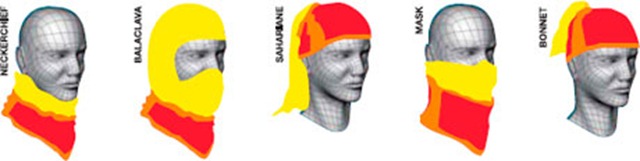
Buff® can be worn in loads of different ways: as a scarf, cap, headscarf, facemask, balaclava, headband, wristband… and that is in my opinion the success factor of this very well know product worldwide. Also the product is available in hundreds of colors and designs like the UAE flag or the traditional Ghutra that many Arabs wear in their heads.

On top of the original Buff®, the company has developed very innovative designs to better accommodate to specific people and usage. They have the WOMEN SLIM FIT BUFF®, one made of REFLECTIVE material, INFINITY LYOCELL long and soft made from eucalyptus wood, WOOL BUFF® made from 100% natural Merino, POLAR versions for very cold weather, HEADBAND, HOODIE BUFF® a stylish and superbly comfortable hooded garment, VISOR BUFF® which mimics a cap, STORM and CYCLONE BUFF® incorporating the amazing Gore Windstopper®, and HIGH UV PROTECTION BUFF® made from CoolMax® Extreme fabric to block 95% UV rays and wick sweat quickly away from skin.

My experience with Buff® has always been fantastic, and after years the last two models are the ones I pick for my outdoors activities these days.

CYCLONE BUFF® is an essential piece of gear whether I’m riding my motorbike in the cold winter in Spain or climbing high mountains somewhere like Nepal. It has two sections, the top with two layer microfiber and the bottom with Gore Windstopper®. The top section is elastic and soft for better fit and comfort, and the tow layer microfiber system has amazing thermal characteristics and works incredibly well keeping the humidity away from the skin. The bottom section has a very wise design: It’s actually made of two different materials, Gore Windstopper® in the front, which today is a standard on wind protection, and a very warm and comfy Polartec-like fabric in the back. The front section is slightly longer going all the way down to the chest, while the back is more elastic. This fantastic design allows the Buff® to seal all around your neck without restricting movement and giving the maximum protection to the front, which is ideal when riding my bike at high speeds while the thermometer drops.

clip_image002

Both sections incorporate POLYGIENE® and Active Odor control technologies, allowing all fabric to stay fresh, and believe me, after a month hiking and climbing in Nepal without showering at all, you’ll really appreciate this… Try to go with one of the Chinese versions of Buff® and even the Yaks will stay away from you on the trail!

clip_image004

We all passionate mountaineers know how important is to keep certain areas of our body sealed to prevent the heart from escaping. There are three key areas to protect, and most newbies forget about them and focus mainly on chest and hands. Most of the heat then tends to scape around the neck, wrist and sculp. These areas are highly irrigated by small capillaries and although it is a myth “40 to 45 percent of body heat” is lost from the head, it’s equally important to protect these areas along with chest and hands.

We also understand how the conditions change from one minute to the other up in the hill, and you need flexibility in your gear to quickly accommodate and prevent overheating and consequent dehydration. That´s why using a balaclava or regular winter hat doesn´t look ideal to me. You have to put it on and off all the time, store in a pocket where it might blow away or you lose it while the conditions are taught… With original Buff® you go from one fitting to other in just one second in order to protect different areas and accommodate to climate conditions. If fits perfectly well under a helmet, and doesn´t feel itchy even after weeks of sweating it out.

clip_image005

HIGH UV PROTECTION BUFF® is my second choice for outdoor activities in the desert or icy mountains. Having to apply high UV protection ointments in your face over and over again is just a hassle you tent to avoid, and then is when problems arise… I´ve just had small surgery done in my left ear to remove a very suspicious lump that was taken under histology to discard skin cancer. Applying full protection sunscreens when you wear globes is not easy (although I have some tricks I´ll explain a separate post) and you are never 100% sure you left some portions of skin exposed, such as ears or nostrils, which commonly are the body parts all of us burn over and over again. The UV Buff® is made from CoolMax® Extreme fabric, which has the ability to block 95% UV rays. This popular fabric is extremely breathable, allowing you to cover your face and mouth even when you are performing cardio intensive activities and you need to respire heavily.

clip_image007

In high altitude and extremely cold conditions this is also a lifesaver when spending a long night wrapped around my subzero sleeping bag. Many mountaineers suffer from what is known as The Khumbu cough or high altitude hack. It is caused by the low humidity and extreme temperatures experienced at altitude. Spending time at extreme altitude (over 5500m) leads to an increased breathing rate, which exposes the delicate lung lining to excess cold air, resulting in dried out membranes and partially damaged bronchi. I still remember my winter climb of Korma Kuh in Iran, where we set up a bivouac with temperatures around -20C and I was comfortably sleeping in my North Face Superlight sleeping bag, with thermal underwear and other stuff. I sealed zippers, velcros, and neck collar in the sleeping bag just to leave my mouth and nose exposed to the air while sleeping. In the morning I had extreme irritation in my throat, and my uvula was the size of an egg! I had ibuprofen, summited my mountain, and went back home with a good lesson learned. Running nose and dry persistent cough can be prevented by keeping the bronchial mucosa moist. Here is where any of my Buff® become an invaluable asset. Breathing through them, especially at night, heats and moisturizes the air. I personally find easier to breathe through my HIGH UV PROTECTION BUFF® than the CYCLONE BUFF®

There are no many things I would improve in these two models of original Buff®, and as I mentioned before the product catalogue is wide enough to cover all scenarios and requirements from outdoors enthusiast like me. There is only one thing I’d love to be incorporated in it, and it’s one of this vapor shield devices that are available in the market these days, like the Psolarmanufactured by EX.Mask

In summary, it’s been many years performing all sort of outdoor activities, and my original Buff® is a piece of gear I trust 100% and I will definitely take with my to the highest mountains on Earth.

clip_image008

clip_image009

Everest 2013 Expedition from Tibet Side

When you hear that someone has reached the top of Mount Everest, you may assume that he or she climbed the Southern Route used by Edmund Hillary and Tenzing Norgay in 1953. After all, this route – which begins with the Khumbu Icefall in Nepal and then proceeds through the Western Cwm, up the Lhotse Face, and to the summit via the South Col and the Hillary Step – is used by more climbers than any other path. There are, however, 14 other routes, and most of them are more difficult than the most popular way.

This is the case of the North Ridge Route, which begins in Tibet. This route has become almost as popular as the South Col route, but is somewhat more challenging. As Eric Simonson of International Mountain Guides explains, not only is the North Ridge technically difficult because of its terrain, but it also requires some particularly careful, even counterintuitive, planning. First of all on the North Ridge climbers spend a lot of time on steeply sloping shale and ice, and “it’s tough to get your crampons into that stuff!” To make matters more difficult, the geography of the North Ridge requires the final camp to be at a much higher elevation than the final camp on the South Col. The result, says Simonson, is that


Another challenge posed by this route is the long traverse along the North Ridge on summit day. The guide explains that “this means you are covering a lot of lateral distance, which really comes into play on the descent“. Here’s where careful planning becomes so important. Because so much of a climber’s time on the North Ridge is spent negotiating sloping rock and ice at the highest altitudes, he must make sure to have plenty of oxygen and energy for use on the difficult descent at least as much as needed to ascend to the summit. Basically, says Simonson, “you have to have enough gas left in your tank (both literally and figuratively) to make the descent. You can’t afford to burn more than 50 percent of your reserves going up, because you’ll definitely need the other half to get down”. The most common problem he’s seen with climbers on the north side is that they underestimate how long it will take them to make the technically difficult, traversing descent to camp from the summit, and they run out of oxygen before they reach the camp. Overall, he explains, “the prolonged time spent at higher altitudes and the time it takes to do that traverse in both directions catch a lot of people off guard on the North Ridge”. Sometimes, it seems, knowing that “it’s all downhill from here” isn’t much of a comfort”.

http://ngm.nationalgeographic.com/2003/05/everest/everest-learn

Expedition description and Calendar

The Drive to Base Camp
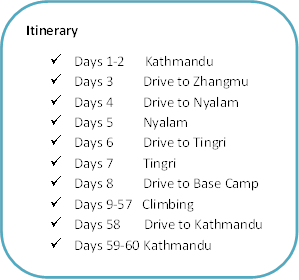
A total number of 8 climbers in this small and exclusive Expedition Team will meet in the capital city of Nepal, Kathmandu where we will stay in the beautiful boutique Courtyard Hotel located in a quiet area of the tourist district of Thamel. After a few days in Kathmandu processing our Tibet group visas and obtaining our climbing permits we drive to the Nepal Tibet border at Kodari where we enter Tibet. We pass through the immigration formalities once in Kodari and then a second time in Zhangmu before officially entering Tibet

Monday 8th April 2013

to Thursday 6th June 2013

Once the immigration formalities have been completed, which sometimes can be lengthy, we start the drive towards base camp. We spend two nights each in the towns of Nyalam and Tingri for cautious acclimatization before arriving on the final day at Old Chinese Base Camp.

Climb Strategy

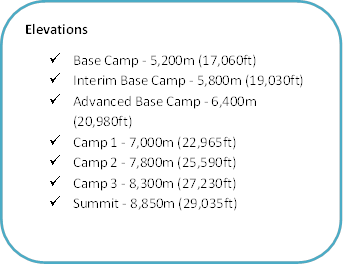
We follow a cautious acclimatization schedule at base camp spending several nights before taking our first trip up the East Rongbuk Valley and walk on the East Rongbuk Glacier towards advanced base camp. We plan only to trek up to advanced base camp a maximum of two times and this includes the summit push. The walk from base camp to interim camp takes around 4-8 hours.

Our schedule usually sees us walk to interim base camp where we spend two evenings and then continue to advanced base camp. We rest at advanced base camp for several days before tagging camp one and returning to advanced base camp. The walk from interim base camp to advanced base camp takes around 4-8 hours where the camp sits at the foot of the North Col.

After more acclimatization days at advanced base camp and the progress of the fixed ropes being placed towards camp two, we climb to camp one where we spend the evening and then in the following days we climb towards camp two reaching an elevation of roughly 7,500-meters before returning to the North Col. We spend a second evening at the North Col before returning to advanced base camp.

The summit push will see us make our second trek up the east Rongbuk Glacier to advanced base camp where we will spend two or three evenings waiting for a favorable weather report. We then climb to camp one, two and three respectively before leaving for the summit from the high camp late in the evening
All climbers and Sherpas will be using supplementary oxygen from camp two and return to camp two.

The Route

The climbing begins by following the trail out of advanced base camp leading to the gear depot. Some teams leave their heavy mountaineering boots; crampons and axes at this area. We then walk over the flat section of the glacier to approach the foot of the north col. Fixed ropes will be in place and we climb slopes up to 45-degrees before reaching the halfway point up the col. The first aluminum ladder crossing a crevasse is short and the route continues culminating with a short steep slope just before the second longer ladder crossing a deep crevasse before arriving in camp. The climb from advanced base camp to camp one takes between 4-8 hours.

Camp one sits on the North Col between the Everest North Ridge and Changtse. The route continues along the North Ridge using the fixed rope and the terrain switches from the snow ridge to easy mixed terrain at 7,500m (24,600ft) where we continue to our camp two. This is one of the longest days on the mountain and takes between 5-10 hours.

Camp two is located on the North Ridge and the tents are erected on platforms constructed from loose rocks. This campsite is very exposed and receives strong winds. Most climbers, if not already, decide to use their supplementary oxygen from here onwards. The route continues up the ridge before traversing diagonally right across the North Face and then takes a more direct route into camp three. The climb from camp two to camp three takes between 3-6 hours.

Summit day will start early and the route heads on moderate terrain with one technical rock section to pass before arriving on the Northwest Ridge. The ridge is narrow and is followed passing the first step, the crux of the climb, the second step with its two ladders in place and the third step before climbing the summit pyramid and then traversing a rocky section to the snow capped summit. The climb from camp three to the summit takes between 7-11 hours with 3-5 hours for the descent to camp three.

Speed winter climb of one for the hardest routes of Mt Damavand (5610m) in Iran. From Dubai Marina to the summit in 32h

This challenge was in my to-do list since I spotted this beautiful volcano in my first visit to Iran on December 2011, when I attempted a winter climb of Pasand Kooh in Alborz range.

On October 23rd 2012 late in the evening, I left my house in Dubai to attempt a crazy winter climb of the highest mountain in the Middle East and biggest volcano in the North Hemisphere, Mt Damavand (5610m). 32 hours after that I was standing totally exhausted on the top of the frozen crater surrounded by volcanic fumaroles. I did my first volcano on 2010 (Mt Rainier, the biggest in North America), and since then I’m officially addicted to the sulfuric acid. This new challenge was a bit crazier, since I’m was doing a winter climb (2013 season already started) on the second hardest route in a country that is going a bit mad these days (thanks to certain westerner governments). It normally takes 4-6 days to safely complete this climb from Teheran, but I aimed to do it in only 3.

The first challenge on this adventure was to get a Visa on my arrival to Teheran. Right after that, with almost no sleep, I was driving out of the airport with Salim, a Teherani who knows the Mountain very well. We drove for about 4 hours to Nandal village (2400m) where we had some cheese, bread and tea, and sorted out our gear before starting our approach in a shabby 4×4 vehicle to Gusfandsara, and 5 hours climb to or first camp at Takhte Fereydoon hut (4300m). From Dubai Marina to there in just one day. On the following day, Thursday 24th, we did our summit push and descent back to the hut to celebrate and sleep before heading back to Nandal and Teheran in the afternoon.

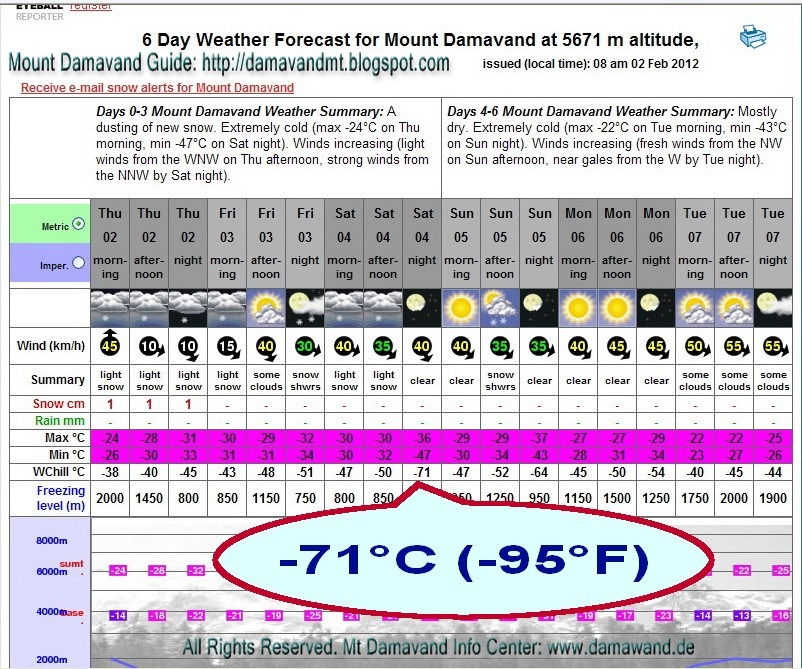
What it makes this challenge somehow special is the difficulty of the ascent on a winter climb. The winter season in Alborz Range may start from October to November and last to May and April. In this period of the year climbing Mt Damavand is a tough and dangerous business. With strong winds more than 100km/h and freezing temperature below -70°C (-94 Fahrenheit), winter ascent is graded as very difficult. Damavand Weather can change from very cold to disastrous in winter, and moving fast without missing the route is a key point for success.

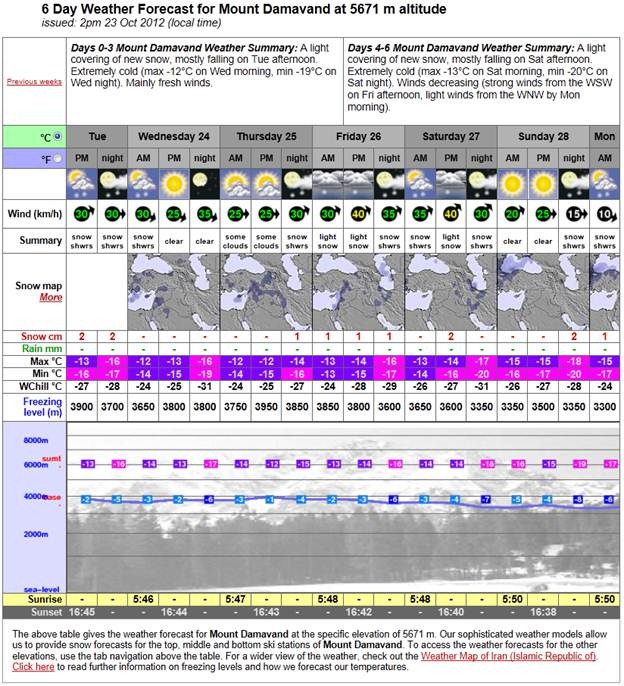
The day before leaving Dubai, the weather forecast looked quite frightening with temperatures ranging from -12C to -16C (thermal sensation -27C) at the top on the summit day, -6C to -10C (thermal sensation -20C) at the hut. Light snow was expected to fall from Friday, so I had to cope well with the altitude not to delay the summit push.

North-East route is a popular summer route. It goes through the North-East ridge that is called Takht-e-Fereydun. That name comes from mytghological story of Zahhak and Fereydun. There is a hut in this route at the altitude of 4300m. We planned to spend one night in the hut although we had the option to spend two nights there for acclimatization.  From then we progress up on the North-East glacier with a fantastic view of the valley and Yakhar glacier right beside this route.

IMG_0473


This what we planned to do, considering the limited timeframe and the restrictions set by weather and acclimatization:

  • Day 1 (Wednesday 24th): Arriving to IKA Airport (Tehran Imam Khomeini International Airport) at 2:30am. Drive from Tehran to Nandal village (2400m) in northern downhills of Mt Damavand. Overnight in a local house. 4×4 drive from Nandal to Gusfandsara. Climb to Takhte Fereydoon hut (4300m)
  • Day 2 (Thursday 25th): Acclimatization and summit push from North-East route. Descent and overnight at Takhte Fereydoon hut
  • Day 5 (Friday 26th): Trek down to Nandal village. Drive back to Tehran for rest and sightseeing.
  • Day 6 (Saturday 27th): Reserve day for bad weather condition or more acclimatization. Overnight flight back to Dubai on Sunday 00:15


Everything run as planned, with the exception of the few hours sleep at Nandal, that we had to skip due to the latest weather forecast that was showing very intimidating winds and snow from Thursday evening, so we had to move fast with no margin for a summit bid on Friday. We left the airport around 3:30am and drove all the way to Nandal village (2400m) where we arrived around 9:00.

IMG_0482


We had a light breakfast and moved fast on the 4×4 to our start point at Gusfandsara. That made the whole climb extraordinarily hard and also dangerous, since we were so exhausted when we arrived to Takhte Fereydoon hut (4300m) that we could barely prepare food and we hit the sleeping bag right away.

IMG_0508


With no enough fuel the summit push on the following day ended up being the most exhausting thing I’ve ever done in my life.

IMG_0587


We descended with strong winds and reached the hut at night when the storm was already forming. That night seemed like the end of the world, with that wind hitting the hut so violently that I thought we’d never make it back to Nandal. We were incredibly exhausted after reaching our summit and we lacked of energy even to melt our drinking water. The altitude and exhausting causes your body to refuse any food intake. I was very worried about the conditions to make it back home safely.

IMG_0616


The following morning we woke up under a snow storm, but luckily the worst part happened the previous night while we were already sleeping in the comfort of the hut. I cannot even think on the consequences of not being able to find the hut last night. With no tent, and stoves that would have been fatal.

IMG_0623


That day I learnt how close we are from disaster if we are too ambitious and we push our limits a bit too far…

IMG_0658

Climbing a Volcano – Mt Damavand (5610m), Iran – Ready to go!!!

I’m now counting down the hours left before I leave to Dubai International Airport . Tonight around 2:30am I will be landing in Tehran Imam Khomeini International Airport from where my new extreme challenge will start. This challenge was in my to-do list since I spotted this beautiful volcano in my last visit to Iran on December 2011, when I attempted a winter climb of Pasand Kooh in Alborz range.

Today I’m leaving to Iran to attempt a crazy winter climb of the highest mountain in the Middle East and biggest volcano in the North Hemisphere, Mt Damavand (5610m). I did my first volcano last year (Mt Rainier, the biggest in North America), and since then I’m officially addicted to the sulfuric acid. This time I’m going a bit crazier since I’m doing a winter climb (2013 season already started) on the second hardest route in a country that is going a bit crazy these days (thanks to certain westerner governments). It normally takes 4-6 days but I’ll try to do it in only 3.

The first challenge on this adventure will be to get a Visa on my arrival to Teheran. Right after that, with almost no sleep, I’ll be driving with Salim, a Teherani who knows the Mountain very well, to Nandal village (2400m) where to have some rest before we start our approach on 4×4 vehicle to Gusfandsara, and 5 hours climb to or first camp at Takhte Fereydoon hut (4300m), all of these in just one day. On Thursday I’ll do my summit push and back to the hut to celebrate and sleep before I head back to Nandal and Teheran.

What it makes this climb somehow special is the difficulty of the ascent on a winter climb. The winter season may start from October to November and last to May and April. In this period climbing to Damavand summit is very tough and dangerous. Because of high wind speed and very low temperature, stormy weather conditions, too much snowfall, icy trails and other risks, winter ascend is graded as very difficult. Damavand Weather could change to disastrous in winter, with strong winds more than 100km/h and freezing temperature below -70°C (-94 Fahrenheit).

Right now the weather forecast looks quite frightening with temperatures ranging from -12C to -16C (thermal sensation -27C) at the top on the summit day, -6C to -10C (thermal sensation -20C) at the hut. There is light snow expected to fall from Friday so I have to cope well with the altitude not to delay the summit push.


clip_image002


North-East route is a popular summer route. It goes through the North-East ridge that is called Takht-e-Fereydun. That name comes from mytghological story of Zahhak and Fereydun. There is a hut in this route at the altitude of 4300m. We will spend one night in the hut although we can spend two nights there for acclimatization. Then we’ll go up on the North-East glacier with a fantastic view of steep valley of Yakhar glacier right beside this route.

This what we planned to do, considering the limited timeframe and the restrictions set but weather and acclimatization:

  • Day 1 (Wednesday 24th): Arriving to IKA Airport (Tehran Imam Khomeini International Airport) at 2:30am. Drive from Tehran to Nandal village (2400m) in northern downhills of Mt Damavand. Overnight in a local house. 4×4 drive from Nandal to Gusfandsara. Climb to Takhte Fereydoon hut (4300m)
  • Day 2 (Thursday 25th): Acclimatization and summit push from North-East route. Descent and overnight at Takhte Fereydoon hut
  • Day 5 (Friday 26th): Trek down to Nandal village. Drive back to Tehran for rest and sightseeing.
  • Day 6 (Saturday 27th): Reserve day for bad weather condition or more acclimatization. Overnight flight back to Dubai on Sunday 00:15


This is a nice North-East route description taken from Summitpost

PART 1 (From road to Takhte-Fereydoon shelter):

After Gazanak village, go from right side of TALKHAAB river in gardens. After one hour you see a spring in gardens. You must take water. This point in the end of gardens .Then you must walk 2 hours and see a little garden and its spring. (This point is the best point for camping in winter) Then you must go forward (from right side of river) and see the last spring. This spring is named Pehen-Kooh spring. This is the last water in north-east route. In this point you see all of the remainder route and main peak of Damavand. From this point you must climb hardly. You can better eat lunch and rest little here and take water. Then you must turn to right on climb from right domain. Now you go up far from the river and bottom of valley. You must climb about 2 hours, so you see a very little spring in grade, you can rest here a few minutes and then go up to a rocky peak. Its name is Menaar peak (Menaareh, 3950m). Before the rocks, you must climb zigzag from a yellow and hard sandy way. Next you must go to round the rocks from left and go up from moraine (stones). When you reach top you will be at top line (4000m). Now turn left on and climb to shelter. After 1.5 hours you reach shelter. Its name is TAKHT-E-FEREYDOON shelter. This shelter in 4500m is solitary shelter in this route. From Haraz road to this shelter takes about 11 hours climbing. Now you are tried. The weather is cold and windy all times. You can rest to next day. If you have not water, you can bring ice from a glacier back of shelter. This shelter was made by students of Tehran University 1978 in commemoration of their friends.

PART 2 (From Takhte-Fereydoon shelter to Damavand peak):

Next day you can stay here to harmony or climb to peak. After shelter the way is clear. First you climb a hill, then climb from a rocky way to top. After this rocks you see another rocks right hand to top. After rocks you must go from a way just top of deep canyon. This canyon is Darre-ye-Yakhaar. It is a glacier canyon. Your way is safe and you like to climb and see beautiful mountain. Here is above 5100m. So you climb from signs and way turn to right. You reach a glacier in grade. You must go across the glacier carefully. This glacier is named Aroosak-haa glacier. Climb and be careful. You smell sulphur and you are at 5500m. Then you see a big glacier named Do-bisel glacier. You must go across it very carefully. Now you are in North route of Damavand peak and near to peak. You climb slowly but after some minutes you will be at top of Damavand peak. From Takhte-Fereydoon shelter to top of peak is about 3.5 ~ 4 hours. You must photograph and return fast because sulphur is dangerous. Also weather is not stable. In return be careful, because two glaciers is in front of you. Also if you mistake in return way, you must go down from North route to other way. Be careful and follow your footprints on glaciers and see the signs .You must reach to Takhte-Fereydoon shelter and rest this night.

PART 3 (Return from Damavand mount):

You must wake up and eat breakfast and return to down, from shelter to village. If you want to return from same route, you can put your backpack in shelter and take a little backpack and climb to peak, but if you want to return from another route to down, you must carry your gears to top of peak and return from any route from top of Damavand peak to down.

If you want to climb in WINTER , BE CAREFUL ! It’s very difficulty and dangerous


This is all for now, I will keep my FB and Blog site updated with my position and progress by using GSM networks and a satellite device. Please subscribe to my blog for updates on my adventures and send me positive energy and oxygen from the distance. I’ll be thinking on all of you from there and send you love and good wishes from the top… inshallah!

Mt Damavand – Winter Climbing

The winter season may start from October to November and last to May and April. In this period climbing to Damavand summit is very tough and dangerous. Because of high wind speed and very low temperature, stormy weather conditions, too much snowfall, icy trails and other risks, winter ascend is graded as very difficult. The ski and snowboard season is from December to mid-May, the best ski months are March & April.

Weather condition in mount Damavand is harsh and severe in winter time. Since the end of October we expect snow fall in high altitudes, which means the condition is considered like winter. The temperature stays sub-zero till next June far up in Damavand.

The south route of Damavand is the easiest route to access during winter. This route is not technically difficult, but still challenging in extreme conditions of very high altitude. Indeed, those people who have previous experience of winter mountaineering and are physically fit have more chance to reach to the summit, while the stable weather condition is an important factor, too.

Damavand Weather could change to disastrous in winter, with strong winds more than 100km/h and freezing temperature below -70°C (-94 Fahrenheit). You must be well-experienced for such a difficult climb or ski mountaineering expeditions in harsh climate. Furthermore remember that rescue and medical facilities are not available in case of injury and emergency, so extra care should be taken for winter climbing and ski touring and it is done by your own risk.

The weather has caused more deaths than any other factor besides bad judgment by climbers. Some climbers appear to rely on weather forecast reports or none at all, but one should note they are forecasts too, and one day their forecast will probably be wrong.

Reinhold Messner

In 1970 when Reinhold Messner attempted a winter climb to Mt Damavand Iran, due to adverse weather conditions failed, because he realized that despite a lack of technical difficulties, is not an easy mountain climbing, but a large and highly conditional alpine challenge.


Weather

http://www.snow-forecast.com/resorts/Damavand/6day/top

http://www.snow-forecast.com/resorts/Damavand/6day/mid

http://www.snow-forecast.com/resorts/Damavand/6day/bot

http://freemeteo.com/default.asp?fid=820323_20120909_190822&isSite=1&hitDNS=www%2Edamawand%2Ede&pid=15&un=1&la=1&gid=138041


Temp-Minus71degC-4Feb2012-Damavand

Wind-Speed-110Km-15March2012-Damavand

Mt Damavand – Climbing Routes

There are at least 16 known routes to the summit which have different difficulties. Some of them are very dangerous and require rock climbing. Three routes are popular with climbers: North, South and North-East faces which are adjacent to villages and all have shelters/huts in midcourse. The most popular route is the Southern Route which has step stamps and also a camp midway called Bargah Sevom Camp/Shelter at 4220m (about 13,845 ft). Damavand is often subject to intense west winds and experiences cold winters, so climbing in this season has always been challenging for domestic as well as foreign climbers. The best major settlement for mountain climbers is the new Iranian Mountain Federation Camp in Polour village, located on the south of the mountain.

The longest route is the Northeastern and it takes two whole days to reach the summit starting from downhill village of Nāndal and a night stay at Takht-e Fereydoun (elevation 4300 m – about 13,000 ft), a two-story shelter. The western route is famous for its sunset view. Sīmorgh shelter in this route at 4100 m (about 13,500 ft) is a newly constructed shelter with two stories. There is a frozen waterfall/Icefall (Persian name Ābshār Yakhī) about 12m tall and the elevation of 5100m is the highest fall in Iran and Middle East. The North face has an extra shelter at 5000m.

South Route: It is easily accessible from Tehran or North of Iran, the short distance from Tehran to the Haraz main road make southern approach the best trail. This is by far the easiest and the best side, and the ascent to the summit by this way is also shorter. Route type is basic mountaineering, with difficulty and climbing grade moderate, walk-up and easy descend.

North East Route: Route type is mountaineering, with difficulty long and hard ascend with cold and wind and long descend. It has a shelter called Takht e Fereydoun at about 4500m. The refuge is called Panagah Simorgh in Persian.

West Route: West route type is basic mountaineering, with difficulty and climbing grade moderate walk-up, basic snow and cold and difficult descend. There is a refuge at 4200 m called Simorgh Camp. The shelter is called Panagah Simorgh in Farsi. Simorgh means Roc, a gigantic legendary bird said to carry off elephants and other large beasts for food. It is mentioned in the famous collection of Iranian tales.

North Route: The north face is the most difficult side of Mt Damavand with difficulty and climbing grade scramble mountaineering, steep, hard ascend, depending on season, cold and windy, snow & ice, difficult descend. It has two shelters called 4000 and 5000.

  Most climbers who have managed to climb to the summit from West, North East, or North Face prefer to descent from south face because of its easy descend footpaths


Climbing Grade in Different Systems

Please note that these grades are Mount Damavand Guide opinion only, there are usually differences between grading in different climbing routes. Regardless of the system used, all grades are an approximation.

  • Difficulty: F, YDS class 2 (and sulphur gas above 5400 m)
  • UIAA: II
  • USA: 5.3
  • Australia: 11
  • France: 2
  • YDS Grade: Grade V, two day climb Classes 2 and 3
  • Adjectival grade: Moderate (M, or “Mod”)
  • French Alpine: PD: peu difficile (not very difficult)
  • New Zealand: Grade 1, Easy scramble. Use of rope generally only for glacier travel.
  • Alaska Grade: Grade 2 Either a moderate fifth-class one-day climb, or a straightforward multiday nontechnical climb


Summit

Mt Damavand shape is conic like many other volcanos, it looks like Fujiyama in Japan, but much greater, with the altitude 5671 meters and a crater diameter approx 200 to 400m across and 30m deep, the crater has a permanent glacier which melts in hot summers and forms a small pool with little water. There is no shelter or refuge at the top, in case you want to challenge 7000 m or higher altitude you can make you own tent for acclimatization somewhere safe and away from sulfuric gases in or around the crater.

The summit is made of lots of yellow sulfurous rocks and pumice stones, usually covered by ice and snow. This stratovolcano has some sign of volcanic activity at the top, a big vent was formed in 2007 just below the crater with high fumarolic activity, through which hot sulphurous gases emerge, releasing a significant amount of smoke and hot sulphuric gases.


Mt Damavand Glaciers

There are some major glaciers on Mt Damavand, these huge mass accumulation of snow and ice are formed during ages and are the main source of water for Talkh Roud River and the Lar Dam Lake, one of the main reservoir of fresh water for capital city of Tehran. These glaciers are mostly located on east and north face. It appears that some of these glaciers cannot qualify as a true permanent glacier because they may disappears during a very hot and dry summer.

The most important glaciers are:

East and North East Face Glaciers:

  • In the enormous Yakhar Valley in the east side of this volcano there is large glacier called Yakhar which is the most well-known and the biggest glacier of the mountain, it starts from about 3500 meters high to just below the summit, it has was climbed many times in summer but not in the winter. This glacier is the main source for Talkhrood River, ending in Caspian Sea.
  • Chalchal Glacier and Arosakha, are other significant glaciers located on these sides.

North Face Glaciers

  • Two large glaciers are located on the north face, called Dobi Sel and Sioleh, the north route ridge passes between these two glaciers, which makes this route colder compared to the other routes.

South Face Glacier

  • There is a small glacier on the south face in Kafar Valley (Kafar Dareh), called South Glacier or Kafar Dareh Glacier. It’s situated between south route ridge and Mollakhoron Ridge, it passes by Damavand Icefall.

West Face Glaciers

  • There are some small and none important glaciers on the west side which do not have particular names.

Summit Glacier

  • There is a small glacier on the volcano crater, called summit glacier, mostly frozen, but in a hot summer you may see a little water in the crater.


Warning

Just near the summit and under the crater, at the junction where south and east climbing routes join together, a big new vent was formed in 2007, which is still exhaling a great amount of smoke and hot sulfuric gases and steam with pestiferous smell, this makes some problem for climbing. Without adequate equipment such as oxygen mask, it is quite dangerous to go close to this vent, because if the wind changes its direction, you could get caught in the sulfuric poison gas.


f_1242853709_DAMAVAND%20MAP2

The Middle East Roof

Damavand is the highest mountain peak in Iran located almost in the center of Alborz mountain range. Damavand is higher than all west Asian & European mountain peaks. Damavand peak is situated in Larijan district, Mazandaran Province, midway the Haraz Road, southwest of Amol City and 69 Kilometers northeast of Tehran. Damavand is an inactive volcanic mountain, always covered with snow. It looks like Fujiyama in Japan but much greater. Its snowy white top with its regular clouds is the most beautiful sight of Iran. There are no records of the last eruption, but there’s hot steam & sulfur gases coming out at the top. Damavand contains about 70 volcanic mouths and one of them is filled with a thick sulfur crest producing a beautiful conical peak with a diameter of some 400 meters. There are some hot springs on its lower slopes like Larijan village. At the summit there is a crater about 150-200 meters across, with a lot of yellow sulfurous rocks and pumice stones. Snow covers the crater and upper slopes in winter, spring and autumn. Because of its great height, the view from top is very extensive, a big panorama of mountains and valley covering many hundreds of square Kilometers. All around are other peaks of the Alborz Mountain Range, in the north to the Caspian Sea, and in the south descending to the deserts of central Iran. When the sky is clear and sunny, Damavand can be seen not only from Tehran but other cities such as Amol, Sari, Qom, Kashan, up 250km far.

The altitude of Damavand Volcano is 5671 meters (18605 feet), it is the highest summit in the Middle East and the second highest volcano in all Asia and the Northen Hemisphere. The highest volcano in Asia is Kunlun Volcano 7167 m (23514 feet) in Tibet.

General Facts

  • Distance from Tehran by road: 80km
  • Attitude: 5671 meters, 18605 feet
  • Prominence: 4667 meters, 15312 feet
  • Latitude: 35° 57′ 19″ N
  • Longitude: 52° 06′ 36″ E

Other Names and Spellings

  • English: Mount or Volcano Damavand, Damawand, Demavand, Demavend, Donbavand, Damāvand.
  • Farsi/Persian: Koh e Damavand alternate Dood koh, Koh Damawand, Qolleh Damāvand. Donbalvand, Dive Sepid, Koh e Ghaf.

First ascents

  • 905 by Abu Dolaf Kazraji
  • The first successful European ascent to the summit happened in 1837 by Tiller Thomson, and the first national ascent was recorded in 1857 by colonel Mohammad Sadeghkhan Gajar ‘s team.


Volcanic Activity

At present volcanic activity is manifested only in the presence of warm and thermal springs with therapeutic qualities which have formed travertine deposits and remain very popular. These mineral hot springs are mainly located on the volcano’s flanks and at the base, giving evidence of volcanic heat comparatively near the surface of the earth. While no historic eruptions have been recorded, hot springs at the base and on the flanks, and fumaroles and solfatara near the summit, indicate a hot or cooling magma body still present beneath the volcano, so that Damavand is a potentially active volcano. The most important of these hot springs are located in Larijan village in the district of Larijan in Lar Valley. The water from this spring is useful in the treatment of chronic wounds and skin diseases. Near these springs there are public baths with small pools for public use.

Since spring 2007, there have been some extraordinary activities such as significant emission of gas, steam, sulfurous materials and increase in hot spring temperature. There has been some news and rumors on the media about Mt Damavand new volcanic activity in 2012, these unverified information is widely spread by radio, tv and internet.  There was a reasonable amount of rain and snow fall in winter 2011 on Mt Damavand area. This usually increases the amount of gas emission from the vents in the in following year, also it may increase the hot water temperatures at the flank of southern thermal springs in 2012. Similar events were experienced in winter 2006 (rain/snow fall) and consequently some more volcanic activities in 2007.


Mythology and folklore

Damavand has, as any cursory reading of Persian literature will indicate, a special place in the Persian mythology and folklore. The popular traditions of the villages around the mountain are filled with legends and superstitions of which traces can be found in place names, as in the upper valley of the Lar, where a small ravine sprinkled with marshes, warm springs, and geysers is named Div Asiab (the devil’s mill).

Damavand is the symbol of Iranian resistance against foreign rule in Persian poetry and literature. In Zoroastrian texts and mythology, the three-headed dragon Azi Dahaka was chained within Mount Damavand, there to remain until the end of the world. In a later version of the same legend, the tyrant Zahhak was also chained in a cave somewhere in mount Damavand after being defeated by Kaveh and Fereydoon. The mountain was also the scene of an episode in the story of Rostam and Esfandiar. Damavand is also significant to the Iranian legend of the heroic Iranian archer Arash Kamangir and a suspected root for Tiregan Festival.


This slideshow requires JavaScript.