Not many climbers around the world have climbed Everest, and I believe very few have tried climbing his/her first 8000 on the Everest North Ridge Route. There are about 5 UAE residents who have already climbed Everest, and we have at least three more trying this year. However my understanding is that none of these UAE based climbers have climbed Chomolungma from Tibet.
My Everest Dream this year is to climb my first eight-thousander on the most difficult route that is climbed commercially these days.
There are different reasons why most climbers would opt for the most popular South Col Route to the Top of The World, especially those with none or little experience climbing above 8000m. In this blog post I’m putting together some facts and figures and describing the main differences between the two main climbing routes in Mt Everest.
Facts & Figures
According to my estimations based on the information available from the most popular sources – e.g. Alanarnette – last year we had 395 successful summits from the south and 153 north. This brings the total number of people who have summited Mt. Everest to around 6200, from which around 2500 have multiple summits (mostly Sherpas). About one climber out of four summited from the North, which is the crazy route I chose for my first attempt.
The South rote seems to be safer and more successful, but it’s also more expensive in terms of permit fees and other costs. South route normally spend less time at the very high altitudes (the highest camp on South is is 7950m versus 8300m on the north). However in the North route climbers spend more time between 6400m and 7000m (Advanced Base Camp) which helps on acclimatization. This route is traditionally considered slightly more dangerous given the exposure to the cold and severe winds combined with the technical difficulties on the last sections of the route, “The Steps” and summit ridge. Also the conflict between China and Tibet makes the whole expedition more challenging since the risk of China closing borders to china again as high these days. In 2008, the northeast route was closed by the Chinese government for the entire climbing season, and the only people able to reach the summit from the north that year were athletes responsible for carrying the Olympic torch for the 2008 Summer Olympics. The route was closed to foreigners once again in 2009 in the run-up to the 50th anniversary of the Dalai Lama’s exile
The north side has had more altitude and exposure-related deaths above 8000m than on the south side. Last season, Alan Arnette posted a very interesting description of the Everest Routes in his blog, looking at some statistics behind Everest in the past decade up to 2011.
| Reason |
Northeast Ridge |
Southeast Route |
Other Routes |
| Fall |
8 |
5 |
1 |
| Altitude |
9 |
6 |
1 |
| Exhaustion |
9 |
1 |
1 |
| Unknown |
7 |
2 |
1 |
| Avalanche |
1 |
3 |
2 |
| Crevasse |
0 |
4 |
0 |
| Exposure |
4 |
0 |
0 |
| Heart/Stroke |
1 |
4 |
0 |
| |
39 |
25 |
6 |
The north side fatality rate is more than 2:1 over the south with falls, altitude issues and exhaustion noted as the primary reasons. The difference is even more extreme when the deaths of 9 south side Sherpas are taken from the total, making the ratio of “member or client” climber deaths from north to south 8:1
The overall member ascent and death rates on the Everest commercial routes (1990-2012) are 36.96 and 1.57 on North Col vs 47.60 and 0.87 on South. The 13% missing is mostly due to turn backs, and that is becoming a serious issue on South side. On May 19, 2012 there were 166 ascents on the South Col route, which means 332 crossings of the Hillary Step (up and down). May 19th was one of the worst nights in Everest history, when six people total died. 4 of them died on the South route at different points close to the Summit, and 2 more on the North (on of them Spanish) under similar conditions. There were about 537 summits in 2011 with 4 deaths, unusually with 3 of those on the south side. So it looks like in the last couple of years the massification of the South route is becoming an issue.
8000ers.com has some very interesting statistics up to 31.12.2010 here
On one of the articles published by National Geographic last year, we can read an interesting note from Eric Simonson of International Mountain Guides
Not only is the North Ridge technically difficult because of its terrain, but it also requires some particularly careful, even counterintuitive, planning. First of all, Simonson points out, on the North Ridge climbers spend a lot of time on steeply sloping shale and ice, and “it’s tough to get your crampons into that stuff!” To make matters more difficult, the geography of the North Ridge requires the final camp to be at a much higher elevation than the final camp on the South Col. The result, says Simonson, is that “North Ridge climbers are forced to spend a lot more time at higher altitudes, and this in and of itself makes the route more demanding.”
Another challenge posed by this route is the long traverse along the North Ridge on summit day. The guide explains that this “means you are covering a lot of lateral distance, which really comes into play on the descent.” Here’s where careful planning becomes so important. Because so much of a climber’s time on the North Ridge is spent negotiating sloping rock and ice at the highest altitudes, he must make sure to have plenty of oxygen and energy for use on the difficult descent—at least as much as he needed to ascend to the summit. Basically, says Simonson, “you have to have enough gas left in your tank (both literally and figuratively) to make the descent. You can’t afford to burn more than 50 percent of your reserves going up, because you’ll definitely need the other half to get down.” The most common problem he’s seen with climbers on the north side is that they underestimate how long it will take them to make the technically difficult, traversing descent to camp from the summit, and they run out of oxygen before they reach the camp.
Overall, he explains, “the prolonged time spent at higher altitudes and the time it takes to do that traverse in both directions catch a lot of people off guard on the North Ridge.” Sometimes, it seems, knowing that “it’s all downhill from here” isn’t much of a comfort.
On his fantastic post last season, Alan takes a brief look at the pros and cons of the most popular routes:
South Col Route
|
Pluses
|
Concerns
|
|
Beautiful trek to base camp in the Khumbu
|
Khumbu Icefall instability
|
|
Easy access to villages for pre-summit recovery
|
Crowds, especially on summit night
|
|
Helicopter rescue from base camp if necessary
|
Cornice Traverse exposure, SE Ridge Slabs
|
|
Slightly warmer sometimes with less winds
|
Slightly longer summit night
|
Northeast Ridge Route
|
Pluses
|
Concerns
|
|
Less crowds
|
Colder temps and harsher winds
|
|
Can drive to base camp
|
Camps at higher elevations
|
|
Easier climbing to mid-level camps
|
A bit more difficult with smooth or loose rocks
|
|
Slightly shorter summit night
|
No opportunity for helicopter rescue at any point
|
This is Alan’s very interesting description of the routes at both sides of Everest
South Col Route
· Base camp: 17,500′/5334m: Home away from home. Located on a moving glacier, tents can shift and platforms melt. The area is harsh but beautiful surrounded by Pumori and the Khumbu Icefall with warm mornings and afternoon snow squalls. With so many expedition tents, pathways and generators, it feels like a small village.
· C1: 19,500′/5943m – 4-6 hours, 1.62 miles: Reaching C1, is the most dangerous part of a south climb since it crosses the Khumbu Icefall. The Icefall is 2,000′ of moving ice, sometimes as much as 3 feet a day. But it is the deep crevasses, towering ice seracs and avalanches off Everest’s West shoulder that creates the most danger.
· C2: 21,000′/6400m – 2-3 hours, 1.74 miles: The trek from C1 to C2 crosses the Western CWM and can be laden with crevasse danger. But it is the extremely hot temperatures that takes a toll on climbers. Again avalanche danger exist from Everest’s West Shoulder that has dusted C1 in recent years.
· C3: 23,500′/7162m – 3-6 hours, 1.64 miles: Climbing the Lhotse Face to C3 is often difficult since almost all climbers are feeling the effects of high altitude and are not yet using supplemental oxygen. The Lhotse Face is steep and the ice is hard. The route is fixed with rope. The angles can range from 20 to 45 degrees. It is a long climb to C3 but is required for acclimatization prior to a summit bid.
· Yellow Band – 3 hours: The route to the South Col begins at C3 and across the Yellow Band. It starts steep but settles into a sustained grade as the altitude increases. Climbers are usually in their down suits and are using supplemental oxygen for the first time. The Yellow Band’s limestone rock itself is not difficult climbing but can be challenging given the altitude. Bottlenecks can occur on the Yellow Band.
· Geneva Spur – 2 hours: This section can be a surprise for some climbers. The top of the Spur leading onto the South Col has some of the steepest climbing thus far. It is easier with a good layer of snow than on the loose rocks.
· South Col: 26,300′/8016m – 1 hour or less: Welcome to the moon. This is a flat area covered with loose rock and surrounded by Everest to the north and Lhotse on the south. Generally, teams cluster tents together and anchor with nets or heavy rocks against the hurricane force winds. This is the staging area for the summit bids and the high point for Sherpas to ferry oxygen and gear for the summit bid.
· Balcony: 27,500′/8400m- 4 – 5 hours: Officially now on Everest, climbers are using supplemental oxygen to climb the steep and sustained route up the Triangular Face. The route is fixed with rope and climbers create a long conga line of headlamps in the dark. The pace is maddeningly slow complete with periods of full stop while climbers ahead rest, consider the decision to turn back or continue to the balcony. It can be rock or snow depending on the year. Rock fall can be an deadly issue and some climbers now use helmets. They swap oxygen bottles at the Balcony while taking a short break for some food and water.
· South Summit : 28500′/8690m – 3 to 5 hours: The climb from the Balcony to the South Summit is steep and continuous. While mostly on a beaten down boot path, it can be challenging near the South Summit with exposed slabs of smooth rock in low snow years. The views of Lhotse and the sun rising to the east is indescribable at this point. Climbers lose radio contact with EBC in this section.
· Hillary Step – 1 hour or less: One of the most exposed section of a south side climb is crossing the cornice traverse between the south summit and the Hillary Step. But the route is fixed and wide enough that climbers rarely have issues. The Hillary Step is a short 40′ section of rock climbing, again fixed with rope, that creates a bottleneck on crowded summit nights. Usually there is an up and down climbing rope to keep people moving.
· Summit: 29,035′/8850m – 1 hour or less: The last section from the Hillary Step to the summit is a moderate snow slope. While tired, climber’s adrenaline keep them going.
· Return to South Col: 4 -7 hours: Care must be taken to avoid a misplaced step down climbing the Hillary Step, the Cornice Traverse or the slabs below the south summit. Also diligent monitoring of oxygen levels and supply is critical to make sure the oxygen lasts back to the South Col.
· Return to C2: 3 hours: Usually climbers are quite tired but happy to be returning to the higher natural oxygen levels regardless of their summit performance. It can be very hot since most climbers are still in their down suits.
· Return to base camp: 4 hours: Packs are heavy since everything they hauled up over the preceding month must be taken back down. It is now almost June so the temperatures are warmer making the snow mushy thus increasing the difficulty. But each step brings them closer to base camp comforts and on to their home and families.
Northeast Ridge Route
· Base camp: 17000′ – 5182m: located on a gravel area near the Rongbuk Monastery, this is the end of the road. All vehicle assisted evacuations start here. There are no helicopter rescues or evacuations on the north side or for any mountain in Tibet.
· Interim camp: 20300′/6187m – 5 to 6 hours (first time): Used on the first trek to ABC during the acclimatization process, this is a spot where a few tents are placed. Usually this area is lightly snow covered or none at all.
· Advanced base camp: 21300′/6492m – 6 hours (first time): Many teams use ABC as their primary camp during the acclimatization period but it is quite high. This area can still be void of snow but offers a stunning view directly at the North Col. It is a harsh environment and a long walk back to the relative comfort of base camp or Tibetan villages.
· North Col or C1: 23,000′/7000m – 4 to 6 hours (first time): Leaving Camp 1, climbers reach the East Rongbuk Glacier and put on their crampons for the first time. After a short walk, they clip into the fixed line and perhaps cross a few ladders that are placed over deep glacier crevasses. The climb from ABC to the North Col steadily gains altitude with one steep section of 60 degrees that will feel vertical. Climbers may use their ascenders on the fixed rope. Rappelling or arm-wrap techniques are used to descend this steep section. Teams will spend several nights at the Col during the expedition.
· Camp 2: 24,750′/7500m – 5 hours: Mostly a steep and snowy ridge climb that turns to rock. High winds are sometimes a problem making this a cold climb. Some teams use C2 as their highest camp for acclimatization purposes.
· Camp 3: 27,390′/8300m – 4 to 6 hours: Teams place their camp 3 at several different spots on the ridge since it is steep, rocky and exposed. Now using supplemental oxygen, tents are perched on rock ledges and are often pummeled with strong winds. This is higher than the South Col in altitude and exposure to the weather. It is the launching spot for the summit bid with some teams spending the night or just a few hours.
· Yellow Band: Leaving C3, climbers follow the fixed rope through a snow filled gully; part of the Yellow Band. From here, climbers take a small ramp and reach the northeast ridge proper.
· First Step: 27890′/8500m: The first of three rock features. The route tends to cross to the right of the high point but some climbers may rate it as steep and challenging. This one requires good foot work and steady use of the fixed rope in the final gulley to the ridge.
· Mushroom Rock -28047′/8549m – 2 hours from C3: A rock feature that spotters and climbers can use to measure their progress on summit night. Oxygen is swapped at this point. The route can be full of loose rock here adding to the difficulty with crampons. Climbers will use all their mountaineering skills.
· Second Step: 28140′/8577m – 1 hour or less: This is the crux of the climb with the Chinese Ladder. Climbers must first ascend about 10′ of rock slab then climb the near vertical 30′ ladder. This section is very exposed with a 10,000′ vertical drop. It is more difficult to navigate on the decent since you cannot see your feet placement on the ladder rungs. This brief section is notorious for long delays thus increasing the chance of frostbite or AMS.
· Third Step: 28500′/8690m – 1 to 2 hours: The easiest of the three steps but requires concentration to be safe.
· Summit Pyramid – 2 to 4 hours: A steep snow slope, often windy and brutally cold, climbers feel very exposed at this point. Towards the top of the Pyramid, climbers are extremely exposed again as they navigate around a large outcropping and experience three more small rock steps on a ramp before the final ridge climb to the summit.
· Summit: 29,035′/8850m – 1 hour: The final 500′ horizontal distance is along the ridge to the summit is quite exposed. Slopes angles range from 30 to 60 degrees.
· Return to Camp 3: – 7 -8 hours: The down climb takes the identical route. Early summiters may experience delays at the 2nd Step with climbers going up or summiters having down climbing issues.
· Return to ABC: 3 hours: Packs can be heavy since everything hauled up over the preceding month must be taken back down. It is now almost June so the temperatures are warmer making the snow mushy thus increasing the difficulty. But each step brings them closer to base camp comforts and on to their home and families.
And finally some history about the first climbing attempts on both routes:
Mt. Everest was first summited by Sherpa Tenzing Norgay and New Zealander Edmond Hillary with a British expedition in 1953. They used the South Col route. At that time the route had only been attempted twice by Swiss teams in the spring and autumn of 1952. They reached 8500m well above the South Col. Of note, Norgay was with the Swiss thus giving him the experience he used on the British expedition. The Swiss returned in 1956 to make the second summit of Everest.
The north side of Everest is steeped in history with multiple attempts throughout the 1920’s and 1930’s. The first attempt was by a British team in 1921. Mallory led a small team to be the first human to set foot on the mountains flanks by climbing up to the North Col (7003m). The second expedition, in 1922 reached 27,300′ before turning back, and was the first team to use supplemental oxygen. It was also on this expedition that the first deaths were reported when an avalanche killed seven Sherpas.
The 1924 British expedition with George Mallory and Andrew “Sandy” Irvine is most notable for the mystery of whether they summited or not. If they did summit, that would precede Tenzing and Hilary by 29 years. Mallory’s body was found in 1999 but there was no proof that he died going up or coming down.
A Chinese team made the first summit from Tibet on May 25, 1960. Nawang Gombu (Tibetan) and Chinese Chu Yin-Hau and Wang Fu-zhou, who is said to have climbed the Second Step in his sock feet, claimed the honor. In 1975, on a successful summit expedition, the Chinese installed the ladder on the Second Step.
Tibet was closed to foreigners from 1950 to 1980 preventing any further attempts until a Japanese team summited in 1980 via the Hornbein Couloir on the North Face.
The north side started to attract more climbers in the mid 1990s and today is almost as popular as the South side when the Chinese allow permits. In 2008 and 2009, obtaining a permit was difficult thus preventing many expeditions from attempting any route from Tibet.
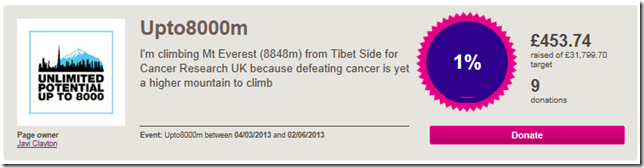
“ I’m climbing Mt Everest (8848m) from Tibet Side for Cancer Research UK because defeating cancer is yet a higher mountain to climb “




 Unlimited Potential, Up to 8000m