Category Archives: Everest

Big THANKS to all my Supporters and Sponsors

This year I have so many people supporting me on my way to the Top of The World, and it feel awesome, and on top of that there are three companies who believe in my dream and they sponsor me by using time, money and resources for my physical and mental preparation, as well as providing me with products that will help me reaching the summit of Mt Everest from the North Face

Thank you very much to International Sports Expertise, Sport in Life, Angelica Horvatic and DMCC


New-cover-page-large


While I’m climbing Everest please help raising $50.000 for life-saving research to bring forward the day when all cancers are cured.

image

Day 4: Burning time with shopping and the Inet

Today it has not been a very exciting day. I spent most of my day hunting for a new set of cheap yet strong duffle bags to replace the ones I’ve been using since I climbed Island Peak in Nepal few years back. For this Everest expedition I have plenty of new climbing gear. We mountaineers and rock climbers are crazy about our gear, always haunting for new stuff to use up the hill. But at the same time we also have that old harness, helmet or shirt that we refuse to replace years after years, a kind of romantic fetichism 😛

It looks like the fake NF bags with decent quality are all sold out so I just wasted half of my day 😛

Then I spend a lot of time setting up my designated expedition laptop. Phil provide us with four of them at BC, and hopefully a reliable internet connection, as well as satellite phones and Thuraya Nova SIM cards, all for free! He believes on the importance of us to be in touch with our families and friends during the time we are resting at BC.

I’ve also worked on my blog and sending some emails and FB updates. Not a very exciting day but somehow productive.

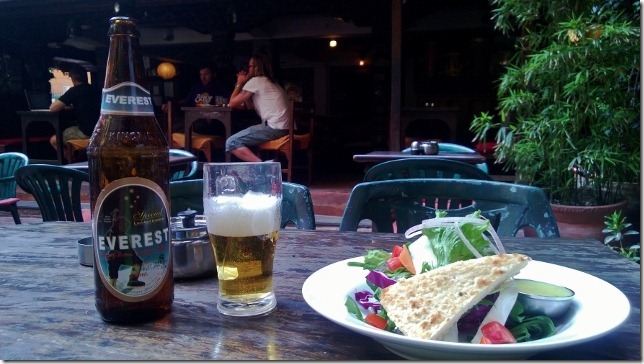
Yallah, one more day in this nice hotel drinking Everest beer and we are off to Kodari to cross the border and start our trip in Tibet.

Day 3: Chilling out at Kathmandu

Last night we had a great time enjoying our Team Dinner in a nice local restaurant at the touristic Thamel district in Kathmandu, with plenty of beer and red wine. After that I had few more beers at the Cortyard Hotel, which has a gorgeous garden beautifully decorated and illuminated, the perfect place to scape from the noisy streets of Kathmandu. I finished the day with a glass of whiskey in my comfy suite. Unfortunately the Hotel gets quite busy these days, and we only have reserved two nights, meaning that we have to move from these luxurious rooms into basic ones, and sharing with someone from the Team.

I’ve got quite lucky since my designated roommate is Ole, a very nice guy from Denmark. He is becoming quite popular these days, since he is running amazing challenges all around the World. He just run 7 marathons in 7 continents in 7 days, isn’t that amazing?! Before that he crossed El Estrecho de Gibraltar in Spain very early in the season, with freezing temperatures, setting a mark of 4.5h and being the first doing it this season, almost a month before the second one. He also cycled Lake Titikaka in Peru and now he is ready to climb Mt Everest. He does not consider himself a mountaineer, because he has only climbed one peak in all his life, and what a peak, Mt Manaslu in Nepal!

He climbed it with Phil and some of the Altitude Junkies going to Everest this time.

This morning I’ve got a FB msg from someone who follows my FB page (Upto8000m) and we have a common friend, Francisco Jose Garcia Romo, the President of the Spanish Mountaineers with Cancer. The message was a bit socking I should say. Mikel just lost his brother Marc in a traffic accident three days back, and he is writing me to ask if I can bring a photo of his brother to Everest. Marc was a passionate climber and his family is planning to take his ashes to the top of the mountains he used to climb. Marc wanted to climb Everest one day, and now I have the mission to take his photo with some words from his family to the Top of the World. What a beautiful ask… I feel so honored and touched by the suffering of this family who just lost a loved one… Mikel and I had a phone conversation last year when I was looking for form a team to climb Passu Peak in Pakistan. We never met after that, and he just knew about my big climb because Jose made a mention on his FB wall. World is so small… Mikel and his family have to climb the biggest mountain this days, I hope they recover from the lost soon. Rest in peace Marc, we’ll climb this one together and get as far as we can.

Jose is a good friend of mine and every time I visit Madrid I go the shop where he works selling outdoor and climbing gear, and we talk about our projects and have good laugh. I love what his is doing with the AEAC (Asociacion Espanola de Alpinistas con Cancer), and I love his passion for the beautiful big mountains in the Pamirs. Every year he guides small groups to Peak Lenin, Pobeda and Khan Tengri. Few weeks before I left to Kathmandu I visited him in his shop in Ribera de Curtidores (he works there off season), and he told me about climbing Pobeda with a friend, nothing commercial, just a romantic climb. He was diagnosed kidney cancer when he was going through a medical check up right before starting his first expedition to that Peak, so coming back and climb it means a lot to him. Since I arrived to Kathmandu I keep thinking on my recent unsuccessful climb of Khan Tengri and my desire to come back soon. There are thousands of peaks to be climbed, but right now my dream is to climb Peak Pobeda and Khan Tengri both in the same season. It’s kind of funny that I’m thinking on that now that I have such a big task ahead, but that is me, always dreams and setting up new plans…

Day 2: The Team Meeting and bad news

Today I woke up in a beautiful and comfortable suite in the Courtyard Hotel, I took a long warm shower and went downstairs to have breakfast and meeting my climbing partners. Right after that, we started our first team meeting, and Phil Crampton, our Expedition Leader, did an amazing presentation, very inspiring and motivational. Unfortunately the presentation started with some bad news. Our schedule to cross the Tibetan border has been delayed due to politics and we are now forced to spend few more days relaxing at Kathmandu. I must say I’m happy about that, since I’ve had the most hectic three weeks of my life before departing and so now I have plenty of time for relaxing, shopping the last pieces of gear and doing lots of pending task in the Internet (including some work related)

One of the members had a friend recording short video interviews of each of us. I must admit I’m terrible with this sort of things, but I don’t want to be the weirdo here refusing to be part of the game.

Tonight we’ll have our first team dinner in a nice restaurant in Thamel. Before that I don’t want to do anything productive, just going for lunch and beers with my new climbing partners and tomorrow I’ll see if I can get a nice expedition T-Shirt done from the local guys who do beautiful hand shedding in a shop very close to the hotel.

This is the final list of climbers in Altitude Junkies 2013 Everest Team

  • Phil Crampton (UK/USA)
  • Nelson Dellis (USA)
  • Javier Fernandez (Spain)
  • Christopher Goodwin (UK)
  • Robert Kay (USA)
  • Ole Mose Nielsen (Denmark)
  • Edita Nichols (Lithuania)
  • Markus Roth (Australia)
  • Edward Searle (UK)
  • Margaret Watroba (Australia)
  • Holly Wright (UK)

We are pleased to have our regular crew of Sherpa and Tibetans under the directorship of our famous Sirdar, Dorjee ‘IMAX’ Sherpa. This years staff supporting the expedition are as follows:

Climbing Sherpa

  • Dorjee Sherpa (Sirdar)
  • Pasang Ongcho Sherpa
  • Kami Neru Sherpa
  • Pasang Nima Sherpa
  • Chhongba Nurbu Sherpa
  • Ang Gelu Sherpa
  • Sangee Sherpa
  • Tarkey Sherpa
  • Jangbu Sherpa
  • Fu Dorjee Sherpa
  • Pemba Zyabu Sherpa
  • Pasang Gelu Sherpa
  • Lakpa Tenzing Sherpa
  • Lakpa Dorjee Sherpa
  • Kitchen Sherpa
  • Da Pasang Sherpa (Head Cook)
  • Pemba Ngtar Sherpa (ABC Cook)

Kitchen Tibetans

  • Gelje
  • Tashi Chusung
  • Tenzing
  • Tashi (1)
  • Norbu (1)
  • Kasang Dorjee
  • Norbu (2)
  • Tashi (2)

Day 1: Arriving at Kathmandu

After few weeks of pre-expedition stress, packing stuff up to the last minute before my taxi arrived home (literally) I took a Flydubai flight to Kathmandu where my Everest 2013 Expedition from North Side is set to begin.

I had an awesome time with my friends on Tuesday night, thanks to my beautiful girlfriend, who organized a surprise farewell party at The Six Senses in the Palm Island. She did an amazingly good job contacting most of my best friends in Dubai, although she didn’t know most of them yet. I finished my last hipoxic training session (5800m) on Tuesday around 8pm and I just wanted to go for dinner with her and relaxing for few hours before resuming all preparation work. I parked my car at her place and first thing she did was opening a bottle of beer for me. Then she drove us in my car to that beautiful place and… surprise! Many of my friends were there. Some others joined us as I was getting more and more surprised. The following day I did my packing and she took me for a 90min full body massage at one of the best places in Dubai. What an amazing pre-expedition retreat. She helped me out the following day with my packing up to the last minute before we left to the airport. She has been extremely helpful, running some important errands that saved me a lot of time and stress.

Now that all stress is over, these are the lessons I learned these days:

– Get the ones you love to help you with logistics, you’ll save lots of time and energy and they’ll feel part of the Everest Dream

– Do not leave packing up to the last day. Even if you have everything ready and ticked in your packing list, it’s better to have the duffle bags loaded few days before. This will give you psychological relief and distress.

– Get 3 or 4 days off work before the expedition to run last minute errands calmly, and especially to share time with the ones you love the most…

Today I have arrived at Kathmandu Airport with no surprises. The flight was busy with so many young nepalis coming back home, but I went through immigration smoothly and all my luggage was delivered with not loses or defects. I had to pay around 700AED for 14kg over my 40kg allowance. Very disappointed that I was not allowed to pre-purchase more 😦

One driver from the hotel was waiting with an old Mercedes to pick me up, and I am extremely pleased with the quality of this small boutique style hotel in the middle of the Thamel district in Kathmandu. The lovely american couple who owns and runs the Cortyard Hotel greeted me with an Everest beer, and I was so happy that I did no even checked my room right away. I’ve just enjoyed the company, nice conversation and delicious stake that one of them personally cooked for me. Amazing service… now I understand why our Expedition Leader, Phil Crampton talks wonders about this place. After couple of hours chatting and drinking with them, I moved my tired butt to my room and I have to say that it looks superb, a traditionally decorated suite with plenty of space to even live there for weeks.

I have met few trekkers and climbers over few beers in the garden, but I’m still unsure which one is in my team. I will find that out tomorrow, and we’ll also hold our first Team meeting were I’ll see all of them. I’ve heard there are some issues with the Chinese group visa, so lets see what Phil has to tell us tomorrow…

Interview with Suzanne Al Houby – the first Arab woman to scale Mount Everest

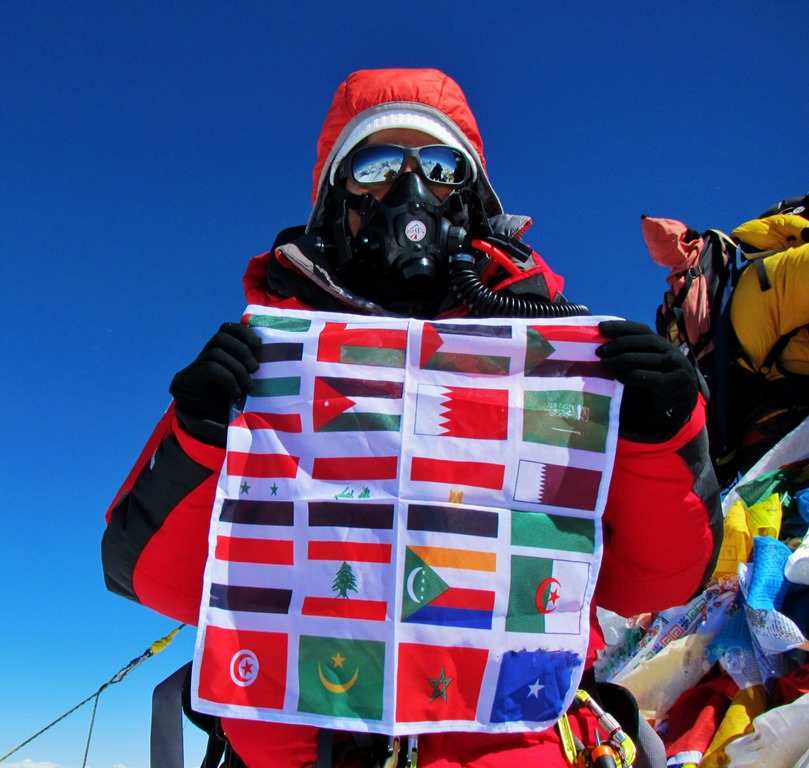
Since the world’s highest peak was first scaled by Sir Edmund Hillary and Tenzing Norgay in 1953, about 100 women from across the world have achieved this feat. One of these heroes that I proudly have as a friend in Dubai, is the Palestinian mountaineer Suzanne Al Houby, who became the first Arab woman to scale Mount Everest on 21 May 2011. She is a source of inspiration for others, and she is now the CEO of Rahhalah Explorers, a Dubai based adventure travel company aimed to help others realizing their full potential in life changing trips all around the world. Suzanne climbed Everest at the same time one on my idols was trying a repetition without Oxygen. That is Edurne Pasaban, an extraordinarily strong mountaineer from the Basque Country in Spain, and the first woman to climb all of the fourteen eight-thousander peaks in the World.  Suzanne represents an evolution on the role of Arab woman in today’s world. She holds many other records, starting on 2003 when she became the first Arab woman to reach the Everest Base Camp. She is also the first Arab woman to scale Mount Elbrus, the highest point in Europe, and the first Palestinian woman to climb Mount Kilimanjaro, Africa’s highest peak. To date, she has successfully reached the summit of the highest mountains on six of the world’s seven continents. Nowadays Suzanne is in the spotlight as mountaineer and entrepreneur, and I have the pleasure to share her thoughts about the long journey she started 10 years ago and her experience climbing what she likes to call “The Mighty E”


My interview with with Suzanne

Q: What was your first climbing experience and when did you decide to climb Mt Everest?

My first climb was Kilimanjaro  back in 2002. And the idea to climb it came out of the blue while I was on a safari trio and got my first glimpse of this huge mountain. I vowed that I will come back to climb it which I did. But with very little knowledge on what to expect, I was absolutely and hopelessly miserable by day 3 and doubted my self! 4 days later, after sucking it up and pushing through, I stood on my first summit and my life changed after that. I just enjoyed pushing myself to where  I never thought possible and it just gave me a different outlook on life. I decided to climb Everest when I was in Antarctica. When I was able to climb in  60 degrees below zero, I overcame my biggest fear of extreme colds and I felt that maybe I am ready for the Mighty E.

Q: What has been the hardest part of your Everest experience?

Every day brought with it so many challenges. As you will soon learn, the only constants are adversity and change and the mental toughness is much needed there. My first time to attempt climbing to camp 3 was horrible and I had to retreat before clipping to the ropes as I couldnt warm my self up. It was very hard for me to be feeling teh freezing cold, getting pain and numbness in my fingers and toes ad decide to turn around when all my team mates are climbing up! But that day the goal was not the summit, it was taking care of myself and avoiding a frost bite! Next day I attempted climbing it again and succeeded and caught up with my team. It was like losing the battle but not the war!

Q: And what was the most detestable section of the South Route and the one you enjoyed the most?

I  hated the ice fall. The fact that you are climbing a living monster that moves all the time is scary. Even when you have to catch your breath – and your lungs are screaming for oxygen – you still have to push through and not stop fearing an avalanche or a serac falling or a crevass opening ! I enjoyed the summit push actually – relatively speaking of course as it was like climbing to heaven! My favorite part was taking a heli out of base camp after 60 days of climbing!

Q: Who would you climb with if you’d have the possibility to choose anyone in the world?

I just finished a climb with one my biggest inspirations – Zed Al Refai, the first Arab man to summit Everest and the 7 summits. It was great.  I was fortunate enough to climb with some of the greatest climbers in the world as well. I always wanted to climb with Dave Hahn, but still didnt get the chance 🙂

Q: Do you have any source of inspiration to climb and achieve other goals such us opening you very own adventure travel company in the Middle East?

Everything inspires me and not one thing!One has to be receptive to all these positive thoughts and signals around to live with positive attitude.  I always first and foremost do things for me – I hope this doesnt sound eccentric, but if I earn my own self respect then I can in many ways reflect and connect with what is around me. The things I felt, the lessons I learned from all my adventure travels, and the people I met who influenced me big time all made me open my own adventure company. I want people to see and feel what the world has to offer! 

Q: If you have to think of the most valuable advice for anyone climbing Everest, what would it be?

One step at a time, that’s all it takes. Do not make any decision based on the ” summit fever”. The mountain will not go any way. Be ready for the emotional and mental challenges that this huge mountain will present to you. And lastly respect Everest and love it ! 

Q: And as entrepreneur in the Middle East, what is the advice you can give to other women attempting to “climb her own mountain”?

The only person who can define what you can or can not do is only you! If you believe in it, go for it. 

Q: What is your favorite piece of gear?

My sleeping bag, it is like home 🙂 

Q: And your favorite movie and book?

I loved “sorrow mountain” about a nun from Tibet struggle in the Chinese prisons. I have learned so much from this book. I am not sure about my favorite movie but one that comes to mind is touching the void – great book and great movie!  

Q: Do you have any preference in terms of brands to choose for your climbing challenges?

I am a gear addict!! Mammut remain my favorite though.  

Q: Do you consider Everest the most challenging climb you have done up to date, or do you have other experiences that put you to the limit at lower altitudes?

Overall, Everest  was the most challenging. However even MB once humbled me big time by its fierce weather and forcing me to turn around!  

Q: Are you planning to complete the 7 summits anytime soon?

Hopefully 🙂 

Q: If you can choose any mountain to climb in the World, which one would be?

Eiger 

Q: In terms of your plans for the future of Rahhalah Explorers, are you considering organizing very challenging trips and expeditions to places like The North Pole?

Of course, any wild adventure you name it we will do it !

Q: Out of all destinations and activities organized under the brand of Rahhalah Explorers, what are your favorite and why?

Kilimanjaro. We have a big family  over there – our local support – and they really feel like family not only to me but to my clients as well. People are so kind, humble and go out of their way to make you feel welcomed and comfortable. Also, Kilimanjaro is a relatively beautiful mountain, non technical and highly supported. therefore it is doable and feels like a vacation. 


IMG_0366

Is Everest North Route suitable for the rookies?

Not many climbers around the world have climbed Everest, and I believe very few have tried climbing his/her first 8000 on the Everest North Ridge Route. There are about 5 UAE residents who have already climbed Everest, and we have at least three more trying this year. However my understanding is that none of these UAE based climbers have climbed Chomolungma from Tibet.

My Everest Dream this year is to climb my first eight-thousander on the most difficult route that is climbed commercially these days.

There are different reasons why most climbers would opt for the most popular South Col Route to the Top of The World, especially those with none or little experience climbing above 8000m. In this blog post I’m putting together some facts and figures and describing the main differences between the two main climbing routes in Mt Everest.


Facts & Figures

According to my estimations based on the information available from the most popular sources – e.g. Alanarnette – last year we had 395 successful summits from the south and 153 north. This brings the total number of people who have summited Mt. Everest to around 6200, from which around 2500 have multiple summits (mostly Sherpas). About one climber out of four summited from the North, which is the crazy route I chose for my first attempt.

The South rote seems to be safer and more successful, but it’s also more expensive in terms of permit fees and other costs. South route normally spend less time at the very high altitudes (the highest camp on South is is 7950m versus 8300m on the north). However in the North route climbers spend more time between 6400m and 7000m (Advanced Base Camp) which helps on acclimatization. This route is traditionally considered slightly more dangerous given the exposure to the cold and severe winds combined with the technical difficulties on the last sections of the route, “The Steps” and summit ridge. Also the conflict between China and Tibet makes the whole expedition more challenging since the risk of China closing borders to china again as high these days. In 2008, the northeast route was closed by the Chinese government for the entire climbing season, and the only people able to reach the summit from the north that year were athletes responsible for carrying the Olympic torch for the 2008 Summer Olympics. The route was closed to foreigners once again in 2009 in the run-up to the 50th anniversary of the Dalai Lama’s exile

The north side has had more altitude and exposure-related deaths above 8000m than on the south side.  Last season, Alan Arnette posted a very interesting description of the Everest Routes in his blog, looking at some statistics behind Everest in the past decade up to 2011.

Reason Northeast Ridge Southeast Route Other Routes
Fall 8 5 1
Altitude 9 6 1
Exhaustion 9 1 1
Unknown 7 2 1
Avalanche 1 3 2
Crevasse 0 4 0
Exposure 4 0 0
Heart/Stroke 1 4 0
  39 25 6


The north side fatality rate is more than 2:1 over the south with falls, altitude issues and exhaustion noted as the primary reasons. The difference is even more extreme when the deaths of 9 south side Sherpas are taken from the total, making the ratio of “member or client” climber deaths from north to south 8:1

The overall member ascent and death rates on the Everest commercial routes (1990-2012) are 36.96 and 1.57 on North Col vs 47.60 and 0.87 on South.  The 13% missing is mostly due to turn backs, and that is becoming a serious issue on South side. On May 19, 2012 there were 166 ascents on the South Col route, which means 332 crossings of the Hillary Step (up and down). May 19th was one of the worst nights in Everest history, when six people total died.  4 of them died on the South route at different points close to the Summit, and 2 more on the North (on of them Spanish) under similar conditions. There were about 537 summits in 2011 with 4 deaths, unusually with 3 of those on the south side. So it looks like in the last couple of years the massification of the South route is becoming an issue.

8000ers.com has some very interesting statistics up to 31.12.2010 here

On one of the articles published by National Geographic last year, we can read an interesting note from Eric Simonson of International Mountain Guides

Not only is the North Ridge technically difficult because of its terrain, but it also requires some particularly careful, even counterintuitive, planning. First of all, Simonson points out, on the North Ridge climbers spend a lot of time on steeply sloping shale and ice, and “it’s tough to get your crampons into that stuff!” To make matters more difficult, the geography of the North Ridge requires the final camp to be at a much higher elevation than the final camp on the South Col. The result, says Simonson, is that “North Ridge climbers are forced to spend a lot more time at higher altitudes, and this in and of itself makes the route more demanding.”

Another challenge posed by this route is the long traverse along the North Ridge on summit day. The guide explains that this “means you are covering a lot of lateral distance, which really comes into play on the descent.” Here’s where careful planning becomes so important. Because so much of a climber’s time on the North Ridge is spent negotiating sloping rock and ice at the highest altitudes, he must make sure to have plenty of oxygen and energy for use on the difficult descent—at least as much as he needed to ascend to the summit. Basically, says Simonson, “you have to have enough gas left in your tank (both literally and figuratively) to make the descent. You can’t afford to burn more than 50 percent of your reserves going up, because you’ll definitely need the other half to get down.” The most common problem he’s seen with climbers on the north side is that they underestimate how long it will take them to make the technically difficult, traversing descent to camp from the summit, and they run out of oxygen before they reach the camp.

Overall, he explains, “the prolonged time spent at higher altitudes and the time it takes to do that traverse in both directions catch a lot of people off guard on the North Ridge.” Sometimes, it seems, knowing that “it’s all downhill from here” isn’t much of a comfort.

 On his fantastic post last season, Alan takes a brief look at the pros and cons of the most popular routes:


South Col Route

Pluses

Concerns

Beautiful trek to base camp in the Khumbu

Khumbu Icefall instability

Easy access to villages for pre-summit recovery

Crowds, especially on summit night

Helicopter rescue from base camp if necessary

Cornice Traverse exposure, SE Ridge Slabs

Slightly warmer sometimes with less winds

Slightly longer summit night


Northeast Ridge Route

Pluses

Concerns

Less crowds

Colder temps and harsher winds

Can drive to base camp

Camps at higher elevations

Easier climbing to mid-level camps

A bit more difficult with smooth or loose rocks

Slightly shorter summit night

No opportunity for helicopter rescue at any point


This is Alan’s very interesting description of the routes at both sides of Everest


South Col Route

·         Base camp: 17,500′/5334m: Home away from home. Located on a moving glacier, tents can shift and platforms melt. The area is harsh but beautiful surrounded by Pumori and the Khumbu Icefall with warm mornings and afternoon snow squalls. With so many expedition tents, pathways and generators, it feels like a small village.

·         C1: 19,500′/5943m – 4-6 hours, 1.62 miles: Reaching C1, is the most dangerous part of a south climb since it crosses the Khumbu Icefall. The Icefall is 2,000′ of moving ice, sometimes as much as 3 feet a day. But it is the deep crevasses, towering ice seracs and avalanches off Everest’s West shoulder that creates the most danger.

·         C2: 21,000′/6400m – 2-3 hours, 1.74 miles: The trek from C1 to C2 crosses the Western CWM and can be laden with crevasse danger. But it is the extremely hot temperatures that takes a toll on climbers. Again avalanche danger exist from Everest’s West Shoulder that has dusted C1 in recent years.

·         C3: 23,500′/7162m – 3-6 hours, 1.64 miles: Climbing the Lhotse Face to C3 is often difficult since almost all climbers are feeling the effects of high altitude and are not yet using supplemental oxygen. The Lhotse Face is steep and the ice is hard. The route is fixed with rope. The angles can range from 20 to 45 degrees. It is a long climb to C3 but is required for acclimatization prior to a summit bid.

·         Yellow Band – 3 hours: The route to the South Col begins at C3 and across the Yellow Band. It starts steep but settles into a sustained grade as the altitude increases. Climbers are usually in their down suits and are using supplemental oxygen for the first time. The Yellow Band’s limestone rock itself is not difficult climbing but can be challenging given the altitude. Bottlenecks can occur on the Yellow Band.

·         Geneva Spur – 2 hours: This section can be a surprise for some climbers. The top of the Spur leading onto the South Col has some of the steepest climbing thus far. It is easier with a good layer of snow than on the loose rocks.

·         South Col: 26,300′/8016m – 1 hour or less: Welcome to the moon. This is a flat area covered with loose rock and surrounded by Everest to the north and Lhotse on the south. Generally, teams cluster tents together and anchor with nets or heavy rocks against the hurricane force winds. This is the staging area for the summit bids and the high point for Sherpas to ferry oxygen and gear for the summit bid.

·         Balcony: 27,500′/8400m- 4 – 5 hours: Officially now on Everest, climbers are using supplemental oxygen to climb the steep and sustained route up the Triangular Face. The route is fixed with rope and climbers create a long conga line of headlamps in the dark. The pace is maddeningly slow complete with periods of full stop while climbers ahead rest, consider the decision to turn back or continue to the balcony. It can be rock or snow depending on the year. Rock fall can be an deadly issue and some climbers now use helmets. They swap oxygen bottles at the Balcony while taking a short break for some food and water.

·         South Summit : 28500′/8690m – 3 to 5 hours: The climb from the Balcony to the South Summit is steep and continuous. While mostly on a beaten down boot path, it can be challenging near the South Summit with exposed slabs of smooth rock in low snow years. The views of Lhotse and the sun rising to the east is indescribable at this point. Climbers lose radio contact with EBC in this section.

·         Hillary Step – 1 hour or less: One of the most exposed section of a south side climb is crossing the cornice traverse between the south summit and the Hillary Step. But the route is fixed and wide enough that climbers rarely have issues. The Hillary Step is a short 40′ section of rock climbing, again fixed with rope, that creates a bottleneck on crowded summit nights. Usually there is an up and down climbing rope to keep people moving.

·         Summit: 29,035′/8850m – 1 hour or less: The last section from the Hillary Step to the summit is a moderate snow slope. While tired, climber’s adrenaline keep them going.

·         Return to South Col: 4 -7 hours: Care must be taken to avoid a misplaced step down climbing the Hillary Step, the Cornice Traverse or the slabs below the south summit. Also diligent monitoring of oxygen levels and supply is critical to make sure the oxygen lasts back to the South Col.

·         Return to C2: 3 hours: Usually climbers are quite tired but happy to be returning to the higher natural oxygen levels regardless of their summit performance. It can be very hot since most climbers are still in their down suits.

·         Return to base camp: 4 hours: Packs are heavy since everything they hauled up over the preceding month must be taken back down. It is now almost June so the temperatures are warmer making the snow mushy thus increasing the difficulty. But each step brings them closer to base camp comforts and on to their home and families.


Northeast Ridge Route

·         Base camp: 17000′ – 5182m: located on a gravel area near the Rongbuk Monastery, this is the end of the road. All vehicle assisted evacuations start here. There are no helicopter rescues or evacuations on the north side or for any mountain in Tibet.

·         Interim camp: 20300′/6187m – 5 to 6 hours (first time): Used on the first trek to ABC during the acclimatization process, this is a spot where a few tents are placed. Usually this area is lightly snow covered or none at all.

·         Advanced base camp: 21300′/6492m – 6 hours (first time): Many teams use ABC as their primary camp during the acclimatization period but it is quite high. This area can still be void of snow but offers a stunning view directly at the North Col. It is a harsh environment and a long walk back to the relative comfort of base camp or Tibetan villages.

·         North Col or C1: 23,000′/7000m – 4 to 6 hours (first time): Leaving Camp 1, climbers reach the East Rongbuk Glacier and put on their crampons for the first time. After a short walk, they clip into the fixed line and perhaps cross a few ladders that are placed over deep glacier crevasses. The climb from ABC to the North Col steadily gains altitude with one steep section of 60 degrees that will feel vertical. Climbers may use their ascenders on the fixed rope. Rappelling or arm-wrap techniques are used to descend this steep section. Teams will spend several nights at the Col during the expedition.

·         Camp 2: 24,750′/7500m – 5 hours: Mostly a steep and snowy ridge climb that turns to rock. High winds are sometimes a problem making this a cold climb. Some teams use C2 as their highest camp for acclimatization purposes.

·         Camp 3: 27,390′/8300m – 4 to 6 hours: Teams place their camp 3 at several different spots on the ridge since it is steep, rocky and exposed. Now using supplemental oxygen, tents are perched on rock ledges and are often pummeled with strong winds. This is higher than the South Col in altitude and exposure to the weather. It is the launching spot for the summit bid with some teams spending the night or just a few hours.

·         Yellow Band: Leaving C3, climbers follow the fixed rope through a snow filled gully; part of the Yellow Band. From here, climbers take a small ramp and reach the northeast ridge proper.

·         First Step: 27890′/8500m: The first of three rock features. The route tends to cross to the right of the high point but some climbers may rate it as steep and challenging. This one requires good foot work and steady use of the fixed rope in the final gulley to the ridge.

·         Mushroom Rock -28047′/8549m – 2 hours from C3: A rock feature that spotters and climbers can use to measure their progress on summit night. Oxygen is swapped at this point. The route can be full of loose rock here adding to the difficulty with crampons. Climbers will use all their mountaineering skills.

·         Second Step: 28140′/8577m – 1 hour or less: This is the crux of the climb with the Chinese Ladder. Climbers must first ascend about 10′ of rock slab then climb the near vertical 30′ ladder. This section is very exposed with a 10,000′ vertical drop. It is more difficult to navigate on the decent since you cannot see your feet placement on the ladder rungs. This brief section is notorious for long delays thus increasing the chance of frostbite or AMS.

·         Third Step: 28500′/8690m – 1 to 2 hours: The easiest of the three steps but requires concentration to be safe.

·         Summit Pyramid – 2 to 4 hours: A steep snow slope, often windy and brutally cold, climbers feel very exposed at this point. Towards the top of the Pyramid, climbers are extremely exposed again as they navigate around a large outcropping and experience three more small rock steps on a ramp before the final ridge climb to the summit.

·         Summit: 29,035′/8850m – 1 hour: The final 500′ horizontal distance is along the ridge to the summit is quite exposed. Slopes angles range from 30 to 60 degrees.

·         Return to Camp 3: – 7 -8 hours: The down climb takes the identical route. Early summiters may experience delays at the 2nd Step with climbers going up or summiters having down climbing issues.

·         Return to ABC: 3 hours: Packs can be heavy since everything hauled up over the preceding month must be taken back down. It is now almost June so the temperatures are warmer making the snow mushy thus increasing the difficulty. But each step brings them closer to base camp comforts and on to their home and families.


And finally some history about the first climbing attempts on both routes:

Mt. Everest was first summited by Sherpa Tenzing Norgay and New Zealander Edmond Hillary with a British expedition in 1953. They used the South Col route. At that time the route had only been attempted twice by Swiss teams in the spring and autumn of 1952. They reached 8500m well above the South Col. Of note, Norgay was with the Swiss thus giving him the experience he used on the British expedition. The Swiss returned in 1956 to make the second summit of Everest.

The north side of Everest is steeped in history with multiple attempts throughout the 1920’s and 1930’s. The first attempt was by a British team in 1921. Mallory led a small team to be the first human to set foot on the mountains flanks by climbing up to the North Col (7003m). The second expedition, in 1922 reached 27,300′ before turning back, and was the first team to use supplemental oxygen. It was also on this expedition that the first deaths were reported when an avalanche killed seven Sherpas.

The 1924 British expedition with George Mallory and Andrew “Sandy” Irvine is most notable for the mystery of whether they summited or not. If they did summit, that would precede Tenzing and Hilary by 29 years. Mallory’s body was found in 1999 but there was no proof that he died going up or coming down.

A Chinese team made the first summit from Tibet on May 25, 1960. Nawang Gombu (Tibetan) and Chinese Chu Yin-Hau and Wang Fu-zhou, who is said to have climbed the Second Step in his sock feet, claimed the honor. In 1975, on a successful summit expedition, the Chinese installed the ladder on the Second Step.

Tibet was closed to foreigners from 1950 to 1980 preventing any further attempts until a Japanese team summited in 1980 via the Hornbein Couloir on the North Face.

The north side started to attract more climbers in the mid 1990s and today is almost as popular as the South side when the Chinese allow permits. In 2008 and 2009, obtaining a permit was difficult thus preventing many expeditions from attempting any route from Tibet.


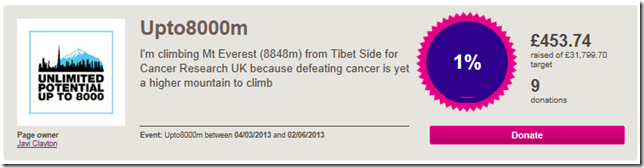
I’m climbing Mt Everest (8848m) from Tibet Side for Cancer Research UK because defeating cancer is yet a higher mountain to climb

I'm climbing Mt Everest (8848m) from Tibet Side for Cancer Research UK because defeating cancer is yet a higher mountain to climb

Everest 2013 Expedition and the need for the bits

I’ve recently approached our Expedition Leader Phil asking for advices on how to get connected via the 3G cellular networks in China, since we are climbing North Side. The answers were pretty much straight forward: 3G is too difficult and expensive, while satellite comms are not possible due to the Mighty E projecting an electromagnetic shadow in Base Camp (5200m). There is however the possibility to get Inmarsat BGANs connected from Advance Base Camp (6400m) but power sources will be limited to a set of portable solar panels and therefore Internet usage will be restricted to pull out weather forecast data and sending the official dispatches.

Besides being an adventurer and crazy Spaniard, I’m an IT Geek, and when someone says “it’s not possible” I feel like taking the challenge and proving they’re wrong.

I don’t know much about the experiences from guys like me going on North Face of Everest with BGAN modems or simpler devices, but I don’t think is such a challenge as explained by our Expedition leader today. He is probably the most experienced Everest climber and guide in the Tibet side these days, but I’m also very experienced on finding Solutions to IT challenges anywhere in this world. Now I feel like not only climbing that mountain but also proving there is no “Impossible” when it comes to IT. It’s just a matter of finding the right formula.

For the last 15 years I’ve been working in the IT arena doing all sort of things, from fixing old CRT computer monitors, to setting up an IP videoconferencing network all around Spain allowing deaf people to communicate from the distance using their natural sign language. Today I’m employed by a large Blue Chip company in Dubai and I work with Telcos all around the world supporting Hosting Solutions to satisfy their customer’s needs. My aim is to work with these Telcos building Messaging and Collaboration Solutions that enable businesses and individuals being connected and productive no matter where they go. As Solution Support Engineer, finding solutions is all about me, not only at work but in all aspects of my life.

This year I’m taking to my Expedition a couple of devices with the brand new Windows 8 operating system (Microsoft Surface and Windows Phone, no laptops of complex toys), and I’m determined to find solutions and get them connected to the Internet, at least to send my own expedition dispatches and updates on the social media, but primarily to satisfy my IT Geek needs and finding the right formula to stay connected up there.

As Altitude Junkie I like to spend my time in the clouds, not only climbing but also flying with a light paraglider and help from the wind. I’m just a newbie but there are so many good pilots out there… and recently I’ve had the opportunity to meet Geoff Davison, Product Manager for Thuraya Telecommunications Company.

Thuraya is a world-leading mobile satellite service provider of voice, data, maritime, rural telephony, fleet management and other telecommunication solutions in remote areas. They provide mobile satellite communications to over 140 countries around the world, offering a congestion-free network that covers most of the planet, encompassing Asia, Africa, Australia, the Middle East and Europe. Thuraya not only delivers a set of incredible products and services, but also they have the know-how and experience required to help me finding that formula and getting these devices connected from Base Camp, proving there is no “Impossible” when it comes to IT. Geoff is committed to help me becoming a good pilot and finding Solutions to stay connected from the Mighty E.

From today I will start describing the process to break communication barriers during complex expedition in extreme natural environments such as the one we’ll find on our journey up to the Top of the World from April 2013.

These are for now the constants in the equation:

· Satellite network coverage and line of sight from Everest Basecamp at Tibet side (5200m)

· Optimizing bandwidth consumption with Windows 8

· Optimizing battery consumption on Microsoft Surface and Windows Phone

· Using portable solar power solutions with tablets and phones

· Mobile device reliability under extreme weather conditions

Would you IT Geeks be interested on investigating solutions and coming up with a case study starting from today and finishing on the summit of Mt Everest? Subscribe to my blog to receive updates and use the contact form to send me all suggestions and ideas.

image


I’m climbing Mt Everest (8848m) from Tibet Side for Cancer Research UK because defeating cancer is yet a higher mountain to climb

I'm climbing Mt Everest (8848m) from Tibet Side for Cancer Research UK because defeating cancer is yet a higher mountain to climb

Defeating cancer is yet a higher mountain to climb

Last summer I was fighting to get to the top of my first 7000m, Khan Tengri, The Lord of the Sky. Meanwhile my friend Gerard was fighting to defeat cerebral cancer. I could not get any higher than 5500m since the mountain refused to let us climb. And my friend could not get any further than two weeks after he was diagnosed, since the illness was not treated at the right time. My uncle Verna, his brother Goyo and my godmother Julia were all at the same time fighting cancer, and today we can happily say they made it to the summit of what it is the highest mountain one can climb. My neighbor Juan is a warrior, someone like Reinhold Messner (the greatest climber in history). He is the person I know who has climbed more 8000. Not those in the Himalayas, but the ones that are higher and must be climbed from the bed of a hospital room. He’s got frostbite several times, and he complains because he does not like the scars. But I think they are pretty cool considering the sort of battles he won. He is still descending from his last 8000, but we all know he’ll remain strong and will make it save back to Base Camp.

For all my family, my friend Gerard and Juan, I want to climb the highest mountain in the Himalayas and raising funds towards investigation cures for Cancer, and defeating the highest mountain not from the hospital room but from the lab in the research room.

Cancer Research UK is the world’s leading charity dedicated to beating cancer through research. They are fighting cancer on all fronts, finding new ways to prevent, diagnose and treat it to save more lives. They are entirely funded by the public. Cancer Research UK pioneers life-saving research to bring forward the day when all cancers are cured.


Cancer Research UK | It’s cancer’s turn to be afraid

image


Donating through JustGiving is simple, fast and totally secure. Your details are safe with JustGiving – they’ll never sell them on or send unwanted emails. Once you donate, they’ll send your money directly to the charity and make sure Gift Aid is reclaimed on every eligible donation by a UK taxpayer. So it’s the most efficient way to donate – I raise more, whilst saving time and cutting costs for the charity.

So please dig deep and donate now.

image

http://www.justgiving.com/upto8000m

Training in the Almas Tower – DMCC

Mount Everest is the Earth’s highest mountain, with a peak at 8,848 meters above sea level and the 5th tallest mountain measured from the center of the Earth. It is located in the Mahalangur section of the Himalayas and it was first ascended by Tenzing Norgay, Edmund Hillary on May 29, 1953. Exactly 60 years after that I’ll be standing up on the highest point on Earth. It all depends mainly on weather, but I’m hoping to make my dream come true at some point between May 25th, my 35 birthday, and May 29th the most significant date in the history of mountaineering as we know it these days.

In order to prepare for this challenge I have climbed many other mountains, not too high in most cases, but with passion, determination and the right training I’m sure I’ll be able to cope with the extreme altitude and severe weather conditions. Training in Dubai to climb Mt Everest might seem foolish, but I’m absolutely convinced this place is not only a gateway for many expats looking to make their dreams come true from the “financial” point of view, but also for some of us who get inspired by those who managed to transform a small city located southeast of the Persian Gulf, into the cosmopolitan metropolis that has grown steadily to become a business and cultural hub of the Middle East and the Persian Gulf region nowadays. The idea of “nothing is impossible”, who is bringing Dubai to the focal point of citizens around the world, is what it drives people like me to attempt our Everest Dream, standing on the highest point on Earth and coming back safe an happy to share the story with others, while changing our own perception of the World.

Training in Dubai during summer time might seem to be extreme for those who are not used to the weather of a tropical desert climate. But climbing some sections of the route up to the summit of Everest is not much different. The Western Cwm, an area climbers go through to reach the summit, can be very hot with temperatures over 37C. While on summit day temperatures can drop down to -62C. Training in extreme weather conditions really helps developing mechanisms in our body to adapt to the conditions in Everest. Training outdoors in Dubai has proved to be very beneficial for me as I prepared for other challenges in the last two years.  I have recently blogged about it here

Some people might also think the orography of UAE is not the most appropriate to prepare for a climb like this. However many people don’t know we have plenty of beautiful mountains, which in some cases are higher than those we find in the home countries of many famous climbers we follow on their challenges around the world. UAE and Oman is a fantastic playground for outdoor enthusiast, and that included Altitude Junkies like me. We might not have snow in our mountains but we are one step away from countries like Iran that stock one of the best selection of 4000m peaks in the World

On top of that, in Dubai we have a big advantage when it comes to train for positive gradient every day. Not many people can go on a long drive to hike 1200m or as higher after work. And that applies to citizens of Dubai as well as those living in Chamonix, France. However what we have in Dubai is the largest number of skyscrapers in just one town. That allows me to train for positive gradient in many different buildings whenever I want. Last year I was visiting friends and climbing the staircase in the buildings where they live. Dubai Trade Center, Dubai Marina, Greens, Tecom, JLT… the possibilities are endless and the result is that you get stronger by the day.

This year I decided to plan for a comprehensive training where I increase elevation gain in a long staircase every week, starting with 750m in the first session and finishing with 2000m

by Mach 30th right before I leave to Tibet and Everest.  My training plan is ambitious and cannot be executed in random places, so I was a bit concerned about finding the right building where to train two-three times per week. Then I looked at the DMCC Almas Tower in JLT, the tallest commercial building in the Middle East, located just 10 minutes away from my house in The Springs. This 63-floor purpose built tower is home to over 300 regional and international companies from the entire value chain in the diamonds and colored stones sector. Almas means Diamond in Arabic, and I felt like discovering a mine when I first heard back from Patricia Adem, from the JLTCommunity Services team in DMCC, after I sent one email with my expedition dossier and request to use DMCC facilities to train every day. Patricia and her colleague Andrew Fairie kindly accepted to hold a meeting were to discuss the best way to help me achieving my goals, and few days after that I was provided with authorization to use Almas Tower facilities as a gateway to the summit of Mt Everest.

Dubai Multi Commodities Centre (DMCC), a government authority established in 2002 to enhance commodity trade flows through Dubai, performs several roles which have firmly established Dubai as a regional and international trading hub. DMCC regulates, promotes and facilitates trade across a range of commodities sectors, including gold, diamonds, pearls, precious metals and tea . It is also the licensing authority and the master developer of the JLT Free Zone which is home to over 5,900 companies and over 55,000 people living and working across 64 towers. Major multinational companies (the likes of DeBeers, LVMH, Harley Davidson, Tilda and Damas) as well as small and medium enterprises across all sectors have made the Jumeirah Lakes Towers (JLT) free zone their home. And today I am proudly sponsored by DMCC and I used the Almas Tower to climb up and down 4352 floors, 16552m vertical distance and 8276m cumulative elevation in only 10 nonconsecutive days. And this is just the beginning… With DMCC’s support I will climb three times the altitude of Mt Everest (8848m) in the Almas Tower before I leave to conquer the Top of The World!


Training