Category Archives: 2012

Climbing is the only cure for gravity… 1 day to go!!!

With just few hours ahead to load all expedition material in a taxi and heading down to Dubai Airport Terminal 2, I feel very close the time when I’ll start receiving the cure for this disease that we climbers and paragliding pilots call Gravity.

And before I leave  I want to share the final notes from our climbing plan on the second phase of my expedition, conquering Khan Tengri, “Lord of the Skies” (7010m – 23000ft)

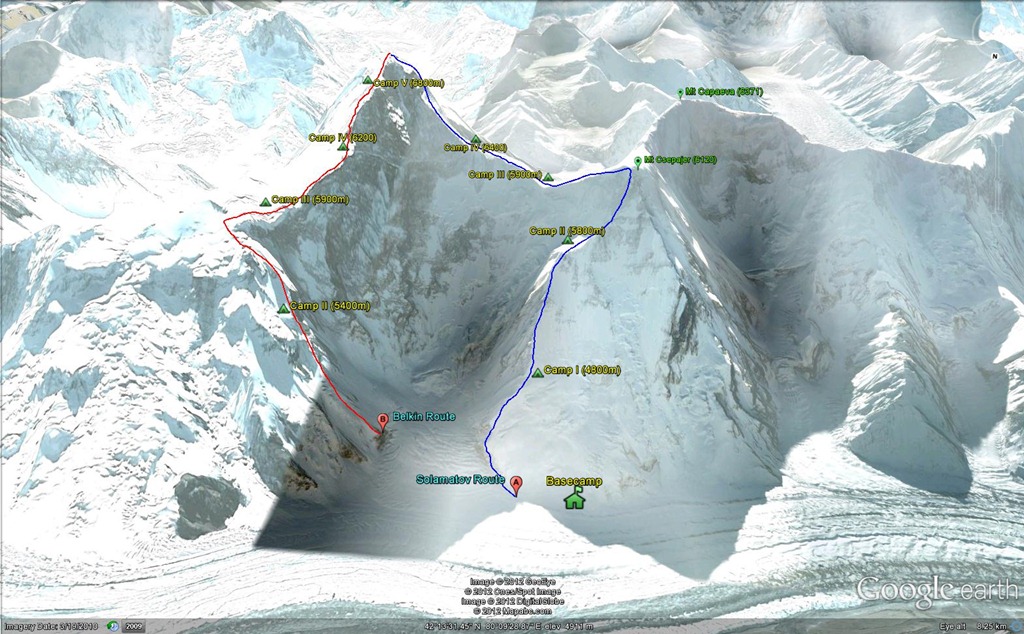
Khan Tengri can be climbed from either South or North Inylchek Glaciers, on which separate base camps are located. The “northern normal route” is more difficult than the “southern normal route”, but it is much less exposed to avalanches. It has eight different routes opened up to date, but we’ll be looking at climbing either Solomatov Route via the north east Chapaev Ridge, which take us to the summit via the West Ridge, or the Belkin Route going through the East Buttress to the North Ridge. Both routes are Russian Grade 5b and were first climbed in 1974 and 75 respectively. The route is to be chosen based on the conditions but most probably we’ll climb the first one which is considered the Normal Route.

I have prepared the following diagram using Google Earth, and I hope we can get Bing Maps to evolve to something similar or even better to this (Google 3D Maps are amazing…)
google-earth-5

BC – Camp 1 (4500m)

Not extremely steep glacier walk up. The last steep portion of the way is fixed with ropes. It is arguably a good idea to cross the crevassed glacier in the lower portion of the ascent using a rope, although most climbers cross this place without bothering to rope up. There is always an avalanche danger at this part. There are two possibilities to make Camp 1 – about one hundred altitude meters from one another. The upper ledge is smaller but somehow nicer. At both places there are enough dry rocky spots to make camping there pleasant. There is also an ice cave (enough for 3 people) near the upper ledge.

Camp 1 – Camp 2 (5600m)

This portion of the climb is fixed with ropes all the way. There are several very steep mixed sections, but the difficulty of the climbing is greatly reduced by the fixed ropes. There is no avalanche danger.

There is no possibility to make a camp in between. Camp 2 is located at a large flat spot under Chapaev peak.

Camp 2 – Camp 3 (6000)

Until the plato before the Chapaev peak the way is fixed with ropes. From this high point one needs to descend to the col between Khan Tengri and Chapaev. There are also some crevasses at this portion of the way, but most climbers don’t take a rope. There are several big snow caves at camp 3 so one doesn’t really need a tent.

Above Camp 3

The fixed ropes end shortly before the summit. From this point on one needs to climb a snow ridge to reach the summit. The quality of the ropes is not as great as at the lower sections of the ascent. There is a possibility for camp 4 at a narrow ledge half way up to the summit from camp 3 at 6 400 m.

Wish me luck!!!

“Lord of the Skies” – 2 days to go

Khan Tengri is located in Tengri Tag Mountain Range of Central Tien-Shan also known as the Mustag (The Ice Mountain). The climate is sharply continental, dry and rigorous. The summer is short, average temperature of about 7 centigrade. The region is called “The Arctic of Kyrgyzstan”, though Central Tien-Shan is situated in the same latitude as the Mediterranean Sea. It is located on the China—Kyrgyzstan—Kazakhstan border, east of lake Issyk Kul, just across the South Ingelchek (or Inylchek) glacier. Its geologic elevation is 6,995 m (22,949 ft), but its glacial cap rises to 7,010 m (22,999 ft). For this reason, in mountaineering circles, including for the Soviet Snow Leopard award criteria, it is considered a 7000-metre peak. The name “Khan Tengri” literally means “King Heaven” in Uyghur and possibly references the deity Tengri. Khan Tengri is the second-highest mountain in the Tian Shan (after peak Pobeda, 7439m), the highest point in Kazakhstan and the third-highest peak in Kyrgyzstan. It is also the world’s most northern 7000m peak, meaning that the air on top will be as thinner as in some of the big eight thousanders that I’m chasing.

We’ll leave Karakol for Maidadir where an old Russian helicopter transport take us up the North Inylchek glacier for Khan Tengri with some good acclimatization already under our belts.

Karakol, formerly Przhevalsk, is fourth largest city in Kyrgyzstan, near the eastern tip of Issyk Kul Lake in Kyrgyzstan, about 150km from the Kyrgyzstan-China border and 380km from the capital Bishkek. It is the administrative capital of Issyk Kul Province. The main road from Karakol continues past the Kuluu valley to the town of Enylchek and the first military checkpoint that is open. At the end of the valley stands peak Khan Tengri. At the military post there is a transit base camp, this area of the valley is known as called Maidadir, and most of the climbing expeditions to Khan Tengri start from here flying in soviet built helicopter, usually loaded beyond capacity with climbers and equipment, to one of the base camps at 4200m. Inylchek Glacier is the second largest mountain glacier in the world after Fedchenko Glacier, the biggest one in the Pamirs. The glacier river of Inylchek stretches for about 60 kilometers. Inylchek is the unique world of ice architecture, a huge museum of fantastic ice created by water, sun and wind. The Inylchek Valley like the majority of valleys and ridges of Tien-Shan extends in the latitudinal direction. Its length is 200 km.

The two base camps on the Northern and Southern Inylchek glaciers respectively are generally accessible by helicopter. Khan Tengri was first climbed by Ukrainian alpinist M. Pogrebetskiy in 1931, from the south side which is now known as Classic Route. Since then 21 routes on four aspects of the mountain have been explored, but possibilities for new routes has not yet been exhausted. Khan Tengri can be climbed from either South or North Inylchek Glaciers, on which separate base camps are located. The “northern normal route” is more difficult than the “southern normal route”, but it is much less exposed to avalanches. It has eight different routes opened up to date, but we’ll be looking at climbing either Solomatov Route via the north east Chapaev Ridge, which take us to the summit via the West Ridge, or the Belkin Route going through the East Buttress to the North Ridge. Both routes are Russian Grade 5b and were first climbed in 1974 and 75 respectively.

The route is to be chosen based on the conditions but most probably we’ll climb the first one which is considered the Normal Route. This follows snow slopes and the NE ridge to Camp 1 (4300m). The ridge continues in a spectacular position with a couple of rocky steps to Camp 2 (5200m) situated in a glacial basin below the final summit slopes. After traversing the summit of Chapayev an easy descent leads to Camp 3 (5800m) on a col below the West ridge of Khan Tengri. This is the site of Camp 4 on the now unsafe Semenvski Glacier route from the south. It is now normal to make summit bids from Camp 3. The ascent is initially on snow slopes that soon turn into steep broken ground that gradually gets steeper as progress is made up the pyramid’s face. Much of the route now consists of fixed line, although of variable quality.

494248

Tien-Shan Unclimbed Peaks – 3 days to go

Jetim Bel Mountain Range is located in about 100kmt south of Issy Kul Lake and biosphere reserve and it’s one of the most virgin Mountain Ranges of Internal Tien Shan in Kyrgyzstan. According to Wikipedia its maximum height is 4627 and the highest know peak is Seok, but we are expecting to climb virgin peaks up to 4800m. This mountain range extends on 102kmt length and 12 width, which is a gigantic playground for mountaineers seeking to conquer unclimbed peaks. We’ll be travelling 320km for about 5h hours from Bihkek to Tamga village facing the south Issy Kul lake side. Tamga aiyl okmotu (Tamga, Tosor) is one of the 42 villages in 8 rural communities (aiyl okmotus) in the Jeti Oguz District, Issyk Kul Province. Issy Kul It is the tenth largest lake in the world by volume and the second largest saline lake after the Caspian Sea. Although it is surrounded by snow-capped peaks, it never freezes hence its name, which means “hot lake” in the Kyrgyz language

From there we’ll be transferred on old Russian 4×4 vehicles to Jetim Bel Mountain Range where our climbing adventure will begin. Preparatory walks will allow us to acclimatize and explore potential routes at the same time. The idea is to climb all together the first peak before setting off in different directions for subsequent peaks. Grades vary from the easiest at Scottish Grade II to the most extreme, we’ll have plenty of choice! Time should permit us to attempt at least two or three peaks before travelling to Karakol to start the second part of our expedition, climbing Khan Tengri, “Lord of the Skies”.

493401

Tien-Shan unclimbed peaks and “Lord of the Skies” – A completely different adventure…10 days to go!

Today I have a 10 days countdown to start this year’s big expedition. I’m just missing some gear, paperwork and medical checks but I have almost everything tied up, and now I want to share more details about the whole adventure.

My dream expedition in Pakistan had to be postponed… It’s been almost three months fighting to get the required resources, forming a team, and finding some sponsorship to make the dream come true. Unfortunately, the current social and political situation in Pakistan is not good enough to get a minimum number of climbers joining the team to cut down expenses. My dream has turned out into something less romantic but definitely more adventurous, with an extreme taste of exploration and passion for true mountaineering:

My goal this year is to climb three virgin peaks, never climbed by humans up to date, somewhere in the Tien-Shan Mountain Range in Kyrgyzstan, and going directly from there up to the top of what it´s considered the most beautiful mountain on earth, Khan Tengri, “The Lord of the Skies”. This a gigantic marble rock pyramid raising up to 7010m (23000ft) and located on the China—Kyrgyzstan—Kazakhstan border. It is also the world’s most northern 7000m peak, meaning that the air on top will be as thinner as in some of the big eight thousanders that I’m chasing.

I’ve been training hard for about a year and a half, and although I still feel not ready for my first 8000, this will definitely be a big test and amazing cultural experience…

456194_2_0C35B390

Our climbing plan

This is our climbing plan for my beautiful 7000, and it looks so exciting! Insane I must say :S

There are many ice walls and crevasses between BC to Camp-1, especially closed to Camp-1.
From ABC to Camp-1, we’ll need to find the exact route and fix the rope for rest of the members. It takes time to find the route among the ice walls and crevasses. We’ll need at least 500 to 700m rope, ice screws and snow bars. We’ll also carry 2 ladders in case crevasses become bigger.
It takes between 4 to 7 days to cross and reach Camp-1.
ABC should be between BC to Camp1. After that, all members should move to camp-1,
Individual climbers or HA porters can’t go back to BC to get food or for rest, because it’s too dangerous to come back to BC alone or even two person. Therefore we’ll need to carry the food and the entire stuff needed in Camp1, and so it is better to set BC in Camp-1 for all climbers, instead of coming down to BC again and again to take the food, which is a high risk. Once Camp-1 is established, then we can easily summit.
There are some crevasses until the summit and we’ll have to find the route again, but it’s more easy.

passu glacier

Preparing my ascent to Passu Peak

Technical climbing, this is an obstacle race to an ice dome on the top of Batura Muztagh. On the first few days of climbing from Basecamp to Camp 1, we’ll ascend 950m of ice, hidden crevasses, and ice shoulders. Then we´ll gradually sail through an ocean of ice between Camp 1, 2 and 3, and after that we’ll have to negotiate our final push to Passu Peak summit on a technical climb, finding crevasses again, and some mixed climbing. The ice flow does not stays the same every year, especially considering the global warming, and our success going across all crevasses will mostly depend on the snow conditions.

Getting ready for this climb is going to be the most challenging thing I’ve ever done in my life. There is a long way ahead to get ready for this challenge, and considering all different factors that come into play, I have to trace a plan for long term success on this climb that will also open the door to my success climbing a big 8000 next year:

· Fitness: This is a high altitude expedition, where we are expecting days of very hard and sustained work for up to 12 hours under extreme weather conditions. On the first stages from Basecamp to Camp 1 I’ll need to carry loads of around 25 kilos. On our final push to the summit we’ll be moving through the frontiers of what in mountaineering is called the Dead Zone, altitude above a certain point where the amount of oxygen is not high enough to sustain human life. In the dead zone I’ll need to breath around 15 times for each step to be taken, and in just 8 hours I’ll burn around 12000 calories, which is 10 times more than the amount burned on a regular day. A very specific training plan covering both the physical and technical aspects of the climb must be elaborated and complemented with a diet and support from a doctor to make sure everything is in order before departure.

· Teamwork: Having a strong team in place will be the most fundamental part of the engine driving me up to the top of my mountain. Team member must have the required fitness and technical levels in order to secure a safe and successful expedition. This climb to Passu Peak has the particularity that individual climbers in the team can’t go back to Basecamp to get food or for rest, because it’s too dangerous and costly in terms of time and energy. Therefore one member on the team getting affected by altitude sickness or any other issue, will force the whole team to abort the expedition. For the same reason we are planning to move all stuff from Basecamp at 4100m up to Camp 1 at 5050m, instead of coming down to BC again and again. This mean we´ll have to work very efficiently as a team distributing tasks such to opening the route and secure it, while carrying all stuff that will make a continuous stay at high altitude sustainable. Finding the right team member with similar levels, aspirations and enough time and money, is becoming the most difficult part of this expedition.

· Logistic: This is by far the most complex adventure I ever managed to lead when it comes to setting up all logistics. There are tasks of all sort of colors and flavors, and a gigantic amount of time and effort to be spent from the very first day I decided to embark in this venture. From looking for detailed information on the Peak and climbing routes, sources of weather prediction, buying and testing the right gear and community equipment, to liaising with local companies and handing over to them most of the paperwork, road transfers, hotels, food provisioning, helicopter rescue hiring, etc..

· Risk and fear management: This is a technical climb with many factors that will seriously affect our safety if we are not physically and mentally prepared to confront the risks and mitigate them. Training to progress on ice and mixed terrain, and having excellence on self-rescue techniques plus practicing it with the team during our first stages of the expedition, will make us feel stronger and being able to manage the fear when we come across difficult situations. Feeling physically strong and having the best climbing gear and equipment is also fundamental to feel capable of breaking or mental limits and having a safe and happy trip up to the summit and back home.


In this blog I want to share all sort of information about the plan and how to execute it, making especial emphasis on the tools I use to work through all logistics and communicate with people involved in the expedition, and how is my approach to work through all problems we all encounter when embarking in a big expedition.


IMG_2484

Passu Peak Expedition 2012

Two summits of a very unique Peak, very rarely climbed, in the Heart of the Karakoram mountain range in Pakistan. The first one is Passu Diar (7295m), and its first summit was done on 1998, very beautiful almost virgin peak… The second is Passu Sar (7478m) and it was first climbed on August 1978, very especial date for me since I was only three months old by that time. On this expedition we are going to attempt a combined climb of both summits on the 34 anniversary of it first climb, three months after my 34th birthday.

Passu Sar (“Passu Dome”, “Passu I”, West Summit, 7478m, 24528ft) is a mountain peak in the Batura Muztagh, a sub-range of the Karakoram mountain range, located in the Gilgit District of the Northern Areas of Pakistan, west of the Hunza Valley. It is the highest point of the Passu massif, which also includes Passu Diar (“Passu East”, “Pasu II”, “Peak 55”, East Summit, 7295m, 24933ft). The peak lies on the main ridge of the Batura Muztagh, about 7 km (4 mi) east of Batura-I (“Batura Sar”, 7885m) surrounded by Shisper (7619m), Balter peak (7400m) and Kampir Deyor peak (7611m).

It’s located about 100km beyond the China border and 150km from Gilgit, between Batura glacier (the 6th longest glacier of the world) Passu glacier, Ghulkin glacier, and Kamaris glacier.

According to Wikipedia my goal has only been accomplished once…

Passu-Peak_2_3691934E