Category Archives: Micro-expeditions

Drakensberg Winter Mountaineering – Part 2

Expedition Logistics

Top of Thukela Falls – Second highest in the world

Mont-Aux Sources hike (3282m) – Once thought to be the highest point in South Africa

Sentinel Peak (3165m) – The most frequently climbed peak in the Drakensberg

Giant’s Castle Massif (3315m) – Home of the range’s best water-ice routes

Mashai Pass & Rhino Peak (3051m) – Winter mixed climbs


Getting There & Around

If you are planning to climb in the Drakensberg, then Durban will be the most practical starting point. If you have flown into the country via Cape Town or Johannesburg International Airports, then you will need to catch a connecting flight to Durban. We can accommodate the program to start from Johannesburg at an additional cost, in which case the trip will finish in Durban.

Transport from Durban to the different camps within the Drakensberg will be provided by the guide in the form of 4×4 vehicle

Durban to Royal Natal National Park Office [3h, 283km] > Durban to Royal Natal National Park Office [3h, 283km] > Garden Castle Nature Reserve [3.5h, 174km]

clip_image002

Accommodation

A range of campsites and mountain huts have been selected based on proximity to the routes planned for winter climbing. Alternatives have been identified in each park including the option for hotels.

These are all open in winter although reservations need to be made well in advance. The trip is planned off peak holiday times.

Bookings can be made over the telephone, although it is also increasingly possible to book over the Internet.

Fuel Cash and Permits

There are different points to fill up the fuel tank before leaving the N3 in the first part of this trip taking place in the Royal Natal National Park. When moving from there to the Maloti-Drakensberg Park and Garden Castle Nature Reserve we pass by major towns where refueling is possible (see map).

Some camps, park entrances, shops and restaurants only take cash payments. This means carrying a significant sum.

Each client will need R40 per day for park permit, although rates might vary from area to area. Wildcards might be accepted in some of these parks, providing that a valid form of identification is presented. Permits are available to the park entrance gates during normal working hours (usually 8am to 4pm, often closed for lunch).

Remember to complete the mountain rescue register at the time of buying the permits.

20645311_10154918505357914_2023963817274183915_o_thumb[1]

The Climate

The Drakensberg and Lesotho have their winters from June till August. The air is mainly very dry and is only interrupted by wet cold fronts every 10 days or so. Not all cold fronts bring snow or rain. Water-ice: The water-ice routes tend to be very consistent, especially in the Giant’s Castle area, but less so at Sani Pass, Garden Castle and eastern Lesotho. Note that for many water-ice routes to form, very little snow has to occur. In fact, in many instances the mountains will be devoid of any snow cover. The ice is only seen when actually looking into the gully where the route is located. Snowfalls, especially during May and June simply enhance the size and thickness of the water-ice. At Giant’s Castle climbable ice is usually formed from early June or even late May and remains so till mid August. The other areas mentioned above tend to be more fickle and will be in season only from late June to mid August. Good snow early in the season can change all this and “sparse” areas like Black Mountain can become excellent routes.

Névé-ice: Névé-ice is dependant on good snowfalls, particularly in June and early July. If this occurs with several heavy falls, these routes can often stay in condition well into September. It is in fact possible to spend the night before the climb in semi-humid conditions below. Then climb for several hours in sub zero temperatures in the gully concerned, and then to top-out into tropical sunshine!

In order for it to change from soft snow to ice, there is a waiting period of at least 10 days, while the snow goes through a daily melting and re-freezing pattern, which causes the individual flakes to bind together. Take note that when these routes are in condition there can often be very little snow cover on the surrounding slopes.

Note these two points:

(A) Do not be put off by the relatively high temperatures in June or July that can be experienced in the foothills or nearby towns and cities to the Drakensberg. The temperatures deep in gullies at the top of the mountains are mostly far below freezing all day long.

(B) In late August and early September there can be heavy, widespread snowfalls. Sadly these do not cause routes to form, as the ambient temperature is already too high, and the snow never hardens and simply melts away.

A five-day forecast for the ‘Berg may be obtained phoning 082 231 1602. The impending arrival of a cold front is usually heralded by high, wispy cirrus clouds moving in from the south west. These clouds become thicker and lower as the front advances. Although the snowfalls are usually light, heavy snowfalls are fairly common and blizzard conditions are not unknown.

Maps of the area

KNZ Wildlife uKhahlamba-Drakensberg Park Hiking maps 1, 3 and 6. Available at the park gates, and also at CitiRock in Cape Town. Availability is not warrantied, so better to have them in advance.

Site conditions and route descriptions

Links to details information provided by the Kwazulu-Natal section of the Mountain Club of South Africa are included below. Guidebooks are available for purchase at CitiRock in Cape Town.

Sentinel Peak climb

  • North Face Route (also known as the Angus Leppan Route, 6 pitches, grade 14)
  • Standard Route (very easy climb, one pitch followed by scrambling), MCM (7 pitch sport climb, grade 18-22)
  • Optional Thukela Gorge walk [5h]
  • Alternative Amphitheatre hike [7h]

Giant’s Castle Massif

  • South face ice routes
  • Frontal Winter Route (Sherman’s Route, grade II, 2 F3)
  • Schole’s Route (F2, 7 pitches)

Mashai Pass & Rhino Peak

  • Mashai Pass (2980m)
  • Eastern Arete Route (E, 4h, 3 pitches)
  • ‘S’ Route (F1, 6h, 5 pitches)

Rock and quality and protection for mixed conditions

The upper layers of the Drakensberg are formed from “Storm Berg Basalt” and is volcanic in origin. It is usually very friable, especially at lower altitudes. The higher one goes, the better the rock becomes generally. The best protection methods are usually spring-loaded cams, as these seem to work better than wedges and hexentrics. It is also well worth taking a small selection of pitons.

For climbing on ice and mixed conditions, a set of ice screws should be added. A snow stake might come useful, although the complete absence of crevasses and the basic winter climbing conditions might make it unnecessary. Showel, probe and avalanche transceiver are completely unnecessary. Ice Axes and Crampons are required for each client, as well Helmet and Harness suitable for winter mountaineering. Classic walking ice axes and crampons are not ideal for ice and mixed climbing conditions. 50m half or twin ropes must be used provided that they include sharp edge and dry cover features.

20690213_10154934999422914_1620088100212720444_o_thumb[2]

Hazards

All the above areas are not prone to snowfalls as experienced in many other mountain areas of the world. There is virtually no avalanche danger except in exceptional years.  In these times there can be small powder slides in steep gullies or small soft cornices for a few days. These conditions seldom pose any real hazard.  Rock falls do occur but are very sporadic and do not occur in regular patterns or areas. Generally the climbing takes place in very stable, safe conditions as experienced nowhere else in the world.

At any time of the year, changes in the weather may be both extreme and very sudden. Keep a constant lookout for any sign of deteriorating weather conditions.

A five day forecast for the ‘Berg may be obtained phoning 082 231 1602 . This forecast is updated daily.

Thick mist is the initial cause of more epics in the ‘Berg than anything else. Mist may sweep across the escarpment, reducing the visibility to a few meters within a matter of minutes. It may occur at any time of the year.

Some of the weather conditions mentioned above may lead to hypothermia. Make sure you can recognise and treat this condition.

The only poisonous snake that occurs at high altitude in the Berg is the ‘Berg adder. They are surprising scarce and their loud hissing is usually heard before they are seen. No fatality has ever been reported from a ‘Berg adder bite, although recovery from a bite is usually long and painful. At lower altitudes a couple of other poisonous species occur, but you will then generally be much closer to the nearest help. Only one death from snakebite has ever been recorded in the ‘Berg.

Security

In some areas on top of the escarpment and near well used passes, impoverished Basotho are inclined to remove boots and packs etc from your tent at night. Standing guard during the night or setting a trip wire attached to a can of stones are the usual low-tech solutions to this occasional problem. Light weight motion detectors combined with alarm systems are becoming more popular. The chances of being physically attacked are extremely remote. Packs of hunting dogs can be an occasional problem, but as long as you are in a party of three or four, then the chances of suffering any form of attack will be minimised.

On a less serious note, baboons and ravens are likely to demolish any food that is not securely packed away. The ravens at Bell Cave have leaned to undo the zips on packs (I kid you not), so turn packs upside down if you leave them in the cave. The ravens at Giant’s Castle amuse themselves by tearing the rubber strips off windscreen wipers, so you might want to remove the wipers and store them in your car before setting off on a hike.

Rescue

Medical emergencies in the Drakensberg fall under the authority of the Provincial Emergency Medical Rescue Service (EMRS). However, due to the hazards and technical difficulties encountered in the Berg, rescues are carried out by the Kwa-Zulu Natal Section of the Mountain Club of South Africa. This is a highly efficient and well-equipped volunteer rescue team and is supported by helicopters from the South African Air Force. In the event of a known death or missing person the rescue team falls under the authority of the South African Police and is supported by that department’s aircraft.

In the event of an accident or death, the nearest ranger or police station should be notified as soon as possible. The rescue call will be made by them. Phone 10177 anywhere in KwaZulu-Natal.

Before reporting the accident, the reporting party should note:

  • The exact location
  • Any patient injuries
  • The time when the accident occurred
  • The state of the patient when last seen
  • What equipment and clothing the patient has with them
  • Whether technical gear would be needed to reach the patient
  • Any particular medical problems
  • What First Aid has already been administered
  • What the present weather conditions are
  • Patient’s name, sex and age.

Group Kit

Following is an example of the group kit required by both clients and guides considering the type of activities proposed and site conditions this time of the year

  • Tents. For this trip, a light tunnel style 1 person tent will be provided per client (e.g Ferrino Lightent 2, Msr Freelite 2). It’s highly advisable for each client to bring their own weather-resistant biby sack which can serve better in caves and huts with wet conditions
  • Group First Aid Kit
  • Emergency Shelter
  • Stove x2
  • Gas canisters 1x8oz x pax
  • 1x Cook set
  • 2x 50m Beal Cobra II 8.6mm half ropes
  • 1x Trad Rack and leader kit
    • 1x set of BD cams C4, sizes 0.5 to 3, two pieces per size, each with a wiregate carabiner
    • 1x set of Metolious micro cams, sizes 00 and 0, one piece per size, each with a wiregate carabiner
    • 1x set of BD stoppers, sizes 1 to 13, one piece each, all split in two wiregate carabiners
    • 7x locking gate carabiners (1x pear shape, 3x oval, 3x asymmetric D shape)
    • 2x wiregate carabiners
    • 6x 18cm wiregate quickdraws (alpine draw)
    • 8x 10mmx60cm dyneema slings, each with a wiregate carabiner
    • 1x 10mmx240cm dyneema sling
    • 2x 13mmx120cm dyneema slings
    • 2x prusik loops
    • 1x Triblock
    • 1x Reverso
    • 1x Micro Traxion
    • 1x Pulley
    • 2m 7mm Cordelette
    • 1x 7mm maillon
    • 1x Nut Tool
    • 1x gear sling
    • 1x PAS lanyard

Personal kit

Following is an example of the personal kit required by both clients and guides considering the type of activities proposed and site conditions this time of the year

Climbing Kit

  • 1x Petzl Lynx modular crampons for mixed climbing
  • 2x Petzl Aztarex ice axe + Climbing Technology elastic leash
  • 1x BD Couloir light alpine climbing harness
  • 1x PAS lanyard
  • 2x oval shaped light locking carabiners
  • 1x wire gate carabiner
  • 1x Petzl Reverso + 1x HMS carabiner
  • 1x Tribloc
  • 2x prusiks

Jackets

  • 1x NF Foehn Gore Tex jacket
  • 2x NF Summit Series PrimaLoft hoddies
  • 1x Rain poncho

Shirts & Tops

  • 1x NF Summit Series light polar fleece
  • 2x NF T-shirt
  • 1x Haglofs merino baselayer underwear long-sleeve
  • 1x NF synthetic baselayer long-sleeve

Pants & Shorts

  • 1x NF Summit Series softshell ice climbing pants
  • 1x NF Hyvent rain pants
  • 1x TrangoWorld Cordura light hiking pants
  • 1x NF light hiking shorts
  • 1x Haglofs merino baselayer underwear leggings
  • 1x NF synthetic baselayer leggings
  • 2x Haglofs boxers
  • 1x NF Summit Series heavy baselayer tights

Shoes

  • 1x Salewa Men’s Pro Gaiter Performance mountaineering boot
  • 1x La Sportiva Boulder X Mid GTX hiking boots
  • 1x Salomon Speedcross trail running shoes
  • 1x Boreal Joker rock climbing shoes

Accessories

  • 2x technical socks (summit), 1x merino socks, 4x hiking socks, 1x compression socks (long flight)
  • 1x polartec Windstopper globes, 1 NF advance mountaineering globes, 1 Mountain Hardwear ice climbing globes
  • 2x glacier glasses, antifog wipes
  • 1x Sun Hat
  • 1x Windstopper Buff, 1 light Buff
  • 1x Wool hat

Additional Equipment

  • 1x NF waterproof XL duffle bag
  • 1x NF Summit Series Verto 32l ligt pack
  • 1x NF Summit Series Prophet 65l pack
  • 4x compression bags
  • 1x NF Superlight 0C 650DF sleeping bag
  • 1x TrangoWorld biby sack
  • 1x Therm-a-Rest NeoAir inflatable mattress, 1x Therm-a-rest Z-Lite mat
  • 1x inflatable seat/pillow
  • 2x 1l Nalgene bottles, 1x 500ml Nalgene bottle
  • 1x Thermal mug, 1x spoon
  • 1x Soft colapsable pee bottle
  • 1x First aid kit
  • 2x Petzl headlamp, 1x spare AAA battery set
  • 1x Leatherman multi-tool knife
  • 5x Zip ties
  • 1x Duct tape
  • 2x Light large plastic dry bags
  • 1x Quick dry towel, 1x micro towel
  • Tolettries

Additional Guide Equipment

  • Compass and map
  • GPS with topo loaded and spare batteries
  • 1x Spot tracker (sat beacon) with spare batteries
  • 2x VHF Radio (if more than two Guides)

20545288_10154913047667914_1817940777745144605_o_thumb[2]

Food and other supplies

On this trip, clients are invited to bring food meeting their own requirements. International clients can bring some items of their preference, such as expedition food ration packs, bar, gels & hydration, etc.

At the beginning of the trip we’ll stop at a local supermarket to stock on supplies, and as we move between all three different National Parks, there will be opportunities for resupplying. Some of the camps selected have facilities such as coffee shops, bars and restaurants, and we’ll find some of these together with small supermarkets as we move between all three different areas. 

Clients also have the option to have ration packs pre-arranged by the guiding company. These are some of the options that can be provided:

EXPEDITION MENU

Breakfast

  • Porridge with Sultanas (fruit)
  • Swiss Muesli with Milk Powder
  • Hot Cereal Start
  • Fruitloaf / Maltloaf

Lunch

  • Digestive Biscuits
  • Primula Cheese Spread
  • Krackawheat (salted cracker biscuits)
  • Processed Cheese
  • Hob-Nobs (sweet oat biscuits)
  • Oat Biscuits
  • Tartex Vegetarian Pate
  • Cheese Biscuits (Cheddars)
  • Tinned Tuna, Sweetcorn and Mayonnaise
  • Tinned Tuna, Mediterrranean Style
  • Tinned Tomato Mackeral
  • Pepperami Salami
  • Instant Cup a Soups

Evening Meal

  • Beef Stew
  • Chicken Curry
  • Pasta Bolognaise
  • Beef and Potato Casserole
  • Cod and Potato Casserole
  • Chicken in Sweet and Sour Sauce
  • Vegetarian Pasta
  • Vegetable Casserole
  • Bean & Vegetable Curry
  • Vegetable Tikka

Dessert

  • Apple and Custard
  • Rice Pudding
  • Chocolate Chip Pudding
  • Mixed Fruit Pudding
  • Fruit Cake
  • Shortbread

Brew Kit / Drinks

  • Tea / Earl Grey Tea
  • Coffee & Milk Powder
  • Lemon Tea
  • Hot Chocolate
  • Refresh Orange (powdered)
  • Hi-Energy Electrolyte drinks (blackcurrant, lemon & Lime, strawberry)
  • Sugar

Extras

  • Dried Fruit and Nuts
  • Dried Apricots
  • Cashew Nuts
  • Salt & Vinegar Peanuts
  • Beef Jerkey
  • Tortillas

Chocolate / Sweets

  • Various Chocolate Bars:-Mars, Snicker, Twix, Topic, Toffee Crisp,Lion Bar, Double Decker, Fruit n Nut,Whole Nut, Bournville, Galaxy
  • Roasted Nut Tracker Bar
  • Starburst sweets
  • Mini-pack Biscuits

20747954_10154931726667914_4552955508919252242_o_thumb[2]

Drakensberg Winter Mountaineering – Part 1

Guided Trip 2017 & 2018

Top of Thukela Falls – Second highest in the world

Mont-Aux Sources hike (3282m) – Once thought to be the highest point in South Africa

Sentinel Peak (3165m) – The most frequently climbed peak in the Drakensberg

Giant’s Castle Massif (3315m) – Home of the range’s best water-ice routes

Mashai Pass & Rhino Peak (3051m) – Winter mixed climbs

20745967_10154931726812914_4712847579212993631_o_thumb[4]

1. Saturday: Durban to Royal Natal National Park Office [3h, 283km]

Optional Thukela Gorge walk [5h]

Night at the Mont Aux Sources Hotel or Camp in the RNNP (Mahai Rest Camp, Thendele Upper Camp)

2. Sunday: Top of Thukela Falls & Mont-Aux Sources hike (3282m) [16km, 6h]

Alternative Amphitheatre hike [7h]

Night at Tugela Falls Hut

3. Monday: Sentinel Peak climb (3165m)

Possible routes: North Face Route (also known as the Angus Leppan Route, 6 pitches, grade 14),

Standard Route (very easy climb, one pitch followed by scrambling), MCM (7 pitch sport climb, grade 18-22)

Night at Tugela Falls Hut

4. Tuesday: Drive to Maloti-Drakensberg Park [2.5h, 169km]

Night at Giant’s Castle Camp

5. Wednesday: Giant’s Castle Massif

Possible routes: South face ice routes, Frontal Winter Route (Sherman’s Route, grade II, 2 F3), Schole’s Route (F2, 7 pitches)

Night at Giant’s Hut or Makaza Camp

6. Thursday: Giant’s Castle Massif

Possible routes: South face ice routes, Frontal Winter Route (Sherman’s Route, grade II, 2 F3), Schole’s Route (F2, 7 pitches)

Night at Giant’s Hut or Makaza Camp

7. Friday: Drive to Garden Castle Nature Reserve [3.5h, 174km]

Night at Drakensberg Gardens hotel or Hermits Wood Campsite

8. Saturday: Mashai Pass & Rhino Peak (3051m) [10h, 25k]

Possible routes: Mashai Pass (2980m), Eastern Arete Route (E, 4h, 3 pitches), ‘S’ Route (F1, 6h, 5 pitches)

Night at Mashai Shelter or Pillar Cave

9. Sunday: Drive to Durban [3h, 245km]

End of trip

Possible Extensions:

  • Mafadi (3450m) – Highest Peak in South Africa
  • Thabana Ntlenyana (3482 m) – Highest Peak south of Kilimanjaro
  • Maloti-Drakensberg Heritage Route
  • Sani Pass ice and Black Mountain pass (3240m)


20728691_10154934993272914_579998626595541494_o_thumb[2]

Trip Description:

The Drakensberg forms the border between the “Mountain Kingdom” of Lesotho in the west and lower lying province of KwaZulu-Natal in the east. The range runs more or less north – south for about 180 km and consists of a deeply incised escarpment with an average altitude of about 3000 m. The name Drakensberg derives from the Dutch name the Mountain of Dragons. The Zulu people call these mountains Quathlamba – the Barrier of Spears.

Information for International Climbers

Before your trip, do the usual thing and buy a copy of the “Lonely Planet” guide to South Africa from your local bookshop! This guide contains most of the general information that you will need to know about visiting South Africa.

If you are planning to climb in the Drakensberg then Durban will be the most practical starting point. If you have flown into the country via Cape Town or Johannesburg International Airports, then you will need to catch a connecting flight to Durban. We can accommodate the program to start from Johannesburg at an additional cost, in which case the trip will finish in Durban.

Winter climbing in the Drakensberg

The Natal Drakensberg is southern Africa’s highest and most spectacular mountain range. It also holds the region’s only consistently forming ice and snow routes. Most documented routes are either pure water-ice or pure névé snow, but there are a few routes which require mixed climbing.

The water-ice routes form mainly as a result of summer streams and seepages icing up on south facing slopes. Most catchments and drainages start to freeze from late May and remain in that state till at least late August, however in the recent years the conditions have become quite variable, therefore we plan for alternative classic alpine climbs in absence of proper winter climbing conditions. 

Most of the consistently forming routes occur in the Central or Southern area of the range. Indeed, the only documented routes north of Giant’s Castle are the South Gully of Champagne Castle, the South Gully of Cathkin Peak and the Cleft Peak Frontal Route. In the last few years a number of water-ice routes have been discovered across the border in Lesotho, especially around Rhino Peak in the Garden Castle Nature Reserve.  There is most likely much more to be found for the adventurous climber.

Royal Natal National Park

Royal Natal National Park has some of the best mountain scenery in Africa. The main feature is the world-famous Amphitheater, a rock wall approximately that is approximately five km in length, and approximately 500m high. On top of the amphitheater is the Mont-aux-Sources peak where the Orange river begins its long journey to the Atlantic Ocean and Tugela river cascades down the face of the amphitheater, in the second highest waterfall in the world, on its way to the Indian ocean.

After 3h drive from Durban, we have plenty of time to rest and prepare for climbing at the Thendele or Mahai Rest camps is situated in some of the most picturesque settings in South Africa, with breathtaking views of the Amphitheater. Alternative accommodation can be arranged at the Mont Aux Sources Hotel.

An optional 5h Thukela Gorge walk can be done as preparation for the coming adventures.

Top of Thukela Falls – Second highest in the world

The 2km drop over a series of falls and cascades and through the gorge to the valley floor makes the Thukela Falls one of the most breathtaking features of the Drakensberg. One sheer drop of 614m is the highest in South Africa, while the combined drop of 948m makes it the second highest falls in the world.

This is the first of our hikes in the Royal Natal National Park combined with an ascent to Mont-Aux Sources.

Mont-Aux Sources hike (3282m) – Once thought to be the highest point in South Africa

Mont-Aux-Sources 3282m is the highest peak in the area, a non-technical trekking ascent using the chain ladders to gain access to the Mont-Aux-Sources Plateau & the Amphitheatre.

Combined with a hike to the Top of Thukela Falls, it will take us around 6h to return to Tugela Falls Hut where we’ll spend the first night outside the camping facilities.

Sentinel Peak (3165m) – The most frequently climbed peak in the Drakensberg

The Zulu name for this impressive peak is Ntabamnyama – the Black One. It is the most frequently climbed peak in the Drakensberg, and a perfect introduction to Berg climbing.

We approach the Sentinel from the Tugela Falls Hut to climb the North Face Route (also known as the Angus Leppan Route, 6 pitches, grade 14) or the easier Standard Route (very easy climb, one pitch followed by scrambling). Experienced and strong climbers have the option to climb the MCM route (7 pitch sport climb, grade 18-22).

We return to Tugela Falls Hut after a long day climbing, where we spend our last night in the Royal Natal National Park.

Maloti-Drakensberg Park

The Maloti-Drakensberg Park, is a transboundary UNESCO World Heritage site composed of the uKhahlamba Drakensberg National Park in South Africa and the Sehlathebe National Park in Lesotho. The site has exceptional natural beauty in its soaring basaltic buttresses, incisive dramatic cutbacks, and golden sandstone ramparts as well as visually spectacular sculptured arches, caves, cliffs, pillars and rock pools. The Park boasts the highest concentrations of rock art south of the Sahara, spectacular mountain peaks, rich biodiversity and rare fossils.

After driving 2.5h from the RNNP, we’ll have plenty of time for provisioning and exploring the area before we set of the following morning searching for the best ice routes in the Giant’s Castle Massif. We spend the night in the Giant’s Castle Camp which has a restaurant among other facilities.

Giant’s Castle Massif (3315m) – Home of the range’s best water-ice routes

They are located on the south side of the massif. Ice forms from late May, right through to late August. The ice is very consistent, even if there has been no snow since almost all the routes form from streams and seepages. They are best approached from the Giant’s Castle Camp where we spent our first night in the Maloti-Drakensberg Park.

An eight-hour hike with full kit over the Giant’s Castle Pass gives access to the upper reaches of the mountain’s south face. Unlike most other winter-climbing areas of the world, these climbs are usually accessed from the top. The lip of the south face has numerous flat areas to camp, from where the climbs are then reached either by abseiling or scrambling down to the beginnings of the icefalls. The top of “Makaza” is the usual base camp and we might use the Giant’s Hut as an alternative shelter to spend the next two nights while we explore the area.

Currently, several major climbs have been done on this peak and numerous others still await first ascents. Most of the unclimbed falls are steep, multi-pitch routes that will require more skill and determination than the present generation of local climbers can deal with.

In this trip we are looking at climbing some of the most accessible, yet stunning classic climbs, such as the South Face ice routes, Frontal Winter Route (Sherman’s Route, grade II, 2 F3) or Schole’s Route (F2).

Garden Castle Nature Reserve

After two full days negotiating some routes in the Giant’s Castle Massif, we drive for about 3.5h to the Garden Castle Nature Reserve, where we spend the first night at the Hermits Wood Campsite with the option of staying at the Drakensberg Gardens hotel.

Garden Castle is the southernmost part of the uKhahlamba Drakensberg Park and incorporates the beautiful Bushman’s Nek Valley. Dominated by the Rhino a 3051m Peak which extends about 2km from the main escarpment, the area is characterized by many unusual sandstone buttresses and other formations.

Mashai Pass & Rhino Peak (3051m) – Winter mixed climbs

The Rhino Peak S-Route climbs a long arête on the peak’s south face (F1, 6h, 5 pitches). The hardest pitch is grade 13. The Rhino Peak Eastern Arête is shorter route suitable for climbers with limited experience (E, 4h, 3 pitches). We approach both routes thorugh the Mashai Pass (2980m) which should offer excellent snow walking conditions this time of the year.

We’ll improvise a camp in the Mashai Shelter or Pillar Cave.

After spending our last night in the Drakensberg, we’ll drive back to Durban for about 3h, leaving enough time to catch a late flight, although we strongly recommend having a spare day for any possible eventuality.


20785816_10154932247087914_2173349757778039249_o_thumb[1][4]

Guides

This trip has been designed to be conducted on a 1:1 guide to client ratio, however the guiding company can accommodate ratios of 1:2 based on the difficulty of routes selected by the clients.

The trip can also be offered as Leaded, for clients looking to climb independently but requiring logistic support and route finding, as well as Consulted, where the guiding company is in charge of all logistic support up to the various camps detailed in the program, but no other guiding services are provided.

All guides in this trip are IFMGA registered or hold a valid National Qualification as a Mountaineering Guide which can be provided to customers upon request.

Fitness and prior experience required

Physical Difficulty and Technical Grade

All our trips have a physical difficulty rating. Our expeditions range from relaxing to hardcore, requiring a lot of pre-trip training. When grading an expedition, we take into account time per day moving, number of physically demanding days in a row, and any other influences such as altitude.

The Drakensberg Winter Mountaineering trip is considered a reasonably technical trip with a difficult level of commitment. Selected routes vary from Moderate to Difficult grades, so clients wishing to participate in this trip must have the right experience and fitness.

The program has been designed with an increasing level of difficulty and commitment, and guides will be able to adapt the route to both your expectations and capabilities. The route options provided in this program include the relative grade based on information published with the Mountain Club of South Africa.

The Drakensberg uses a modified and shortened version of the system used in the Canadian Rockies. Here three aspects of a route are covered. The commitment grade given in Roman numerals gives an indication of the difficulty of the approach and descent as well as how sustained the climbing will be. The technical grade is simply how hard any single section of climbing is likely to be under average conditions. Grades range from 1-6. Pitches that normally take place on water-ice are prefixed by WI.
Technical rock grades are included if mixed ground is likely to be encountered. This is shown in the old South African system. Note that in keeping with international trends the rock grade is given in “how it feels” to climb a section of rock in heavy boots, crampons etc. It is not given as how difficult it is if climbed with summer rock shoes and warm hands!

Commitment Grades
Roman Numerals I to III.

I – A route with an easy walk-in of less than 3 hours and easy navigation to and from the route. Descent by walking off and with escape routes from the pitches. Characteristically these routes would seldom be more than 2 pitches in length. 
II – Routes which could have walk-ins of several hours in remote areas. Descent could be by abseil or down unmarked routes. A good degree of mountain experience will be needed for the approach climb and descent.
III – Routes which will demand small expedition organization and will usually, require a few days’ round trip. Camping or bivying at high altitude in a remote wilderness area is required. Climbing will usually involve multi-pitch, sustained climbing. Descent or retreat will most likely be by abseil from rock or ice “V” thread belays (Abalakov Sandwich).

Technical Grades
This grade denotes the hardest section of climbing during an average winter. If climbing is on water-ice the grade carries the acronym WI.

Grade 1 – Easy, walkable slopes with perhaps short steeper sections.
Grade 2 – Easy angled front pointing, short sections of 80 degrees with good protection.
Grade 3 – Sustained climbing up to 80 degrees between rests. Could have short sections of steeper ground. Good resting places and requires ability to place protection while on front points.
Grade 4 – Sustained full pitch of off-vertical ice or shorter sections of dead vertical ground.
Grade 5 – Long sustained pitch of near-vertical ice with few or no resting spots. Areas of chandeliers, bulges or featureless ice could be encountered.
Grade 6 – A pitch of dead vertical ice or near vertical with sections of thin highly technical ice or other obstacles such as overhangs or bulges. Protection will be scarce and placed while in very precarious positions. To date no climbs of this grade have been opened in the Berg.

Comfort level
This trip has a relative good level of comfort and most nights will be spent in well stablished camps including a variety of facilities which in some cases include restaurants and showers. However, due to the alpine nature of this trip, some nights will be done in improvised camps close to the routes we plan for climbing.

Each client is provided with a light tunnel style 1 person tent (e.g Ferrino Lightent 2, Msr Freelite 2) or 2 person dome tent for couples (e.g. MSR Advance Pro 2). It’s highly advisable for each client to bring their own weather-resistant biby sack which can serve better in caves and huts with wet conditions.

Clients wanting to have a luxury experience in between nights sleeping up in the mountains, can be provided with that option at an additional cost (e.g. Drakensberg Gardens Golf & Spa Resort)


Documentation

The following documents are provided to clients before, during and after the trip:

  • Trip flyer and detailed program description
  • Application form
  • Detailed customized program, with amendments to the standard program and clear instructions for meet and greet procedures. It also includes a definition of Individually Guided, Leaded and Consulted trips, with a clear description of the scope and limits of the guiding services.
  • Visa invitation letter if required by international clients
  • Kit list and contact numbers to be used once in the country (including emergencies)
  • Indemnity form
  • Feedback form

Costs

Cost to each client: excluding flights, accommodation in Durban, insurance, permits, food and beverages – Refer to the about section in this website to request a quote for this trip


20786133_10154935002187914_5593918398624703385_o_thumb[1]

Bolivian Peaks–6 Peaks in 12 Days!

Climbing 6 peaks ranging from 5320m to 6438m, just in 12 days!


Bolivian peaks 4_thumb[4]


My 12km in 12Days challenge in 2014 was an unforgettable experience, where I met my friend Walter George, AGMP/UIAGM Mountain Guide in Peru, and we aimed to climb two 6000m peaks in twelve days.

This year we’ll be conquering some of the most spectacular peaks in Cordillera Real in Bolivia, home to more than 600 peaks over 5000m.

We are aiming to climb CERRO AUSTRIA, PIRAMIDE BLANCA, PEQUEÑO ALPAMAYO, CABEZA DE CONDOR, HUAYNA POTOSI, and the jewel crown ILLIMANY. Our plan is to conquer all 6 peaks ranging from 5320m to 6438m, just in 12 days!


June 16 – Day 1: Flight from Madrid to Santa Cruz, connecting flight to La Paz

June 17 – Day 2: Arriving in La Paz 3700m – Muela de Diablo acclimatization hike (3825m)

June 18 – Day 3: Basecamp Condoriri, Laguna Chiar Khota (4600m)

June 19 – Day 4: Cerro Austria (5000m)

June 20 – Day 5: Pyramide Blanca (5230m)

June 21 – Day 6: Pequeño Alpamayo (5370m)

June 22 – Day 7: Cabeza de Condor (5483m)

June 23 – Day 8: Rest day in La Paz

June 24 – Day 9: High Camp Huayna Potosi

June 25 – Day 10: Summit Huayna Potosi (6088m) and drive back to La Paz

June 26 – Day 11: Rest day in La Paz

June 27 – Day 12: Base Camp Illimani

June 28 – Day 13: High Camp Illimani

June 29 – Day 14: Summit Illimani (6438m)

June 30 – Day 15: Back to La Paz, end of the expedition


Competing in the ICEMAN Polar Challenge, the ultimate Arctic Adventure Race!

ICEMAN Arctic Adventure Race followed by Mountaineering Expedition to Liverpool Land in Greenland.

What is the best way to practice everything learnt in a Polar Training? Competing in the ICEMAN Polar Challenge, the ultimate Arctic Adventure Race!

Iceman Polar

Bordering the world’s largest frozen fjord and biggest National Park, the race route traces on of the most stunningly remote regions of the high arctic. Hurry Fjord, the spectacular Liverpool Land mountains and Greenland’s most isolated village, Ittoqqortoormiit form the backdrop to the latest in extreme adventure racing.

The emphasis on this three weeks expedition will be on gaining good all round winter Arctic and polar experience and learning to operate safely whilst ski touring and pulk sledge hauling. The initial Polar Training and Adventure Race will involve fantastic opportunities to travel on a variety of terrain including frozen fjords, icecaps, glaciers, valleys and sea ice. A small and dedicated team will pull pulks throughout the ICEMAN Arctic Adventure Race route and be camping in full snow and winter conditions.

Competitors will endure challenging sub-zero temperatures and test their skill, commitment and resilience on this multi-day adventure. This is the world’s toughest Arctic mountain ski race. Beautiful, tough and absolutely unforgettable.

Once the training and race are completed on the first week, a small and dedicated team will depart from Constable Point by snowmobile with an aim to establish base camp in the Sødal valley where easy access can be gained on to the Bjering Pedersens icecap. This high icecap offers access to numerous peaks with unparalleled views of other alpine summits, glaciers and the ice berg studded east coast. Camping will be in full snow and winter conditions throughout for the remaining of the three week’s expedition.

The beauty of the area is that there isn’t any climbing history, guidebooks or detailed maps. It’s true exploratory mountaineering in its purest form. The more obvious summits have been climbed, but only by their easiest routes, so anything other than that will be a first ascent. There are hundreds of routes in the region, so plenty to go at! We’ll probably want to climb the high peak of Korsbjerg as well.

Artic Mountaineering and Bolivian Peaks: 2 months to go!

It´s been a long time since I set off for my last mountaineering challenge, 12Km in 12Days, back in July 2014… Today marks the countdown for a new double challenge starting in the Artic and finishing in Bolivia.

Exactly two months from today, I’ll set off to Reykjavik from my second home in Madrid. From there I’ll transfer to Akureyri in Iceland, where I’ll meet my expedition leader and partners before we board a small airplane that will take us to our Artic playground: The Liverpool Land peninsula in eastern GREENLAND! One week of Polar Training for prospective North & South Pole expeditions and Greenland Icecap crossings, followed by two week’s Arctic Mountaineering expedition in Liverpool Land. Our aim is to stablish base camp in the Sødal valley where easy access can be gained on to the Bjering Pedersens icecap. This high icecap offers access to numerous peaks with unparalleled views of other alpine summits, glaciers and the ice berg studded east coast, and offers the opportunity for rare ski and mountaineering ascents of remote arctic summits in this amazing and rarely visited region of the High Arctic. We are looking to climb some virgin peaks, as well as opening new routes in classics such as Tvillingerne or Korsbjerg.

Two months later I’ll be conquering some of the most spectacular peaks in Cordillera Real in Bolivia, home to more than 600 peaks over 5000m. My plan is to conquer 6 peaks in 12 days. My 12km in 12Days challenge in 2014 was an unforgettable experience, where I met my friend Walter George, AGMP/UIAGM Mountain Guide in Peru, and we aimed to climb two 6000m peaks in twelve days. This year we are aiming to climb CERRO AUSTRIA, PIRAMIDE BLANCA, PEQUEÑO ALPAMAYO, CABEZA DE CONDOR, HUAYNA POTOSI, and the jewel crown ILLIMANY! All six peaks ranging from 5320m to 6438m, just in twelve days.

I’ve been quite busy working out all logistics and setting up an ambitious training plan, considering I’ve been in the dry docks for about two years now. Today the start of my training plan kicks off, and I’ll be posting some interesting stuff in my Facebook page and blog, for those friends interested on learning more about mountaineering and how to train for challenges in the Artic, Bolivia, or anywhere else in this wonderful planet we call HOME.


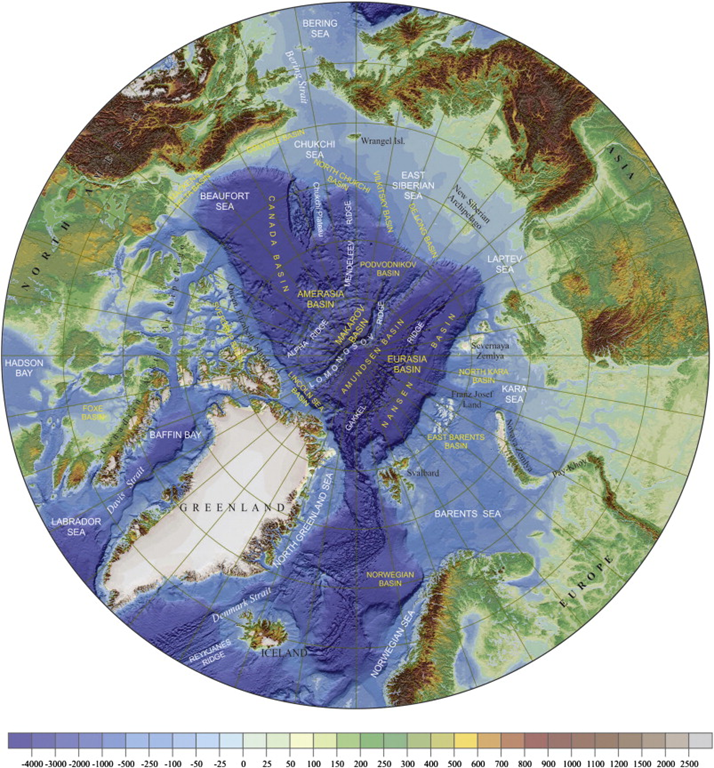
Topography-and-bathymetry-map-of-the-Arctic-region-at-15M-scale-in-a-polar-stereographic

Speed winter climb of one for the hardest routes of Mt Damavand (5610m) in Iran. From Dubai Marina to the summit in 32h

This challenge was in my to-do list since I spotted this beautiful volcano in my first visit to Iran on December 2011, when I attempted a winter climb of Pasand Kooh in Alborz range.

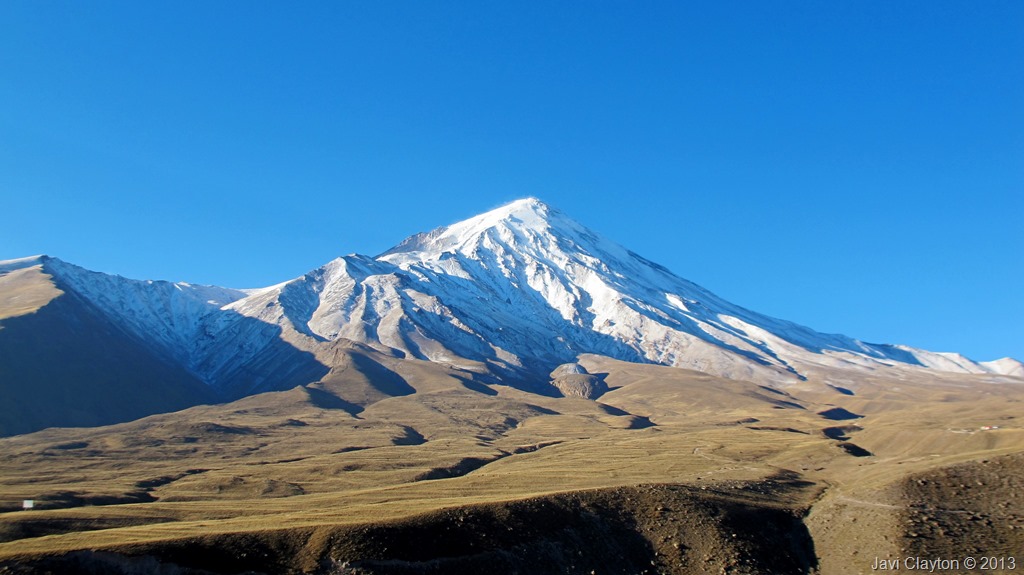
On October 23rd 2012 late in the evening, I left my house in Dubai to attempt a crazy winter climb of the highest mountain in the Middle East and biggest volcano in the North Hemisphere, Mt Damavand (5610m). 32 hours after that I was standing totally exhausted on the top of the frozen crater surrounded by volcanic fumaroles. I did my first volcano on 2010 (Mt Rainier, the biggest in North America), and since then I’m officially addicted to the sulfuric acid. This new challenge was a bit crazier, since I’m was doing a winter climb (2013 season already started) on the second hardest route in a country that is going a bit mad these days (thanks to certain westerner governments). It normally takes 4-6 days to safely complete this climb from Teheran, but I aimed to do it in only 3.

The first challenge on this adventure was to get a Visa on my arrival to Teheran. Right after that, with almost no sleep, I was driving out of the airport with Salim, a Teherani who knows the Mountain very well. We drove for about 4 hours to Nandal village (2400m) where we had some cheese, bread and tea, and sorted out our gear before starting our approach in a shabby 4×4 vehicle to Gusfandsara, and 5 hours climb to or first camp at Takhte Fereydoon hut (4300m). From Dubai Marina to there in just one day. On the following day, Thursday 24th, we did our summit push and descent back to the hut to celebrate and sleep before heading back to Nandal and Teheran in the afternoon.

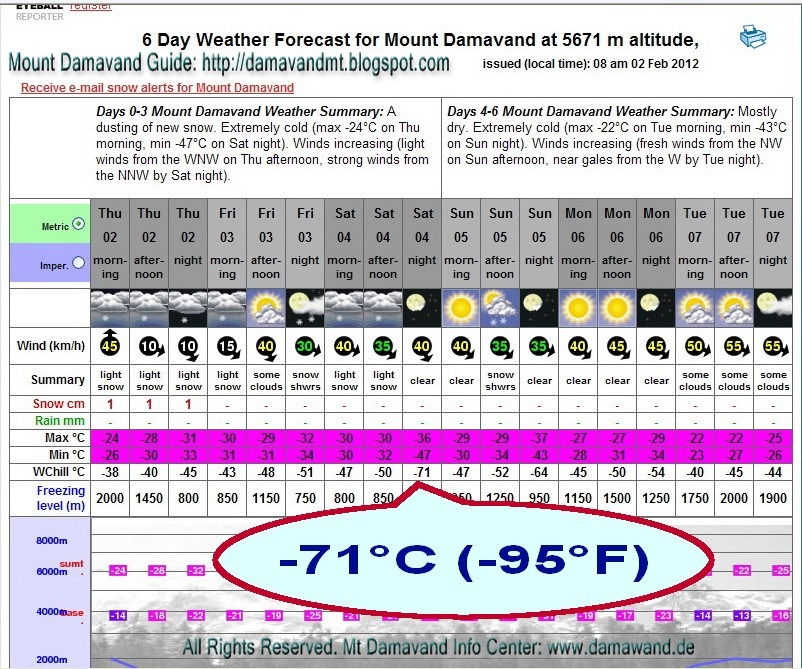
What it makes this challenge somehow special is the difficulty of the ascent on a winter climb. The winter season in Alborz Range may start from October to November and last to May and April. In this period of the year climbing Mt Damavand is a tough and dangerous business. With strong winds more than 100km/h and freezing temperature below -70°C (-94 Fahrenheit), winter ascent is graded as very difficult. Damavand Weather can change from very cold to disastrous in winter, and moving fast without missing the route is a key point for success.

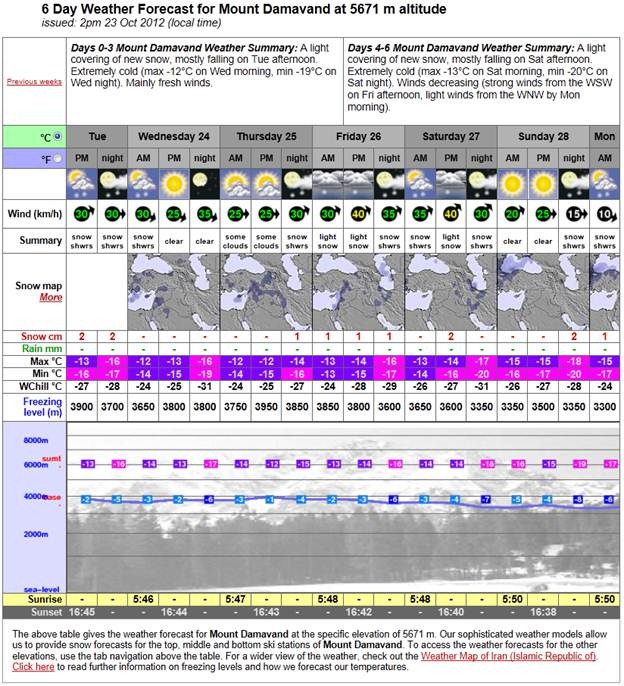
The day before leaving Dubai, the weather forecast looked quite frightening with temperatures ranging from -12C to -16C (thermal sensation -27C) at the top on the summit day, -6C to -10C (thermal sensation -20C) at the hut. Light snow was expected to fall from Friday, so I had to cope well with the altitude not to delay the summit push.

North-East route is a popular summer route. It goes through the North-East ridge that is called Takht-e-Fereydun. That name comes from mytghological story of Zahhak and Fereydun. There is a hut in this route at the altitude of 4300m. We planned to spend one night in the hut although we had the option to spend two nights there for acclimatization.  From then we progress up on the North-East glacier with a fantastic view of the valley and Yakhar glacier right beside this route.

IMG_0473


This what we planned to do, considering the limited timeframe and the restrictions set by weather and acclimatization:

  • Day 1 (Wednesday 24th): Arriving to IKA Airport (Tehran Imam Khomeini International Airport) at 2:30am. Drive from Tehran to Nandal village (2400m) in northern downhills of Mt Damavand. Overnight in a local house. 4×4 drive from Nandal to Gusfandsara. Climb to Takhte Fereydoon hut (4300m)
  • Day 2 (Thursday 25th): Acclimatization and summit push from North-East route. Descent and overnight at Takhte Fereydoon hut
  • Day 5 (Friday 26th): Trek down to Nandal village. Drive back to Tehran for rest and sightseeing.
  • Day 6 (Saturday 27th): Reserve day for bad weather condition or more acclimatization. Overnight flight back to Dubai on Sunday 00:15


Everything run as planned, with the exception of the few hours sleep at Nandal, that we had to skip due to the latest weather forecast that was showing very intimidating winds and snow from Thursday evening, so we had to move fast with no margin for a summit bid on Friday. We left the airport around 3:30am and drove all the way to Nandal village (2400m) where we arrived around 9:00.

IMG_0482


We had a light breakfast and moved fast on the 4×4 to our start point at Gusfandsara. That made the whole climb extraordinarily hard and also dangerous, since we were so exhausted when we arrived to Takhte Fereydoon hut (4300m) that we could barely prepare food and we hit the sleeping bag right away.

IMG_0508


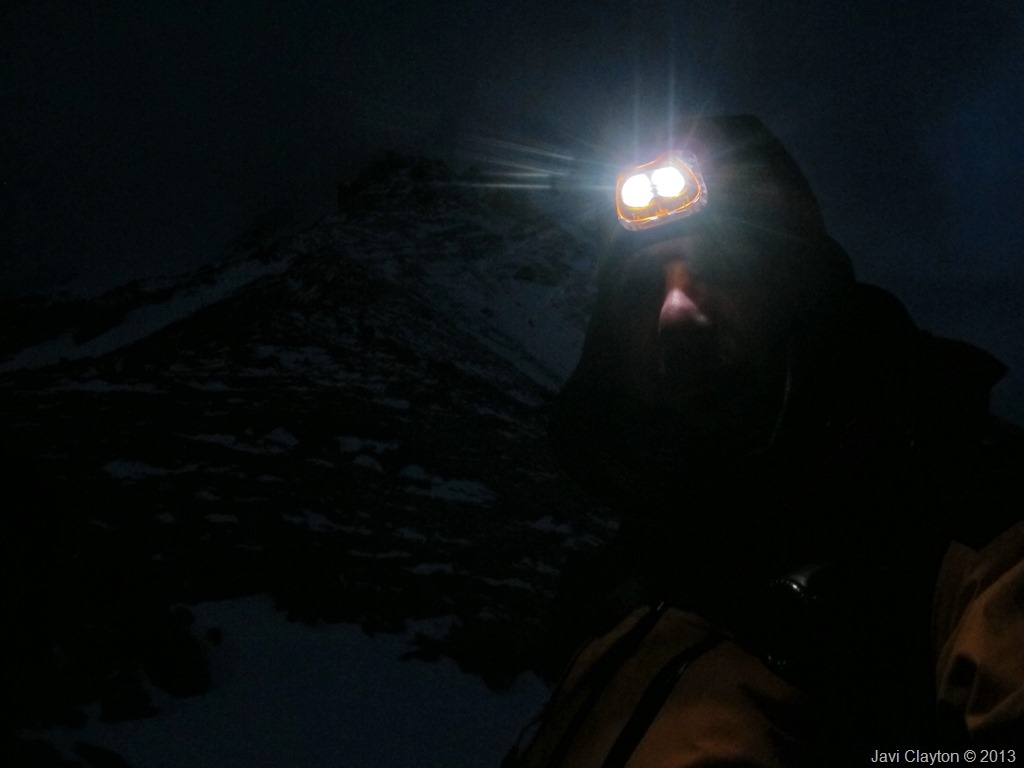
With no enough fuel the summit push on the following day ended up being the most exhausting thing I’ve ever done in my life.

IMG_0587


We descended with strong winds and reached the hut at night when the storm was already forming. That night seemed like the end of the world, with that wind hitting the hut so violently that I thought we’d never make it back to Nandal. We were incredibly exhausted after reaching our summit and we lacked of energy even to melt our drinking water. The altitude and exhausting causes your body to refuse any food intake. I was very worried about the conditions to make it back home safely.

IMG_0616


The following morning we woke up under a snow storm, but luckily the worst part happened the previous night while we were already sleeping in the comfort of the hut. I cannot even think on the consequences of not being able to find the hut last night. With no tent, and stoves that would have been fatal.

IMG_0623


That day I learnt how close we are from disaster if we are too ambitious and we push our limits a bit too far…

IMG_0658

Climbing a Volcano – Mt Damavand (5610m), Iran – Ready to go!!!

I’m now counting down the hours left before I leave to Dubai International Airport . Tonight around 2:30am I will be landing in Tehran Imam Khomeini International Airport from where my new extreme challenge will start. This challenge was in my to-do list since I spotted this beautiful volcano in my last visit to Iran on December 2011, when I attempted a winter climb of Pasand Kooh in Alborz range.

Today I’m leaving to Iran to attempt a crazy winter climb of the highest mountain in the Middle East and biggest volcano in the North Hemisphere, Mt Damavand (5610m). I did my first volcano last year (Mt Rainier, the biggest in North America), and since then I’m officially addicted to the sulfuric acid. This time I’m going a bit crazier since I’m doing a winter climb (2013 season already started) on the second hardest route in a country that is going a bit crazy these days (thanks to certain westerner governments). It normally takes 4-6 days but I’ll try to do it in only 3.

The first challenge on this adventure will be to get a Visa on my arrival to Teheran. Right after that, with almost no sleep, I’ll be driving with Salim, a Teherani who knows the Mountain very well, to Nandal village (2400m) where to have some rest before we start our approach on 4×4 vehicle to Gusfandsara, and 5 hours climb to or first camp at Takhte Fereydoon hut (4300m), all of these in just one day. On Thursday I’ll do my summit push and back to the hut to celebrate and sleep before I head back to Nandal and Teheran.

What it makes this climb somehow special is the difficulty of the ascent on a winter climb. The winter season may start from October to November and last to May and April. In this period climbing to Damavand summit is very tough and dangerous. Because of high wind speed and very low temperature, stormy weather conditions, too much snowfall, icy trails and other risks, winter ascend is graded as very difficult. Damavand Weather could change to disastrous in winter, with strong winds more than 100km/h and freezing temperature below -70°C (-94 Fahrenheit).

Right now the weather forecast looks quite frightening with temperatures ranging from -12C to -16C (thermal sensation -27C) at the top on the summit day, -6C to -10C (thermal sensation -20C) at the hut. There is light snow expected to fall from Friday so I have to cope well with the altitude not to delay the summit push.


clip_image002


North-East route is a popular summer route. It goes through the North-East ridge that is called Takht-e-Fereydun. That name comes from mytghological story of Zahhak and Fereydun. There is a hut in this route at the altitude of 4300m. We will spend one night in the hut although we can spend two nights there for acclimatization. Then we’ll go up on the North-East glacier with a fantastic view of steep valley of Yakhar glacier right beside this route.

This what we planned to do, considering the limited timeframe and the restrictions set but weather and acclimatization:

  • Day 1 (Wednesday 24th): Arriving to IKA Airport (Tehran Imam Khomeini International Airport) at 2:30am. Drive from Tehran to Nandal village (2400m) in northern downhills of Mt Damavand. Overnight in a local house. 4×4 drive from Nandal to Gusfandsara. Climb to Takhte Fereydoon hut (4300m)
  • Day 2 (Thursday 25th): Acclimatization and summit push from North-East route. Descent and overnight at Takhte Fereydoon hut
  • Day 5 (Friday 26th): Trek down to Nandal village. Drive back to Tehran for rest and sightseeing.
  • Day 6 (Saturday 27th): Reserve day for bad weather condition or more acclimatization. Overnight flight back to Dubai on Sunday 00:15


This is a nice North-East route description taken from Summitpost

PART 1 (From road to Takhte-Fereydoon shelter):

After Gazanak village, go from right side of TALKHAAB river in gardens. After one hour you see a spring in gardens. You must take water. This point in the end of gardens .Then you must walk 2 hours and see a little garden and its spring. (This point is the best point for camping in winter) Then you must go forward (from right side of river) and see the last spring. This spring is named Pehen-Kooh spring. This is the last water in north-east route. In this point you see all of the remainder route and main peak of Damavand. From this point you must climb hardly. You can better eat lunch and rest little here and take water. Then you must turn to right on climb from right domain. Now you go up far from the river and bottom of valley. You must climb about 2 hours, so you see a very little spring in grade, you can rest here a few minutes and then go up to a rocky peak. Its name is Menaar peak (Menaareh, 3950m). Before the rocks, you must climb zigzag from a yellow and hard sandy way. Next you must go to round the rocks from left and go up from moraine (stones). When you reach top you will be at top line (4000m). Now turn left on and climb to shelter. After 1.5 hours you reach shelter. Its name is TAKHT-E-FEREYDOON shelter. This shelter in 4500m is solitary shelter in this route. From Haraz road to this shelter takes about 11 hours climbing. Now you are tried. The weather is cold and windy all times. You can rest to next day. If you have not water, you can bring ice from a glacier back of shelter. This shelter was made by students of Tehran University 1978 in commemoration of their friends.

PART 2 (From Takhte-Fereydoon shelter to Damavand peak):

Next day you can stay here to harmony or climb to peak. After shelter the way is clear. First you climb a hill, then climb from a rocky way to top. After this rocks you see another rocks right hand to top. After rocks you must go from a way just top of deep canyon. This canyon is Darre-ye-Yakhaar. It is a glacier canyon. Your way is safe and you like to climb and see beautiful mountain. Here is above 5100m. So you climb from signs and way turn to right. You reach a glacier in grade. You must go across the glacier carefully. This glacier is named Aroosak-haa glacier. Climb and be careful. You smell sulphur and you are at 5500m. Then you see a big glacier named Do-bisel glacier. You must go across it very carefully. Now you are in North route of Damavand peak and near to peak. You climb slowly but after some minutes you will be at top of Damavand peak. From Takhte-Fereydoon shelter to top of peak is about 3.5 ~ 4 hours. You must photograph and return fast because sulphur is dangerous. Also weather is not stable. In return be careful, because two glaciers is in front of you. Also if you mistake in return way, you must go down from North route to other way. Be careful and follow your footprints on glaciers and see the signs .You must reach to Takhte-Fereydoon shelter and rest this night.

PART 3 (Return from Damavand mount):

You must wake up and eat breakfast and return to down, from shelter to village. If you want to return from same route, you can put your backpack in shelter and take a little backpack and climb to peak, but if you want to return from another route to down, you must carry your gears to top of peak and return from any route from top of Damavand peak to down.

If you want to climb in WINTER , BE CAREFUL ! It’s very difficulty and dangerous


This is all for now, I will keep my FB and Blog site updated with my position and progress by using GSM networks and a satellite device. Please subscribe to my blog for updates on my adventures and send me positive energy and oxygen from the distance. I’ll be thinking on all of you from there and send you love and good wishes from the top… inshallah!

Mt Damavand – Winter Climbing

The winter season may start from October to November and last to May and April. In this period climbing to Damavand summit is very tough and dangerous. Because of high wind speed and very low temperature, stormy weather conditions, too much snowfall, icy trails and other risks, winter ascend is graded as very difficult. The ski and snowboard season is from December to mid-May, the best ski months are March & April.

Weather condition in mount Damavand is harsh and severe in winter time. Since the end of October we expect snow fall in high altitudes, which means the condition is considered like winter. The temperature stays sub-zero till next June far up in Damavand.

The south route of Damavand is the easiest route to access during winter. This route is not technically difficult, but still challenging in extreme conditions of very high altitude. Indeed, those people who have previous experience of winter mountaineering and are physically fit have more chance to reach to the summit, while the stable weather condition is an important factor, too.

Damavand Weather could change to disastrous in winter, with strong winds more than 100km/h and freezing temperature below -70°C (-94 Fahrenheit). You must be well-experienced for such a difficult climb or ski mountaineering expeditions in harsh climate. Furthermore remember that rescue and medical facilities are not available in case of injury and emergency, so extra care should be taken for winter climbing and ski touring and it is done by your own risk.

The weather has caused more deaths than any other factor besides bad judgment by climbers. Some climbers appear to rely on weather forecast reports or none at all, but one should note they are forecasts too, and one day their forecast will probably be wrong.

Reinhold Messner

In 1970 when Reinhold Messner attempted a winter climb to Mt Damavand Iran, due to adverse weather conditions failed, because he realized that despite a lack of technical difficulties, is not an easy mountain climbing, but a large and highly conditional alpine challenge.


Weather

http://www.snow-forecast.com/resorts/Damavand/6day/top

http://www.snow-forecast.com/resorts/Damavand/6day/mid

http://www.snow-forecast.com/resorts/Damavand/6day/bot

http://freemeteo.com/default.asp?fid=820323_20120909_190822&isSite=1&hitDNS=www%2Edamawand%2Ede&pid=15&un=1&la=1&gid=138041


Temp-Minus71degC-4Feb2012-Damavand

Wind-Speed-110Km-15March2012-Damavand

Mt Damavand – Climbing Routes

There are at least 16 known routes to the summit which have different difficulties. Some of them are very dangerous and require rock climbing. Three routes are popular with climbers: North, South and North-East faces which are adjacent to villages and all have shelters/huts in midcourse. The most popular route is the Southern Route which has step stamps and also a camp midway called Bargah Sevom Camp/Shelter at 4220m (about 13,845 ft). Damavand is often subject to intense west winds and experiences cold winters, so climbing in this season has always been challenging for domestic as well as foreign climbers. The best major settlement for mountain climbers is the new Iranian Mountain Federation Camp in Polour village, located on the south of the mountain.

The longest route is the Northeastern and it takes two whole days to reach the summit starting from downhill village of Nāndal and a night stay at Takht-e Fereydoun (elevation 4300 m – about 13,000 ft), a two-story shelter. The western route is famous for its sunset view. Sīmorgh shelter in this route at 4100 m (about 13,500 ft) is a newly constructed shelter with two stories. There is a frozen waterfall/Icefall (Persian name Ābshār Yakhī) about 12m tall and the elevation of 5100m is the highest fall in Iran and Middle East. The North face has an extra shelter at 5000m.

South Route: It is easily accessible from Tehran or North of Iran, the short distance from Tehran to the Haraz main road make southern approach the best trail. This is by far the easiest and the best side, and the ascent to the summit by this way is also shorter. Route type is basic mountaineering, with difficulty and climbing grade moderate, walk-up and easy descend.

North East Route: Route type is mountaineering, with difficulty long and hard ascend with cold and wind and long descend. It has a shelter called Takht e Fereydoun at about 4500m. The refuge is called Panagah Simorgh in Persian.

West Route: West route type is basic mountaineering, with difficulty and climbing grade moderate walk-up, basic snow and cold and difficult descend. There is a refuge at 4200 m called Simorgh Camp. The shelter is called Panagah Simorgh in Farsi. Simorgh means Roc, a gigantic legendary bird said to carry off elephants and other large beasts for food. It is mentioned in the famous collection of Iranian tales.

North Route: The north face is the most difficult side of Mt Damavand with difficulty and climbing grade scramble mountaineering, steep, hard ascend, depending on season, cold and windy, snow & ice, difficult descend. It has two shelters called 4000 and 5000.

  Most climbers who have managed to climb to the summit from West, North East, or North Face prefer to descent from south face because of its easy descend footpaths


Climbing Grade in Different Systems

Please note that these grades are Mount Damavand Guide opinion only, there are usually differences between grading in different climbing routes. Regardless of the system used, all grades are an approximation.

  • Difficulty: F, YDS class 2 (and sulphur gas above 5400 m)
  • UIAA: II
  • USA: 5.3
  • Australia: 11
  • France: 2
  • YDS Grade: Grade V, two day climb Classes 2 and 3
  • Adjectival grade: Moderate (M, or “Mod”)
  • French Alpine: PD: peu difficile (not very difficult)
  • New Zealand: Grade 1, Easy scramble. Use of rope generally only for glacier travel.
  • Alaska Grade: Grade 2 Either a moderate fifth-class one-day climb, or a straightforward multiday nontechnical climb


Summit

Mt Damavand shape is conic like many other volcanos, it looks like Fujiyama in Japan, but much greater, with the altitude 5671 meters and a crater diameter approx 200 to 400m across and 30m deep, the crater has a permanent glacier which melts in hot summers and forms a small pool with little water. There is no shelter or refuge at the top, in case you want to challenge 7000 m or higher altitude you can make you own tent for acclimatization somewhere safe and away from sulfuric gases in or around the crater.

The summit is made of lots of yellow sulfurous rocks and pumice stones, usually covered by ice and snow. This stratovolcano has some sign of volcanic activity at the top, a big vent was formed in 2007 just below the crater with high fumarolic activity, through which hot sulphurous gases emerge, releasing a significant amount of smoke and hot sulphuric gases.


Mt Damavand Glaciers

There are some major glaciers on Mt Damavand, these huge mass accumulation of snow and ice are formed during ages and are the main source of water for Talkh Roud River and the Lar Dam Lake, one of the main reservoir of fresh water for capital city of Tehran. These glaciers are mostly located on east and north face. It appears that some of these glaciers cannot qualify as a true permanent glacier because they may disappears during a very hot and dry summer.

The most important glaciers are:

East and North East Face Glaciers:

  • In the enormous Yakhar Valley in the east side of this volcano there is large glacier called Yakhar which is the most well-known and the biggest glacier of the mountain, it starts from about 3500 meters high to just below the summit, it has was climbed many times in summer but not in the winter. This glacier is the main source for Talkhrood River, ending in Caspian Sea.
  • Chalchal Glacier and Arosakha, are other significant glaciers located on these sides.

North Face Glaciers

  • Two large glaciers are located on the north face, called Dobi Sel and Sioleh, the north route ridge passes between these two glaciers, which makes this route colder compared to the other routes.

South Face Glacier

  • There is a small glacier on the south face in Kafar Valley (Kafar Dareh), called South Glacier or Kafar Dareh Glacier. It’s situated between south route ridge and Mollakhoron Ridge, it passes by Damavand Icefall.

West Face Glaciers

  • There are some small and none important glaciers on the west side which do not have particular names.

Summit Glacier

  • There is a small glacier on the volcano crater, called summit glacier, mostly frozen, but in a hot summer you may see a little water in the crater.


Warning

Just near the summit and under the crater, at the junction where south and east climbing routes join together, a big new vent was formed in 2007, which is still exhaling a great amount of smoke and hot sulfuric gases and steam with pestiferous smell, this makes some problem for climbing. Without adequate equipment such as oxygen mask, it is quite dangerous to go close to this vent, because if the wind changes its direction, you could get caught in the sulfuric poison gas.


f_1242853709_DAMAVAND%20MAP2

The Middle East Roof

Damavand is the highest mountain peak in Iran located almost in the center of Alborz mountain range. Damavand is higher than all west Asian & European mountain peaks. Damavand peak is situated in Larijan district, Mazandaran Province, midway the Haraz Road, southwest of Amol City and 69 Kilometers northeast of Tehran. Damavand is an inactive volcanic mountain, always covered with snow. It looks like Fujiyama in Japan but much greater. Its snowy white top with its regular clouds is the most beautiful sight of Iran. There are no records of the last eruption, but there’s hot steam & sulfur gases coming out at the top. Damavand contains about 70 volcanic mouths and one of them is filled with a thick sulfur crest producing a beautiful conical peak with a diameter of some 400 meters. There are some hot springs on its lower slopes like Larijan village. At the summit there is a crater about 150-200 meters across, with a lot of yellow sulfurous rocks and pumice stones. Snow covers the crater and upper slopes in winter, spring and autumn. Because of its great height, the view from top is very extensive, a big panorama of mountains and valley covering many hundreds of square Kilometers. All around are other peaks of the Alborz Mountain Range, in the north to the Caspian Sea, and in the south descending to the deserts of central Iran. When the sky is clear and sunny, Damavand can be seen not only from Tehran but other cities such as Amol, Sari, Qom, Kashan, up 250km far.

The altitude of Damavand Volcano is 5671 meters (18605 feet), it is the highest summit in the Middle East and the second highest volcano in all Asia and the Northen Hemisphere. The highest volcano in Asia is Kunlun Volcano 7167 m (23514 feet) in Tibet.

General Facts

  • Distance from Tehran by road: 80km
  • Attitude: 5671 meters, 18605 feet
  • Prominence: 4667 meters, 15312 feet
  • Latitude: 35° 57′ 19″ N
  • Longitude: 52° 06′ 36″ E

Other Names and Spellings

  • English: Mount or Volcano Damavand, Damawand, Demavand, Demavend, Donbavand, Damāvand.
  • Farsi/Persian: Koh e Damavand alternate Dood koh, Koh Damawand, Qolleh Damāvand. Donbalvand, Dive Sepid, Koh e Ghaf.

First ascents

  • 905 by Abu Dolaf Kazraji
  • The first successful European ascent to the summit happened in 1837 by Tiller Thomson, and the first national ascent was recorded in 1857 by colonel Mohammad Sadeghkhan Gajar ‘s team.


Volcanic Activity

At present volcanic activity is manifested only in the presence of warm and thermal springs with therapeutic qualities which have formed travertine deposits and remain very popular. These mineral hot springs are mainly located on the volcano’s flanks and at the base, giving evidence of volcanic heat comparatively near the surface of the earth. While no historic eruptions have been recorded, hot springs at the base and on the flanks, and fumaroles and solfatara near the summit, indicate a hot or cooling magma body still present beneath the volcano, so that Damavand is a potentially active volcano. The most important of these hot springs are located in Larijan village in the district of Larijan in Lar Valley. The water from this spring is useful in the treatment of chronic wounds and skin diseases. Near these springs there are public baths with small pools for public use.

Since spring 2007, there have been some extraordinary activities such as significant emission of gas, steam, sulfurous materials and increase in hot spring temperature. There has been some news and rumors on the media about Mt Damavand new volcanic activity in 2012, these unverified information is widely spread by radio, tv and internet.  There was a reasonable amount of rain and snow fall in winter 2011 on Mt Damavand area. This usually increases the amount of gas emission from the vents in the in following year, also it may increase the hot water temperatures at the flank of southern thermal springs in 2012. Similar events were experienced in winter 2006 (rain/snow fall) and consequently some more volcanic activities in 2007.


Mythology and folklore

Damavand has, as any cursory reading of Persian literature will indicate, a special place in the Persian mythology and folklore. The popular traditions of the villages around the mountain are filled with legends and superstitions of which traces can be found in place names, as in the upper valley of the Lar, where a small ravine sprinkled with marshes, warm springs, and geysers is named Div Asiab (the devil’s mill).

Damavand is the symbol of Iranian resistance against foreign rule in Persian poetry and literature. In Zoroastrian texts and mythology, the three-headed dragon Azi Dahaka was chained within Mount Damavand, there to remain until the end of the world. In a later version of the same legend, the tyrant Zahhak was also chained in a cave somewhere in mount Damavand after being defeated by Kaveh and Fereydoon. The mountain was also the scene of an episode in the story of Rostam and Esfandiar. Damavand is also significant to the Iranian legend of the heroic Iranian archer Arash Kamangir and a suspected root for Tiregan Festival.


This slideshow requires JavaScript.