Arctic Mountaineering Expedition to Liverpool Land in Greenland: Testing SPOT updates
Unlimited Potential, Up to 8000m
"Success isn’t a result of spontaneous combustion. You must set yourself on fire…"
ICEMAN Arctic Adventure Race & Mountaineering Expedition to Liverpool Land in Greenland
Expedition Logistics – My Gear List
Personal gear
- Expedition Rucksack / Kit Bag
- Small Day Sack
- Waterproof bags / Plastic Zip Bags
- Waterproof Documents Bag / Holder
- Tent
- Tent Mini-Thermometer
- Snow Pegs (14 per tent)
- 2mm Foam Tent Floor Insulation
- Foam Sleeping Mattress (layer 1)
- Inflatable Mattress (layer 2)
- Repair Kit for Inflatable Mattress
- Sleeping Bag
- Inflatable seat / pillow
- Eye shield / Ear Plugs
- Glacier Glasses (100% uva/uvb)
- Snow Goggles (100% uva/uvb)
- Sun Hat
- Normal Set Of Clothes
- Thin Thermal Liner Socks
- Thick Ski / Mountain Socks
- Sports / Thermal Underwear
- Thin Thermal Trouser Underwear
- Thin Thermal Shirt Underwear
- Warm / Fleece Salopettes
- Mid Layer Thermal Fleece / Shirt
- Outer Layer Thermal Fleece
- Windproof Breathable Salopettes
- Insulated Down Jacket
- Windproof/Waterproof Outer Shell Jacket
- Thin Thermal Liner Gloves
- Windproof Ski / Fleece Gloves
- Expedition Mittens / Gloves
- Full Face Balaclava
- Warm / Fleece Hat
- Mountaineering Boots
- Hiking Boots
- Sorel extreme winter snow boots
- Spare Boot Laces
- 1 litre Metal Thermos Flask
- Water Bottle (+ insulation)
- Food Bowl
- Insulated Drinking Mug / Cup
- Spoon & Knife
- Total Sun Block
- Lip Cream
- Nivea / Vaseline
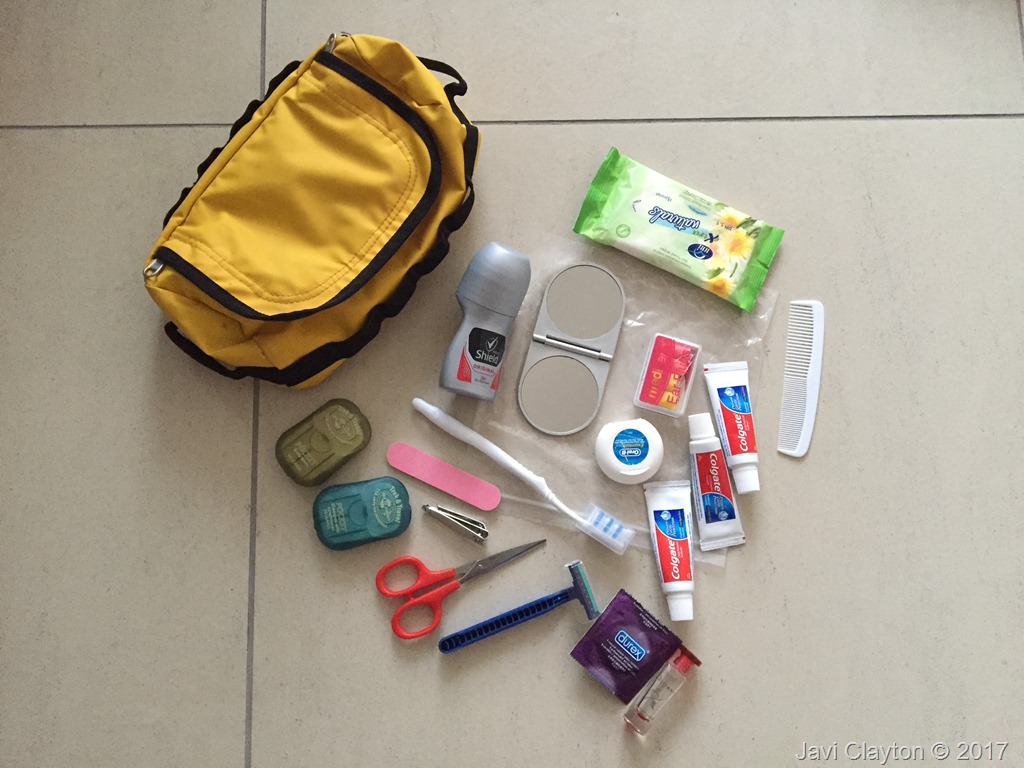
- Toothbrush / Toothpaste / Comb
- Mini Pack Towel
- Baby Wipes / Cleansing Tissues
- Razor
- Pee Bottle
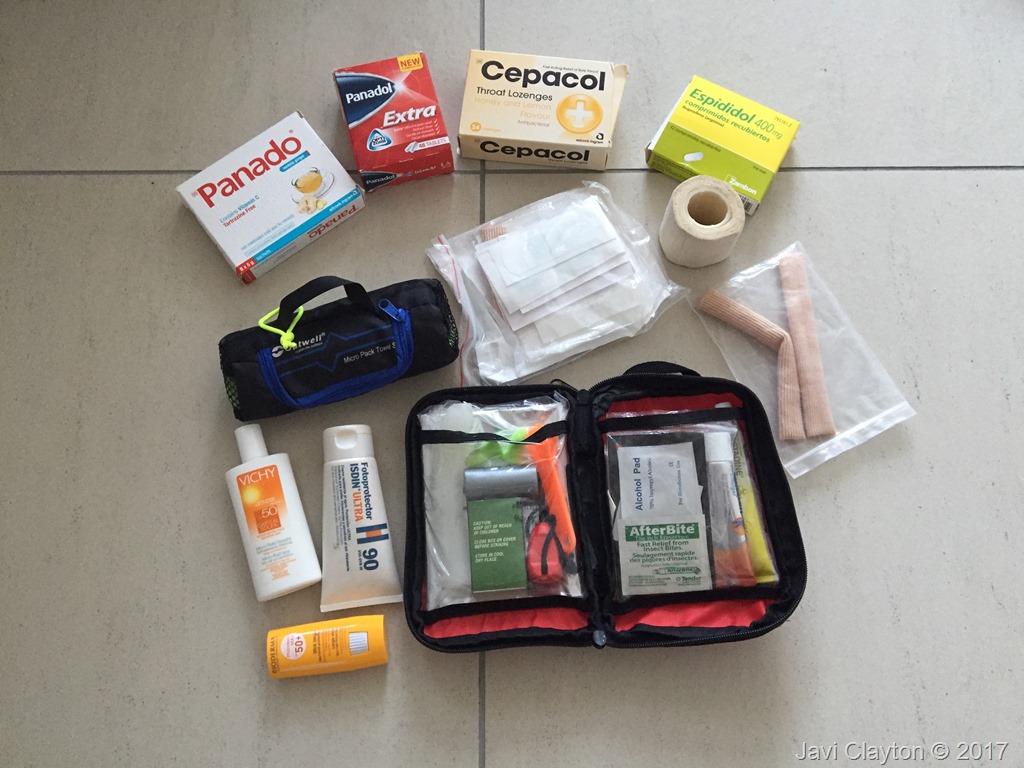
- Personal First Aid Kit
Technical gear
- Knife / Multi-tool
- Ice Axe
- Ice Hammer
- Crampons
- Harness
- Avalanche Probe
- Avalanche Transceiver
- Screw Gate Karabiners (personal) x5
- Karabiners
- Dyneema slings
- Ice Screws
- Pulleys
- Petzl Tibloc
- Prussiks
- Helmet
- Skis / Poles / Bindings / Boots
- Ski Bag
- Skins (with tip/tail fixes) or Short (kicker) Skins
- Glide Wax
- Skin Glue and Applicator
- Full Set Of Ski & Binding Spares
Electronics
- Altimeter Watch
- Topographic maps
- Compass
- Small Binoculars
- GPS
- GPS Batteries
- SPOT
- SPOT Batteries
- Cameras / Gopro/ Spare Batteries
- Headlampd x2
- Headlampd batteries
- USB data / charging cables
- Solar Panel
Accessories
- Passport
- Flight Vouchers
- Insurance Documents
- Currency
- Credit Card
- Diary / Pen / Note Book / Books
- Leatherman multi-tool knife
- Waterproof matches and candle
- Zip ties
- Whistle


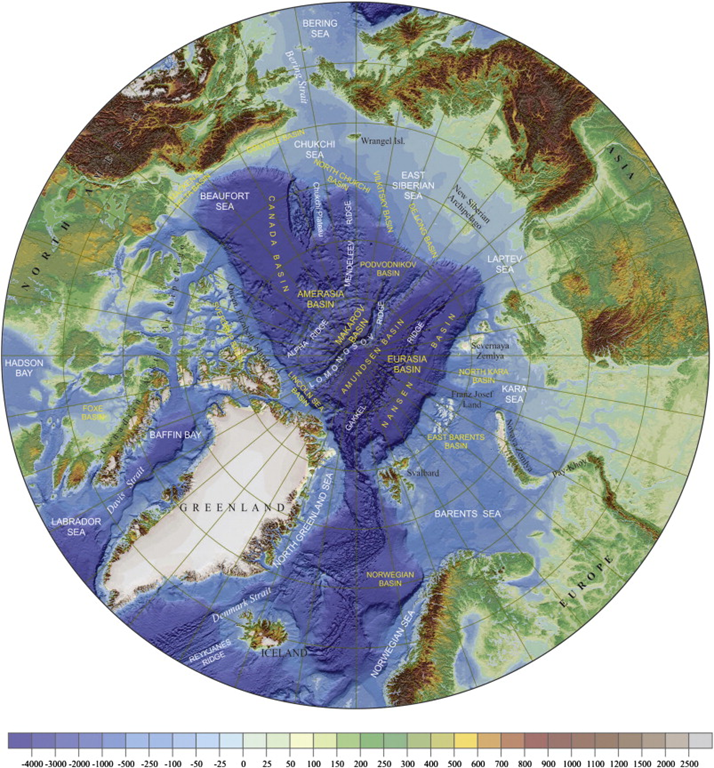
Competing in the ICEMAN Polar Challenge, the ultimate Arctic Adventure Race!
ICEMAN Arctic Adventure Race followed by Mountaineering Expedition to Liverpool Land in Greenland.
What is the best way to practice everything learnt in a Polar Training? Competing in the ICEMAN Polar Challenge, the ultimate Arctic Adventure Race!

Bordering the world’s largest frozen fjord and biggest National Park, the race route traces on of the most stunningly remote regions of the high arctic. Hurry Fjord, the spectacular Liverpool Land mountains and Greenland’s most isolated village, Ittoqqortoormiit form the backdrop to the latest in extreme adventure racing.
The emphasis on this three weeks expedition will be on gaining good all round winter Arctic and polar experience and learning to operate safely whilst ski touring and pulk sledge hauling. The initial Polar Training and Adventure Race will involve fantastic opportunities to travel on a variety of terrain including frozen fjords, icecaps, glaciers, valleys and sea ice. A small and dedicated team will pull pulks throughout the ICEMAN Arctic Adventure Race route and be camping in full snow and winter conditions.
Competitors will endure challenging sub-zero temperatures and test their skill, commitment and resilience on this multi-day adventure. This is the world’s toughest Arctic mountain ski race. Beautiful, tough and absolutely unforgettable.
Once the training and race are completed on the first week, a small and dedicated team will depart from Constable Point by snowmobile with an aim to establish base camp in the Sødal valley where easy access can be gained on to the Bjering Pedersens icecap. This high icecap offers access to numerous peaks with unparalleled views of other alpine summits, glaciers and the ice berg studded east coast. Camping will be in full snow and winter conditions throughout for the remaining of the three week’s expedition.
The beauty of the area is that there isn’t any climbing history, guidebooks or detailed maps. It’s true exploratory mountaineering in its purest form. The more obvious summits have been climbed, but only by their easiest routes, so anything other than that will be a first ascent. There are hundreds of routes in the region, so plenty to go at! We’ll probably want to climb the high peak of Korsbjerg as well.
ARTIC MOUNTAINEERING EXPEDITION – 1 month to go!
Polar Training for prospective North & South Pole expeditions and Greenland Icecap crossings, followed by Arctic Mountaineering expedition to Liverpool Land.
The “climbing” icons represent potential targets for first winter climbs of virgin peaks or with very few repetitions.
The “tent” icons represent potential locations to set up camps for drop off and pick up in the glaciers, as well as a high camp in the Bjerring Pedersens icecap which will be crossed during our exploratory search for alpine peaks and virgin summits
The emphasis on this Polar Training will be on gaining good all round winter Arctic and polar experience and learning to operate safely whilst ski touring and pulk sledge hauling. The course will involve fantastic opportunities to travel on a variety of terrain including frozen fjords, icecaps, glaciers, valleys and sea ice. The small and dedicated team will pull pulks throughout the expedition and be camping in full snow and winter conditions, following Iceman Polar Race.
Once the training is completed on the first week, a small and dedicated team will depart from Constable Point by snowmobile with an aim to establish base camp in the Sødal valley where easy access can be gained on to the Bjering Pedersens icecap. This high icecap offers access to numerous peaks with unparalleled views of other alpine summits, glaciers and the ice berg studded east coast. Camping will be in full snow and winter conditions throughout for the remaining of the three week’s expedition.
The beauty of the area is that there isn’t any climbing history, guidebooks or detailed maps. It’s true exploratory mountaineering in its purest form. The more obvious summits have been climbed, but only by their easiest routes, so anything other than that will be a first ascent. There are hundreds of routes in the region, so plenty to go at! We’ll probably want to climb the high peak of Korsbjerg as well.

Artic Mountaineering and Bolivian Peaks: 2 months to go!
It´s been a long time since I set off for my last mountaineering challenge, 12Km in 12Days, back in July 2014… Today marks the countdown for a new double challenge starting in the Artic and finishing in Bolivia.
Exactly two months from today, I’ll set off to Reykjavik from my second home in Madrid. From there I’ll transfer to Akureyri in Iceland, where I’ll meet my expedition leader and partners before we board a small airplane that will take us to our Artic playground: The Liverpool Land peninsula in eastern GREENLAND! One week of Polar Training for prospective North & South Pole expeditions and Greenland Icecap crossings, followed by two week’s Arctic Mountaineering expedition in Liverpool Land. Our aim is to stablish base camp in the Sødal valley where easy access can be gained on to the Bjering Pedersens icecap. This high icecap offers access to numerous peaks with unparalleled views of other alpine summits, glaciers and the ice berg studded east coast, and offers the opportunity for rare ski and mountaineering ascents of remote arctic summits in this amazing and rarely visited region of the High Arctic. We are looking to climb some virgin peaks, as well as opening new routes in classics such as Tvillingerne or Korsbjerg.
Two months later I’ll be conquering some of the most spectacular peaks in Cordillera Real in Bolivia, home to more than 600 peaks over 5000m. My plan is to conquer 6 peaks in 12 days. My 12km in 12Days challenge in 2014 was an unforgettable experience, where I met my friend Walter George, AGMP/UIAGM Mountain Guide in Peru, and we aimed to climb two 6000m peaks in twelve days. This year we are aiming to climb CERRO AUSTRIA, PIRAMIDE BLANCA, PEQUEÑO ALPAMAYO, CABEZA DE CONDOR, HUAYNA POTOSI, and the jewel crown ILLIMANY! All six peaks ranging from 5320m to 6438m, just in twelve days.
I’ve been quite busy working out all logistics and setting up an ambitious training plan, considering I’ve been in the dry docks for about two years now. Today the start of my training plan kicks off, and I’ll be posting some interesting stuff in my Facebook page and blog, for those friends interested on learning more about mountaineering and how to train for challenges in the Artic, Bolivia, or anywhere else in this wonderful planet we call HOME.
“Success is the point where preparation meets opportunity” – Everest Expedition from Tibet side 2013 – Presentation
Are you planning to climb big mountains? Is Sagamartha your ultimate goal? Do you watch all those climbing movies, read all the Everest books, and you want to ask questions and learn more?
Join Javi Clayton and Sports in Life in this presentation of a five years journey preparing to reach The Top of the World.
Preparing to climb big eight-thousanders requires experience and commitment and is a life experience that change us adventures and mountaineers for the rest of our lives. On this presentation hosted by Sports in Life in their showroom in Dubai, we are going to discuss the concepts of Success, Preparation and Opportunity. Talking about how to set clear and realistic goals, walking around the problems while taking the right decisions…
Is the Everest North Route suitable for the Rookies? We are going to have an open session to discuss the differences between the two most popular climbing routes in Everest, looking at facts and figures, and trying to get an insight on a total different experience climbing from two different sides of a mountain range separating the plains of the Indian subcontinent from the Tibetan Plateau.
We want to make the session educative and having all attendees to learn and share their knowledge. Building a community of mountaineers in Dubai is still a challenge, and we hope to host a large group of Mountain Junkies in UAE, and start to working together on bringing awareness on this “sport”, inspiring the local community and youth to reach the most beautiful and extreme places in our Mother Earth.
Everest climber Javi Clayton will walk the audience through the following topics
- Expedition logistics
- Training in Dubai (by International Sport Expertise)
- You are what you eat
- Training mind and body (by Angelica Wellness Coach)
- Gearing up for Everest
- Technology over 7000m
- The high altitude aid kit
- Processing, disinfecting and transporting water
- The challenge of exercising and staying hydrated under extreme weather and high altitude conditions
- New challenges… Greenland WindSled project 2014
For more details visit my FB page

Men’s Fitness interview on July’s issue–The Climber

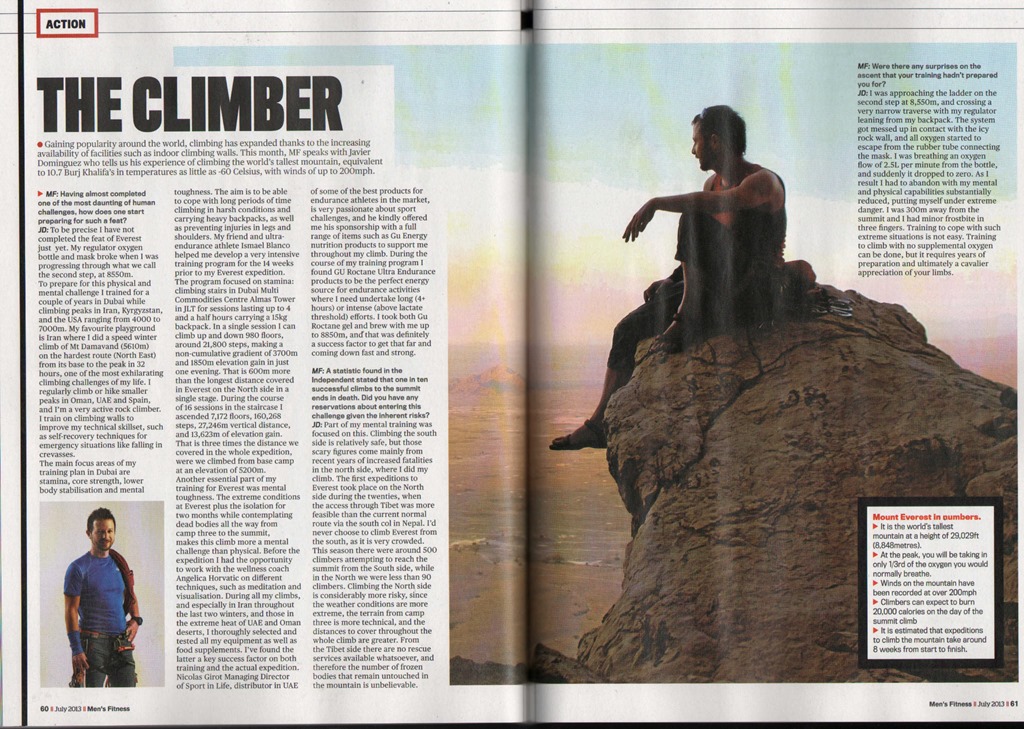
Gaining popularity around the world, climbing has expanded thanks to the increasing availability of facilities such as indoor climbing walls. This month, MF speaks with Javier Dominguez who tells us his experience of climbing the world’s tallest mountain, equivalent to 10.7 Burj Khalifas in temperatures as little as -60 Celsius, with winds of up to 200mph.
Having almost completed one of the most daunting of human challenges, how does one start preparing for such a feat?
To be precise I have not completed the feat of Everest just yet… my regulator oxygen bottle and mask broke when I was progressing through what we call the 2nd Step, at 8550m.
To prepare for this physical and mental challenge I trained for couple of years in Dubai while climbing peaks in Iran, Kyrgyzstan, and USA ranging from 4000 to 7000m. My favorite playground is Iran where I did a speed winter climb of Mt Damavand (5610m) on the hardest route (North East) from my doorstep in Dubai to the summit in 32 hours, one of the most exhilarating climbing challenges of my life. I regularly climb or hike smaller peaks in Oman, UAE and Spain, and I’m a very active rock climber. I train on climbing walls to improve my technical skillset, such as self-recovery techniques for emergency situations like falling in crevasses.
The main focus areas of my training plan in Dubai are stamina, core strength, lower body stabilisation and mental toughness. The aim is to be able to cope with long periods of time climbing in harsh conditions and carrying heavy backpacks, as well as preventing injuries in legs and shoulders. My friend and ultra-endurance athlete Ismael Blanco helped me develop a very intensive training program for the 14 weeks prior to my Everest expedition. The program focused on stamina: climbing stairs in DMCC Almas Tower in JLT for sessions lasting up to 4 and a half hours carrying a 15kg backpack. In a single session I can climb up and down 980 floors, around 21,800 steps, making a non-cumulative gradient of 3700m and 1850m elevation gain in just one evening. That is 600m more than the longest distance covered in Everest on the North side in a single stage. During the course of 16 sessions in the staircase I ascended 7,172 floors, 160,268 steps, 27,246m vertical distance, and 13,623m of elevation gain. That is three times the distance we covered in the whole expedition, were we climbed from Base Camp at an elevation of 5200m.
Another essential part of my training for Everest was mental toughness. The extreme conditions at Everest plus the isolation for two months while contemplating dead bodies all the way from Camp 3 to the summit, makes this climb more a mental challenge than physical. Before the expedition I had the opportunity to work with the wellness coach Angelica Horvatic on different techniques, such as meditation and visualisation.
During all my climbs, and especially in Iran throughout the last two winters, and those in the extreme heat of UAE and Oman deserts, I thoroughly selected and tested all my equipment as well as food supplements. I’ve found the latter a key success factor on both training and the actual expedition. Nicolas Girot Managing Director of Sport in Life, distributor in UAE of some of the best products for endurance athletes in the market, is very passionate about sport challenges, and he kindly offered me his sponsorship with a full range of items such as Gu Energy nutrition products to support me throughout my climb. During the course of my training program I found GU Roctane Ultra Endurance products to be the perfect energy source for endurance activities where I need undertake long (4+ hours) or intense (above lactate threshold) efforts. I took both Gu Roctane gel and brew with me up to 8850m, and that was definitely a success factor to get that far and coming down fast and strong.
What were the biggest challenges you had to overcome while on the mountain?
The use of the oxygen system was definitely the most difficult aspect . When I first used it at an approximate elevation of 7,700m right before Camp 2 in the North route of Everest, I promised myself this will be the first and last mountain I climb with use of supplemental oxygen. The oxygen mask restricts your vision and you can barely see your feet on technical terrain, it gets full of moisture that eventually freezes and you end up troubleshooting issues with it more than enjoying the climb for which you have so long prepared for …
Carrying a 10kg backpack all the way from Base Camp to Camp 3 was very hard considering the extreme altitude, where everything feels 10 times heavier. In this expedition my partners and I were climbing independently, meaning that we had to carry all personal gear and food, and only the group gear and O2 bottles where taken higher up to the different camps by our Sherpas.
The lack of appetite and high calorie consumption was a big challenge. During my training in Dubai I managed to get my rest pulse down to 48bmp. While sleeping at basecamp it was close to double. At extreme altitude, even if you don’t move from your sleeping bag the whole day you burn more calories than in a marathon. I managed to cope well with that thanks to the range of Gu Roctane products.
A statistic found in the Independent stated that one in ten successful climbs to the summit ends in death. Did you have any reservations about entering this challenge given the inherent risks?
Part of my mental training was focused on this. Climbing south side is relatively safe, but those scary figures come mainly from recent years of increased fatalities in the North side, where I did my climb. The first expeditions to Everest took place on the North side during the twenties, when the access through Tibet was more feasible than the current normal route via the South Col in Nepal. I’d never choose to climb Everest from the South, as it is very crowded. This season there were around 500 climbers attempting to reach the summit from the South side, while in the North we were less than 90 climbers. Climbing the North side is considerably more risky, since the weather conditions are more extreme, the terrain from Camp 3 is more technical, and the distances to cover throughout the whole climb are greater. From the Tibet side there are no rescue services available whatsoever, and therefore the number of frozen bodies that remain untouched in the mountain is unbelievable.
Were there any surprises on the ascent that your training hadn’t prepared you for?
I was approaching the ladder on the Second Step at 8,550m, and crossing a very narrow traverse with my regulator leaning from my backpack. The system got messed up in contact with the icy rock wall, and all oxygen started to escape from the rubber tube connecting the mask. I was breathing an oxygen flow of 2.5L per minute from the bottle, and suddenly it dropped to zero. As I result I had to abandon with my mental and physical capabilities substantially reduced, putting myself under extreme danger. I was 300m away from the summit and I had minor frostbite in three fingers. Training to cope with such extreme situation is not easy. Training to climb with no supplemental oxygen can be done, but it requires years of preparation and ultimately a cavalier appreciation of your limbs.
What advice would you offer to anyone who is considering following in your footsteps?
“Success is the point where preparation meets opportunity”. Train for stamina and mental toughness. Research for the best gear and climbing equipment and learn how to use it efficiently. Learn from other’s mistakes, such us placing the O2 bottle in your backpack improperly. And be extremely patient on this challenge where all stars need to be aligned for success.
Having almost conquered this mountain, what is next on your list of challenges?
I’m preparing for a Polar expedition with my friend and idol Ramon Larramendi, the best explorer in the modern history of my mother country, Spain.
I’m also working to improve my piloting skills and paraglide this winter from the top of the mountain in Madrid that was my training ground many years ago: “La Maliciosa”. The idea is to do a speed winter climb, running with my mountain glider and taking off from the top to land on the North Slope.
Day 37 – May 10: Lets get out of here!
Today we woke up with a wonderful weather, no white plume on the summit and very calm winds. We had our breakfast quite anxious to look at the latest weather forecast to be delivered around 10am. The largest Chinese Team has left the camp next to ours around 9am, doing celebrations, taking photos and getting blessings from the ones staying at BC, so we assume they are moving to IBC and getting positioned at ABC for the summit push tomorrow afternoon. Our Sherpas radioed good news: the Tibetan rope fixers have finalized their work this morning. I was organizing my blog notes and trying to get few things organized before going for walk, when Phil started to tell to everyone of us “we are leaving tomorrow”… We had a Team Meeting at around 10:15 and we all decided to take the following bet:
There are two weather windows opening before end of May. The first is on the 14th to 15th with 45 miles wind speed on the summit, picking up gradually after that, and dropping again around the 22nd to 25th to very calm winds. Our plan is to go for the first one, and considering only the Chinese team is getting positioned now, we’ll go very early tomorrow straight to ABC with no stop at IBC. That will give us the chance to go the Summit the following day right before or after that team, meaning we might be able to climb alone in the line without having to negotiate the difficult sections with other teams. Most of the teams have just finished their rotations, and back to BC. It is quite challenging for then to get positioned as fast as we’ll do, since we have had plenty of rest and we have everything arranged to leave at any time. We can also take the risk of going on a window that might eventually be too small and not as good as the second one in terms of wind speeds, because we’ve done only one rotation, and so if we have to abandon our summit push on this small weather window, it would count as our second rotation and we can retrieve to BC to have more rest before going for a second push on the 25th. Many of the teams here can’t take this risk , since they have already gone through a crazy number of rotations and sleeping at high camps. We are fresh but strong, and we are playing with the best cards 🙂
If everything goes as expected we’ll have the opportunity to summit as per the following schedule:
– Day 1 – May 11: BC > ABC
– Day 2 – May 12: ABC > C1
– Day 3- May 13: C1 > C2
– Day 4 – May 14: C2 > C3
– Day 5 – May 15: C3 > S > C3
– Day 6 – May 16: C3 > ABC (rest at C1)
– Day 7 – May 17: Rest at ABC
– Day 8 – May 18: ABC > BC
If the winds are higher than expected we might need to cancel our plan at a certain point, probably before moving above C1 (May 13th) and coming back to BC to wait for the better window on the 25th.
I’d love to have this blog entry posted today May 10th, but it make sense that we keep our plan “secret” for a few days. Therefore I’ll ask my brother to post it in two or three days. Lets hope that the weather prediction is quite conservative and we can climb with low winds rather than the scary 45 miles that we expect on summit day. It might not be the most beautiful summit push, and I might not even be able to take many photos from the top, but we all prefer to take the risk and having the chance to do a super-early summit this year, rather than going with about 80 climbers on the 25th.
Wish my luck, and see you from the Top of the World in 5 days!
It’s the final countdown
We are approaching exciting times, since today looks like most of the stars are getting aligned for us to go on the Summit Push.
The Tibetan rope fixers left Base Camp two days ago, and they must be very close to complete the work, getting all fixed lines in place above Camp 3.
Our Sherpas left four days ago to provision Camp 2, in two rotations. They already left 44 bottles of oxygen up there before coming down to BC for a good rest when the weather went crazy at ABC on the 3rd of May. They were expected to complete this work tomorrow, but yesterday we learned some of them went crazy and carried double load, meaning they don’t have to go up again. That is absolute madness… 33kg backpack with oxygen and other supplies up to 7850m. They are the only Sherpas in the North side that can take the challenge of carrying insane loads with bad weather (high wind speeds), and the reason for this is because they have plenty of oxygen bottles to be used at their own discretion. They have the best climbing gear, such as brand new Mountain Hardwear tents, delicious food and plenty of beer. Name any other Sherpa in the Everest these days that is treated equally as we Westerner climbers do… Our Sherpas of course are strong with high oxygen flow rates into their masks, and they are very motivated with extraordinarily good salaries. The motivation does not come from a summit bonus, although I guess Phil will include some if we summit early and with no major issues this year. Having these guys moving so fast and strong on the mountain makes me feel very safe and confident here. If something goes wrong these true heroes will be around us to get things sorted out 🙂
As for the weather conditions, looks like there is a tiny windows opening now and closing around the 12, with high winds on the 14-16, and dropping down again on the 17th. But we need our heroes to provision Camp 3 on the next couple of days and coming down to ABC for two days rest… Therefore we are forced to wait a bit more while looking at the weather predictions before deciding when to leave Base Camp, probably in three more days…
Lets hope for a good weather window to open of us anytime around the 19th so that I can be back home on the 25th to celebrate both my Everest Summit and Birthday with Angelica and all my friends ❤


The Climbing Strategy
From the Chinese Base Camp, our main operations base at the North Side of Everest, there are six different camps followed by six features or obstacles on our way to the Top of the World.
- Base Camp (Camp 1), 5200m
- Interim Base Camp (Camp 2), 5800m
- Advance Base Camp (Camp 3), 6450m
- Camp 1 – North Col (Camp 4), 7050m
- 7500m – O2
- Camp 2 (Camp 5), 7850m – O2
- Camp 3 (Camp 6), 8300m – O2
- 1st step, 8501m – O2
- Mushroom rock, 8549m – O2
- 2nd step, 8577m – O2
- Summit Pyramid, 8699m – O2
- 3rd step, 8690m – O2
- Summit Ridge, 8800m – O2
Elevations go from 5200m of our Base Camp, up to the 8848m of the Summit as per the Chinese geography. That makes a total of 3648m elevation gain we´ll have to negotiate during what we call the Summit Push. That is a specific period of time when we climb with the solely intention of conquering the summit, and it´s primarly mandated by three factors:
– Rope fixing progress on the route stablished to the summit. This is weather and politics dependent.
– Weather window. This depends on the climatology (winds and precipitations) and conditions of the terrain (morphology of the glacier, snow and rocky sections)
– Health condition and acclimatization. These depends on too many variables to be listed here.
In order to increase their possibilities to summit Everest, climbing teams use state of the art technologies from their Base Camps to obtain sophisticated weather forecast reports that can be a combination of predictions formulated by both westerner and asian agencies.
Simultaneously, these teams develop what we call a Climbing Strategy, that allow climbers to work on acclimatizing their bodies to the extreme conditions that they´ll have to face during the Summit Push. These strategies varies significantly from one team to another. We can see teams going through a very strict series of “rotations” between camps, trying to spend time at high altitude forcing their bodies to accommodate by triggering changes such us raising their hemoglobin levels, changing food habits and sleeping patterns.
Our Climbing strategy is more relaxed, and it is mandated by all three different factors listed above. Initially we programmed a full week rest at Base Camp followed by two rotations from Advance Base Camp to tag the North Col. We don’t sleep any higher than ABC before our Summit Push. Plenty of interesting food and sleep, plus easy exercise at Base Camps, are key ingredients on our recipe. We’ll go on six bottles of oxygen during our Summit Push from approximately 7500m, and sleep on 0.5l/h of O2 both at Camp 2 and 3. Two climbers have 1 and 2 personal sherpas, and there are 14 more helping the rest of the Team on the way up to the Roof of the World (not all of them climbing at the same time most probably).
Weather conditions finally limited our program to one rotation with plenty of downtime at ABC (7 days). We were aiming for another full week resting at BC before we start our Summit Push. However the high winds above ABC are forcing us to extend our stay a bit more (12 days so far). Once a favorable weather window opens, hopefully in the next 4 to 5 days, we’ll move straight to ABC with no stop at the dirty Interim Camp, one full day rest at ABC, and hopefully one single night at each High Camp before reaching our goal. One last night at Camp 3 before retrieving to ABC, with the option of extra night at Camp 1 if we feel weak, otherwise just a few hours break.
Summit Push schedule:
– Day 1: ABC > C1
– Day 2: C1 > C2
– Day 3: C2 > C3
– Day 4: C3 > S > C3
– Day 5: C3 > ABC (rest at C1)
– Day 6: Rest at ABC
– Day 7: ABC > BC
The military style programs we are observing this year on the North Ridge Route include spending several nights at Camp 1 or even Camp 2, with a crazy number of rotations, 3 or 4. Long and extenuating treks to the neighborhood peaks at BC, or regular walks from ABC to Crampon Point (6500m) are also included to burn out all energy accumulated before starting this trip. Some teams are having poor diets both at BC and ABC, carbohydrates based (i.e. cheap rice and noodles), and at this point we can see many climbers abandoning the expedition with weak physical and mental conditions. We estimate a 15% or climbers have already left the expedition on the North Side due to these unfavorable conditions, two of them evacuated with severe illness.
It is also interesting to learn from many climbers trying to climb The North Ridge Route this year on “suicidal style”. We have a group of six Ecuadorian guides, some from the Seattle based expedition company Mountain Madness (see my previous blog post) apparently climbing with no Sherpa support nor oxygen. There is another Ecuadorian climber that I had the pleasure to meet recently, who will try a speed climb on the same route without O2. Apparently he had already tried this last year, but he had to turn back at 8600m when his personally Sherpa had half his body paralyzed. This climber is sharing BC and ABC services provided by a Nepali company with an American guy who is solo climbing the same route, means no support nor oxygen whatsoever. Considering the harsh conditions experienced this year above ABC, looks like he has not been able to set any camp above the North Col, and so at this point we all wonder what his strategy will be once the weather window opens… It is very sad to say so, but if we look at the climbing statistics on the North side for the last five years, we will most likely see some of these climbers being evacuated or even worse… I’m not sure what solo climbing means for some of these guys, but I hope they at least contemplate having a plan B, and if things go wrong they will have someone on the radio ready to rescue them. However it looks like this is not always the case, especially for someone climbing Everest with a budget around 8000 USD. Every year there are few cases like these, and it looks like they rely on the well organized teams to get help when things up the hill don’t go as they expect. Oooops, I’m at camp3 and I don’t have a tent, would you mind making some room in yours for me? Some of my climbing idols have been involved in nasty experiences, such us Edurne Pasaban who did a hard work to set up all camps on his climb to Everest without O2, just to find one of them was used and assaulted before she was doing her Summit Push. Today’s celebrity Simone Moro, was caught last year “borrowing” oxygen cashed by one of the big teams on the South Side (no wonder why he has so many fans within the Sherpa community…). All this solo climbing stories and incidents bring a big controversy onto the table… I have my own opinion, however I’m not sure what my position would be if I’m struggling to keep my fingers unfrozen and one of this guys is agonizing on my way down from the summit. I just hope I never have to decide on a extreme situation like that… All the best for these especial climbers working out their Everest Dream on such special way. I hope they make it up to the summit and back home save and happy!
It’s been few days reading the weather forecast from from a Swiss company and a reliable company based in Seattle, and now we have a good idea on when we could have our summit day. Tomorrow I’ll post some more details on the dates we currently have in mind to execute our climbing strategy.
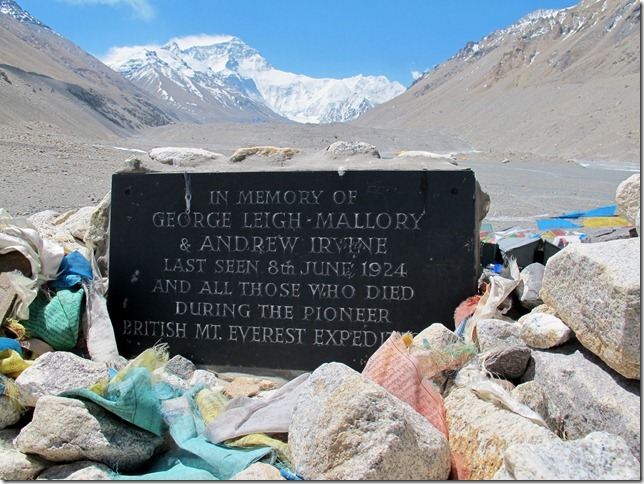
Stay tuned, looks like we are very close to start the action 60 years after the first Everest summit on Normal South Route, and almost 90 after George Mallory and Andrew Irvine opened the North Ridge route and probably summit the Highest Peak on Earth 🙂
 Unlimited Potential, Up to 8000m