Category Archives: 2012

Mt Damavand – Winter Climbing

The winter season may start from October to November and last to May and April. In this period climbing to Damavand summit is very tough and dangerous. Because of high wind speed and very low temperature, stormy weather conditions, too much snowfall, icy trails and other risks, winter ascend is graded as very difficult. The ski and snowboard season is from December to mid-May, the best ski months are March & April.

Weather condition in mount Damavand is harsh and severe in winter time. Since the end of October we expect snow fall in high altitudes, which means the condition is considered like winter. The temperature stays sub-zero till next June far up in Damavand.

The south route of Damavand is the easiest route to access during winter. This route is not technically difficult, but still challenging in extreme conditions of very high altitude. Indeed, those people who have previous experience of winter mountaineering and are physically fit have more chance to reach to the summit, while the stable weather condition is an important factor, too.

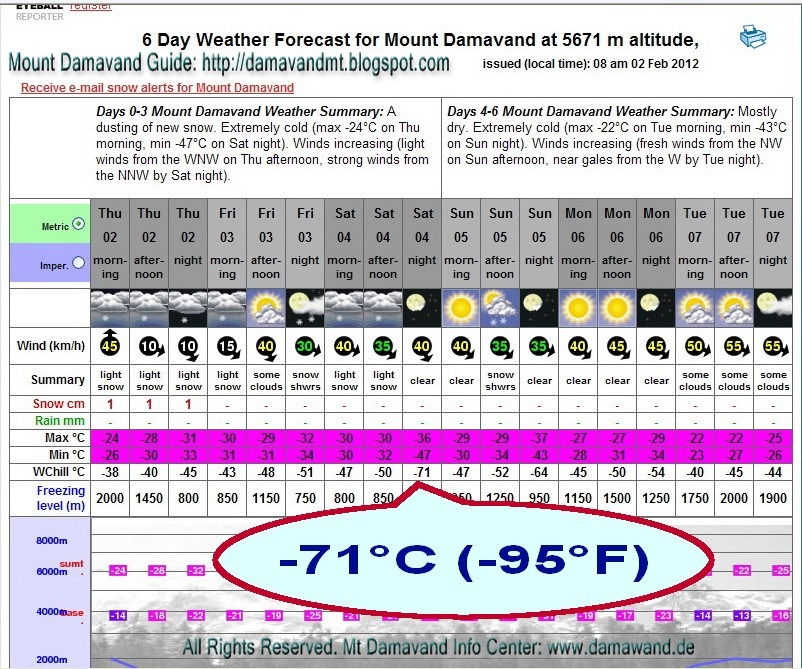
Damavand Weather could change to disastrous in winter, with strong winds more than 100km/h and freezing temperature below -70°C (-94 Fahrenheit). You must be well-experienced for such a difficult climb or ski mountaineering expeditions in harsh climate. Furthermore remember that rescue and medical facilities are not available in case of injury and emergency, so extra care should be taken for winter climbing and ski touring and it is done by your own risk.

The weather has caused more deaths than any other factor besides bad judgment by climbers. Some climbers appear to rely on weather forecast reports or none at all, but one should note they are forecasts too, and one day their forecast will probably be wrong.

Reinhold Messner

In 1970 when Reinhold Messner attempted a winter climb to Mt Damavand Iran, due to adverse weather conditions failed, because he realized that despite a lack of technical difficulties, is not an easy mountain climbing, but a large and highly conditional alpine challenge.


Weather

http://www.snow-forecast.com/resorts/Damavand/6day/top

http://www.snow-forecast.com/resorts/Damavand/6day/mid

http://www.snow-forecast.com/resorts/Damavand/6day/bot

http://freemeteo.com/default.asp?fid=820323_20120909_190822&isSite=1&hitDNS=www%2Edamawand%2Ede&pid=15&un=1&la=1&gid=138041


Temp-Minus71degC-4Feb2012-Damavand

Wind-Speed-110Km-15March2012-Damavand

Mt Damavand – Climbing Routes

There are at least 16 known routes to the summit which have different difficulties. Some of them are very dangerous and require rock climbing. Three routes are popular with climbers: North, South and North-East faces which are adjacent to villages and all have shelters/huts in midcourse. The most popular route is the Southern Route which has step stamps and also a camp midway called Bargah Sevom Camp/Shelter at 4220m (about 13,845 ft). Damavand is often subject to intense west winds and experiences cold winters, so climbing in this season has always been challenging for domestic as well as foreign climbers. The best major settlement for mountain climbers is the new Iranian Mountain Federation Camp in Polour village, located on the south of the mountain.

The longest route is the Northeastern and it takes two whole days to reach the summit starting from downhill village of Nāndal and a night stay at Takht-e Fereydoun (elevation 4300 m – about 13,000 ft), a two-story shelter. The western route is famous for its sunset view. Sīmorgh shelter in this route at 4100 m (about 13,500 ft) is a newly constructed shelter with two stories. There is a frozen waterfall/Icefall (Persian name Ābshār Yakhī) about 12m tall and the elevation of 5100m is the highest fall in Iran and Middle East. The North face has an extra shelter at 5000m.

South Route: It is easily accessible from Tehran or North of Iran, the short distance from Tehran to the Haraz main road make southern approach the best trail. This is by far the easiest and the best side, and the ascent to the summit by this way is also shorter. Route type is basic mountaineering, with difficulty and climbing grade moderate, walk-up and easy descend.

North East Route: Route type is mountaineering, with difficulty long and hard ascend with cold and wind and long descend. It has a shelter called Takht e Fereydoun at about 4500m. The refuge is called Panagah Simorgh in Persian.

West Route: West route type is basic mountaineering, with difficulty and climbing grade moderate walk-up, basic snow and cold and difficult descend. There is a refuge at 4200 m called Simorgh Camp. The shelter is called Panagah Simorgh in Farsi. Simorgh means Roc, a gigantic legendary bird said to carry off elephants and other large beasts for food. It is mentioned in the famous collection of Iranian tales.

North Route: The north face is the most difficult side of Mt Damavand with difficulty and climbing grade scramble mountaineering, steep, hard ascend, depending on season, cold and windy, snow & ice, difficult descend. It has two shelters called 4000 and 5000.

  Most climbers who have managed to climb to the summit from West, North East, or North Face prefer to descent from south face because of its easy descend footpaths


Climbing Grade in Different Systems

Please note that these grades are Mount Damavand Guide opinion only, there are usually differences between grading in different climbing routes. Regardless of the system used, all grades are an approximation.

  • Difficulty: F, YDS class 2 (and sulphur gas above 5400 m)
  • UIAA: II
  • USA: 5.3
  • Australia: 11
  • France: 2
  • YDS Grade: Grade V, two day climb Classes 2 and 3
  • Adjectival grade: Moderate (M, or “Mod”)
  • French Alpine: PD: peu difficile (not very difficult)
  • New Zealand: Grade 1, Easy scramble. Use of rope generally only for glacier travel.
  • Alaska Grade: Grade 2 Either a moderate fifth-class one-day climb, or a straightforward multiday nontechnical climb


Summit

Mt Damavand shape is conic like many other volcanos, it looks like Fujiyama in Japan, but much greater, with the altitude 5671 meters and a crater diameter approx 200 to 400m across and 30m deep, the crater has a permanent glacier which melts in hot summers and forms a small pool with little water. There is no shelter or refuge at the top, in case you want to challenge 7000 m or higher altitude you can make you own tent for acclimatization somewhere safe and away from sulfuric gases in or around the crater.

The summit is made of lots of yellow sulfurous rocks and pumice stones, usually covered by ice and snow. This stratovolcano has some sign of volcanic activity at the top, a big vent was formed in 2007 just below the crater with high fumarolic activity, through which hot sulphurous gases emerge, releasing a significant amount of smoke and hot sulphuric gases.


Mt Damavand Glaciers

There are some major glaciers on Mt Damavand, these huge mass accumulation of snow and ice are formed during ages and are the main source of water for Talkh Roud River and the Lar Dam Lake, one of the main reservoir of fresh water for capital city of Tehran. These glaciers are mostly located on east and north face. It appears that some of these glaciers cannot qualify as a true permanent glacier because they may disappears during a very hot and dry summer.

The most important glaciers are:

East and North East Face Glaciers:

  • In the enormous Yakhar Valley in the east side of this volcano there is large glacier called Yakhar which is the most well-known and the biggest glacier of the mountain, it starts from about 3500 meters high to just below the summit, it has was climbed many times in summer but not in the winter. This glacier is the main source for Talkhrood River, ending in Caspian Sea.
  • Chalchal Glacier and Arosakha, are other significant glaciers located on these sides.

North Face Glaciers

  • Two large glaciers are located on the north face, called Dobi Sel and Sioleh, the north route ridge passes between these two glaciers, which makes this route colder compared to the other routes.

South Face Glacier

  • There is a small glacier on the south face in Kafar Valley (Kafar Dareh), called South Glacier or Kafar Dareh Glacier. It’s situated between south route ridge and Mollakhoron Ridge, it passes by Damavand Icefall.

West Face Glaciers

  • There are some small and none important glaciers on the west side which do not have particular names.

Summit Glacier

  • There is a small glacier on the volcano crater, called summit glacier, mostly frozen, but in a hot summer you may see a little water in the crater.


Warning

Just near the summit and under the crater, at the junction where south and east climbing routes join together, a big new vent was formed in 2007, which is still exhaling a great amount of smoke and hot sulfuric gases and steam with pestiferous smell, this makes some problem for climbing. Without adequate equipment such as oxygen mask, it is quite dangerous to go close to this vent, because if the wind changes its direction, you could get caught in the sulfuric poison gas.


f_1242853709_DAMAVAND%20MAP2

The Middle East Roof

Damavand is the highest mountain peak in Iran located almost in the center of Alborz mountain range. Damavand is higher than all west Asian & European mountain peaks. Damavand peak is situated in Larijan district, Mazandaran Province, midway the Haraz Road, southwest of Amol City and 69 Kilometers northeast of Tehran. Damavand is an inactive volcanic mountain, always covered with snow. It looks like Fujiyama in Japan but much greater. Its snowy white top with its regular clouds is the most beautiful sight of Iran. There are no records of the last eruption, but there’s hot steam & sulfur gases coming out at the top. Damavand contains about 70 volcanic mouths and one of them is filled with a thick sulfur crest producing a beautiful conical peak with a diameter of some 400 meters. There are some hot springs on its lower slopes like Larijan village. At the summit there is a crater about 150-200 meters across, with a lot of yellow sulfurous rocks and pumice stones. Snow covers the crater and upper slopes in winter, spring and autumn. Because of its great height, the view from top is very extensive, a big panorama of mountains and valley covering many hundreds of square Kilometers. All around are other peaks of the Alborz Mountain Range, in the north to the Caspian Sea, and in the south descending to the deserts of central Iran. When the sky is clear and sunny, Damavand can be seen not only from Tehran but other cities such as Amol, Sari, Qom, Kashan, up 250km far.

The altitude of Damavand Volcano is 5671 meters (18605 feet), it is the highest summit in the Middle East and the second highest volcano in all Asia and the Northen Hemisphere. The highest volcano in Asia is Kunlun Volcano 7167 m (23514 feet) in Tibet.

General Facts

  • Distance from Tehran by road: 80km
  • Attitude: 5671 meters, 18605 feet
  • Prominence: 4667 meters, 15312 feet
  • Latitude: 35° 57′ 19″ N
  • Longitude: 52° 06′ 36″ E

Other Names and Spellings

  • English: Mount or Volcano Damavand, Damawand, Demavand, Demavend, Donbavand, Damāvand.
  • Farsi/Persian: Koh e Damavand alternate Dood koh, Koh Damawand, Qolleh Damāvand. Donbalvand, Dive Sepid, Koh e Ghaf.

First ascents

  • 905 by Abu Dolaf Kazraji
  • The first successful European ascent to the summit happened in 1837 by Tiller Thomson, and the first national ascent was recorded in 1857 by colonel Mohammad Sadeghkhan Gajar ‘s team.


Volcanic Activity

At present volcanic activity is manifested only in the presence of warm and thermal springs with therapeutic qualities which have formed travertine deposits and remain very popular. These mineral hot springs are mainly located on the volcano’s flanks and at the base, giving evidence of volcanic heat comparatively near the surface of the earth. While no historic eruptions have been recorded, hot springs at the base and on the flanks, and fumaroles and solfatara near the summit, indicate a hot or cooling magma body still present beneath the volcano, so that Damavand is a potentially active volcano. The most important of these hot springs are located in Larijan village in the district of Larijan in Lar Valley. The water from this spring is useful in the treatment of chronic wounds and skin diseases. Near these springs there are public baths with small pools for public use.

Since spring 2007, there have been some extraordinary activities such as significant emission of gas, steam, sulfurous materials and increase in hot spring temperature. There has been some news and rumors on the media about Mt Damavand new volcanic activity in 2012, these unverified information is widely spread by radio, tv and internet.  There was a reasonable amount of rain and snow fall in winter 2011 on Mt Damavand area. This usually increases the amount of gas emission from the vents in the in following year, also it may increase the hot water temperatures at the flank of southern thermal springs in 2012. Similar events were experienced in winter 2006 (rain/snow fall) and consequently some more volcanic activities in 2007.


Mythology and folklore

Damavand has, as any cursory reading of Persian literature will indicate, a special place in the Persian mythology and folklore. The popular traditions of the villages around the mountain are filled with legends and superstitions of which traces can be found in place names, as in the upper valley of the Lar, where a small ravine sprinkled with marshes, warm springs, and geysers is named Div Asiab (the devil’s mill).

Damavand is the symbol of Iranian resistance against foreign rule in Persian poetry and literature. In Zoroastrian texts and mythology, the three-headed dragon Azi Dahaka was chained within Mount Damavand, there to remain until the end of the world. In a later version of the same legend, the tyrant Zahhak was also chained in a cave somewhere in mount Damavand after being defeated by Kaveh and Fereydoon. The mountain was also the scene of an episode in the story of Rostam and Esfandiar. Damavand is also significant to the Iranian legend of the heroic Iranian archer Arash Kamangir and a suspected root for Tiregan Festival.


This slideshow requires JavaScript.

Climbing a Volcano – Mt Damavand دماوند

I finally have my flight tickets to Iran, and that means there is no way back for my next extreme challenge… I have two weeks more to train for a three days ascent to the highest volcano in Asia, and highest mountain in the Middle East, Mt Damavand. This beauty is 5610m high and I’m doing one the hardest routes in the north east face. Last year I did my first volcano in the States, Mt Rainier, 4392m in only two days, and it was the hell of a beautiful and hard climb! Few months before that I did amazing Island Peak in Nepal, with 6189m and plenty of days to acclimatize. This challenge will be physically extreme, since I’m climbing 580m less and I only have three days to complete what it normally takes 4… Time to test my lungs between the sulfuric fumaroles. Two weeks left for training… two weeks countdown starts just now!!!


IMG_9238

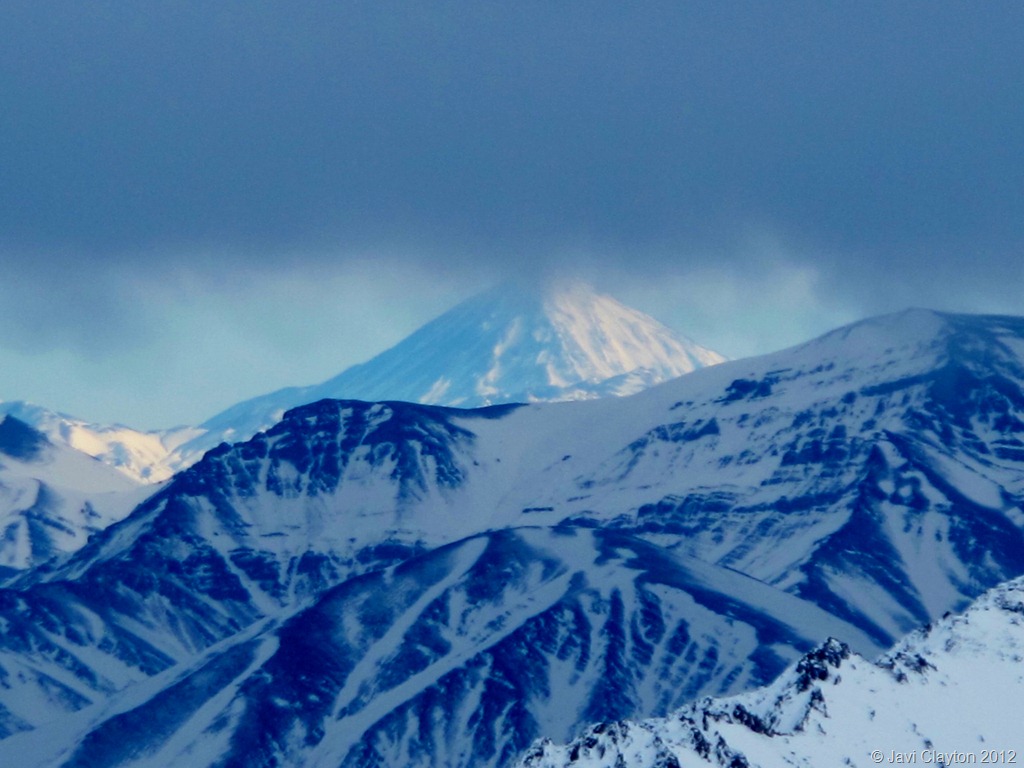
This picture of Mt Damavand was taken during my Winter Climb of Korma Kuh in 2011

Tien Shan Unclimbed Peaks & Lord of the Skies – Dispatches from the expedition Part II

Aug2: Just had the most hilarious night with my climbing team mates. Alcoholic night before we get back to the mountains. These folks are awesome, I LOVE CLIMBING ♥


Aug3: We just arrived to Karakol where I have good internet connectivity. Before I could just send updates via satellite, but no seeing comments on them, your kind words, blessings and wishes… You all have no idea of how happy I feel today, after reading ALL of them. The week has been hard, and this is just the beginning of this adventure up to the top of a difficult 7000m. THANK YOU SO MUCH for your support, now my batteries are fully charged with all your positive energy. I need to sort out some logistics in this village but I’ll reply to you all tonight!


Aug3: Some of my team mates went to sleep already while some of us are so nervous that we can’t make it yet, despite of the fact tomorrow we have a very early start, 6 hours drive to a small airstrip where we’ll take a russian helicopter to fly all the way up to Base Camp. I wish I’d feel stronger on the legs, but I can’t feel better on my heart after reading your comments today. I LOVE CLIMBING AND I LOVE MY FRIENDS ♥

GPS location 42.15264, 77.5429 Date/Time:08/03/2012 07:18:18 GST

http://www.bing.com/maps/?v=2&where1=42.15264%2C%2077.5429&q=42.15264N%2077.5429E&form=LMLTSN&cp=42.152666520380364~77.5429&lvl=12&sty=b&encType=1

http://maps.google.com/maps?f=q&hl=en&geocode=&q=42.15264,77.5429&ll=42.15264,77.5429&ie=UTF8&z=12&om=1


Aug4: The hotel at Karakol was like a palace, but we have to leave for 6h drive to an airstrip where a russian helicopter will take us to Khan Tengri BC!

GPS location 42.08675, 79.24471 Date/Time:08/04/2012 16:19:58 GST

http://www.bing.com/maps/?v=2&where1=42.08675%2C%2079.24471&q=42.08675N%2079.24471E&form=LMLTSN&cp=42.09451245798117~79.24471&lvl=12&sty=b&encType=1

http://maps.google.com/maps?f=q&hl=en&geocode=&q=42.08675,79.24471&ll=42.08675,79.24471&ie=UTF8&z=12&om=1


Aug5: Heli flight was delayed till this morning. We had 30 min amazing flight over Inylchek glacier to land in front of Khan Tengri, breathtaking experience!!!

GPS location 42.24804, 80.14363 Date/Time:08/05/2012 18:51:17 GST

http://www.bing.com/maps/?v=2&where1=42.24804%2C%2080.14363&q=42.24804N%2080.14363E&form=LMLTSN&cp=42.2480666092677~80.14363000000001&lvl=12&sty=b&encType=1

http://maps.google.com/maps?f=q&hl=en&geocode=&q=42.24804,80.14363&ll=42.24804,80.14363&ie=UTF8&z=12&om=1


Aug6: Yesterday we crossed the glacier and cashed tents and gear close to BC 4005m. Today we set up Camp1 at 4500m and back to BC. 8h of hard yet beautiful work

GPS location 42.232, 80.1571 Date/Time:08/06/2012 10:41:59 GST

http://www.bing.com/maps/?v=2&where1=42.232%2C%2080.1571&q=42.232N%2080.1571E&form=LMLTSN&cp=42.23202659430393~80.15709999999998&lvl=12&sty=b&encType=1

http://maps.google.com/maps?f=q&hl=en&geocode=&q=42.232,80.1571&ll=42.232,80.1571&ie=UTF8&z=12&om=1

GPS location 42.24804, 80.14361 Date/Time:08/06/2012 18:50:04 GST

http://www.bing.com/maps/?v=2&where1=42.24804%2C%2080.14361&q=42.24804N%2080.14361E&form=LMLTSN&cp=42.2480666092677~80.14361000000001&lvl=12&sty=b&encType=1

http://maps.google.com/maps?f=q&hl=en&geocode=&q=42.24804,80.14361&ll=42.24804,80.14361&ie=UTF8&z=12&om=1


Aug7: We took food and other supplies up to Camp1 and cashed tents and gas half way up to Camp2 at 4900m, 8h. Sleeping at C1. Tomorrow up to C2. Feeling weak 😦

GPS location 42.232, 80.15709 Date/Time:08/07/2012 17:55:42 GST

http://www.bing.com/maps/?v=2&where1=42.232%2C%2080.15709&q=42.232N%2080.15709E&form=LMLTSN&cp=42.23202659430393~80.15709&lvl=12&sty=b&encType=1

http://maps.google.com/maps?f=q&hl=en&geocode=&q=42.232,80.15709&ll=42.232,80.15709&ie=UTF8&z=12&om=1


Aug8: We woke up under a snow storm. We run down to BC to avoid getting trapped at C1. Quite nasty day I hate it! Thinking on my beautiful Sister, Happy Bday ♥


Aug9: Lots of avalanches, people going down to escape from disaster. Waiting at BC for the snow to transform. I took a bath in the glacier! Feeling strong again

GPS location 42.24804, 80.14365 Date/Time:08/09/2012 19:21:08 GST

http://www.bing.com/maps/?v=2&where1=42.24804%2C%2080.14365&q=42.24804N%2080.14365E&form=LMLTSN&cp=42.2480666092677~80.14365&lvl=12&sty=b&encType=1

http://maps.google.com/maps?f=q&hl=en&geocode=&q=42.24804,80.14365&ll=42.24804,80.14365&ie=UTF8&z=12&om=1


Aug10: Taking more food and gas up to C1. I feel very strong and want to move to C2, people advise me to rest at C1. I miss my people… Ready to rock and roll!

GPS location 42.23198, 80.1571 Date/Time:08/10/2012 17:43:05 GST

http://www.bing.com/maps/?v=2&where1=42.23198%2C%2080.1571&q=42.23198N%2080.1571E&form=LMLTSN&cp=42.23200659428526~80.15709999999998&lvl=12&sty=b&encType=1

http://maps.google.com/maps?f=q&hl=en&geocode=&q=42.23198,80.1571&ll=42.23198,80.1571&ie=UTF8&z=12&om=1


Aug11: Moving from C1 to C2 with 25kg backpack. Extremely hard 9h work. 900m technical ascent on a crest full of snow ice and rock. Smashed… but so beautiful!

GPS location 42.22274, 80.15147 Date/Time:08/11/2012 18:04:11 GST

http://www.bing.com/maps/?v=2&where1=42.22274%2C%2080.15147&q=42.22274N%2080.15147E&form=LMLTSN&cp=42.222766585668694~80.15147000000002&lvl=12&sty=b&encType=1

http://maps.google.com/maps?f=q&hl=en&geocode=&q=42.22274,80.15147&ll=42.22274,80.15147&ie=UTF8&z=12&om=1


Aug12: Last night we got the worst news, snow storm threatens Khan Tengri. We have to abandon 😦 I’ve got CO2 intoxication in the tent and feel sick. Sad day…

GPS location 42.24804, 80.14359 Date/Time:08/12/2012 20:15:42 GST

http://www.bing.com/maps/?v=2&where1=42.24804%2C%2080.14359&q=42.24804N%2080.14359E&form=LMLTSN&cp=42.26164756104794~80.19630013766716&lvl=12&sty=b&encType=1

http://maps.google.com/maps?f=q&hl=en&geocode=&q=42.24804,80.14359&ll=42.24804,80.14359&ie=UTF8&z=12&om=1


Aug13: Yesterday 7h of technical descent with 30+kg backpack. I had so much fun! But I was exhausted. We take the heli today escaping from storm. Game is over.


Aug14: Thank you so much to everybody who sent me oxygen from the distance while I was fighting to conquer “The Lord of the Skies”. We could not get any higher than 5500m due to bad weather and avalanches which took down two austrian climbers. We had several warnings and I think we made the right decision when we got the weather forecast at Camp2. Back at the heli base we were informed Khan Tengri and Pobeda have claimed two lives this season, and several climbers were injured due to rock falling and avalanches. On the bright side of the things we are coming back home with 12 summits (four in my case) from a virgin mountain range where most peaks remain unclimbed.

Right now I have mixed feelings… not because we failed to summit our 7000 but because this has been, once again, a life changing experience… These days I’ve discovered things about myself and the people around me that make me feel sad. Before I left Dubai few weeks back I had a clear idea of where I wanted to go tomorrow, but today I have no clue about it. All I know is I want to be in High Places… I’ll be back home on Monday ready to climb, fly, and preparing for my next challenge that will take place on March 2013. I have about one moth to tight things before I make it official at work. I’ll keep you posted 🙂


Aug14: Fun night yesterday eating pizza, singing karaoke and drinking vodka at Karakol. Just leaving to a resort at Issyk Kul lake to chill out for few days.


Aug16: Yesterday I had a fantastic day in the beach in Tamche, at the north side of Issyk Kul lake, taking photos with the locals (they love it), playing voleibol and soccer with them and my climbing buddies, and dancing in a creepy disco full of teenagers. The people in this side of the world seem to be nice but made of steel and quite enigmatic. It’s a hidden paradise for climbers but definetely not a place where I’d like to live. Today we are heading back to Bishkek where I’m organizing a short rafting trip. I must admit that I’m missing home, my training routine, and small things in my regular daily life. And I miss my Harley, my ever green terrace, koi fish tank, amarilis flowers, and many other things in my home country. Crossing over the Liffey river every single day, listening to irish balads on Sunday morning, and trekking from Houth to Greystones on rainy weekends. I miss España and I miss beautiful Ireland ♥


Aug18: Leaving Kyrgyzstan and heading back home. I have the feeling I’ll be back one day… Khan Tengri, this time you made it hard for us, but I’ll see you soon 🙂
Tien Shan Unclimbed Peaks & Lord of the Skies – Dispatches from the expedition Part I

Jul21: Landed in Bishkek after a crazy and stressful day. I just met one of my climbing partners from Australia and guess what he is bringing with him… his mountain paraglider!!!! Life is full of surprises!


Jul22: Crazy night at Bishkek.., not a good start for a 7000! From tomorrow I have to behave :p


Jul22: Enjoying the city with my new Kyrzyg friends. Awesome hosts, I have no clue how I’m going to show them my gratitude…

GPS location 42.85978, 74.60008 Date/Time:07/22/2012 09:18:11 GST

http://www.bing.com/maps/?v=2&where1=42.85978%2C%2074.60008&q=42.85978N%2074.60008E&form=LMLTSN&cp=42.85980718571956~74.60008000000002&lvl=12&sty=b&encType=1

http://maps.google.com/maps?f=q&hl=en&geocode=&q=42.85978,74.60008&ll=42.85978,74.60008&ie=UTF8&z=12&om=1


Jul22: Today I met the rest of expedition team members. We have all sort of characters, one Everest summiter and two young Iranian ladies. Getting ready for a 6 hours drive on an old russian truck to Tamga village


Jul23: Leaving to Tamga village, and tomorrow to Jentim-Bel. 700km on an old russian truck before starting the first set of climbs in the unclimbed mountain range

GPS location 42.1575, 77.52773 Date/Time:07/23/2012 16:13:27 GST

http://www.bing.com/maps/?v=2&where1=42.1575%2C%2077.52773&q=42.1575N%2077.52773E&form=LMLTSN&cp=42.15752652490211~77.52773000000003&lvl=12&sty=b&encType=1

http://maps.google.com/maps?f=q&hl=en&geocode=&q=42.1575,77.52773&ll=42.1575,77.52773&ie=UTF8&z=12&om=1


Jul23: Last night before starting our true adventure. Tomorrow we leave Tamga to set our basecamp in the middle of a virgin area. From there the action will follow!


Jul24: Good morning beautiful peaks! Cant wait to test my new ice tools! I’ll be offline for about 10 days before heading to my 7000 I’ll update our location with Spot

GPS location 41.80879, 77.57567 Date/Time:07/24/2012 17:22:34 GST

http://www.bing.com/maps/?v=2&where1=41.80879%2C%2077.57567&q=41.80879N%2077.57567E&form=LMLTSN&cp=41.808816202211865~77.57567000000001&lvl=12&sty=b&encType=1

http://maps.google.com/maps?f=q&hl=en&geocode=&q=41.80879,77.57567&ll=41.80879,77.57567&ie=UTF8&z=12&om=1


Jul25: The team is fantastic with all sort of characters, the valley beautiful but hostile, our Base Camp is taking form and we start exploring climbing options

GPS location 41.80204, 77.56298 Date/Time:07/25/2012 12:02:33 GST

http://www.bing.com/maps/?v=2&where1=41.80204%2C%2077.56298&q=41.80204N%2077.56298E&form=LMLTSN&cp=41.802066196000254~77.56298&lvl=12&sty=b&encType=1

http://maps.google.com/maps?f=q&hl=en&geocode=&q=41.80204,77.56298&ll=41.80204,77.56298&ie=UTF8&z=12&om=1


Jul26: We summited our first unclimbed 4200m. Mariam almost had a fatal accident and I had extreme dehidration on the way down, not a good start, I’m not strong

GPS location 41.80061, 77.54311 Date/Time:07/26/2012 13:42:11 GST

http://www.bing.com/maps/?v=2&where1=41.80061%2C%2077.54311&q=41.80061N%2077.54311E&form=LMLTSN&cp=41.800636194684486~77.54311&lvl=12&sty=b&encType=1

http://maps.google.com/maps?f=q&hl=en&geocode=&q=41.80061,77.54311&ll=41.80061,77.54311&ie=UTF8&z=12&om=1


Jul27: Yesterday I was so badly dehidrated that I ended up with edema in my feet causing bleeding under my nails, again.. Resting today at BC, worried, unhappy

GPS location 41.80901, 77.57575 Date/Time:07/27/2012 18:35:41 GST

http://www.bing.com/maps/?v=2&where1=41.80901%2C%2077.57575&q=41.80901N%2077.57575E&form=LMLTSN&cp=41.809036202414326~77.57575&lvl=12&sty=b&encType=1

http://maps.google.com/maps?f=q&hl=en&geocode=&q=41.80901,77.57575&ll=41.80901,77.57575&ie=UTF8&z=12&om=1


Jul28: We summited our second unclimbed 4350m First one took us 11h this one 9 and still I feel weak descending. Team has split so that we can attack many peaks

GPS location 41.81832, 77.50503 Date/Time:07/28/2012 09:44:18 GST

http://www.bing.com/maps/?v=2&where1=41.81832%2C%2077.50503&q=41.81832N%2077.50503E&form=LMLTSN&cp=41.818346210983954~77.50503&lvl=12&sty=b&encType=1

http://maps.google.com/maps?f=q&hl=en&geocode=&q=41.81832,77.50503&ll=41.81832,77.50503&ie=UTF8&z=12&om=1


Jul29: 3rd summit. Very long beautiful crest 4155m. I’m teaming with a paraglider from Oz, Iranian doctor girl, and old fireman Everest summiter. My feet is bad

GPS location 41.75946, 77.56577 Date/Time:07/29/2012 11:06:41 GST

http://www.bing.com/maps/?v=2&where1=41.75946%2C%2077.56577&q=41.75946N%2077.56577E&form=LMLTSN&cp=41.75948615684669~77.56576999999998&lvl=12&sty=b&encType=1

http://maps.google.com/maps?f=q&hl=en&geocode=&q=41.75946,77.56577&ll=41.75946,77.56577&ie=UTF8&z=12&om=1


Jul30: Resting at BC 3260m. Bath and laundry in the river. Training with ropes. Wild horses and marmots everywhere. Team moral is awesome. Mine is not good…

GPS location 41.80901, 77.57575 Date/Time:07/30/2012 18:24:40 GST

http://www.bing.com/maps/?v=2&where1=41.80901%2C%2077.57575&q=41.80901N%2077.57575E&form=LMLTSN&cp=41.809036202414326~77.57575&lvl=12&sty=b&encType=1

http://maps.google.com/maps?f=q&hl=en&geocode=&q=41.80901,77.57575&ll=41.80901,77.57575&ie=UTF8&z=12&om=1


Jul31: 4rd unclimbed summit 4105m. Good fun! Amir had an accident and cut his hand very badly. I feel strong, feet healed. Rains a lot again. Missing my people

GPS location 41.82518, 77.59697 Date/Time:07/31/2012 11:02:50 GST

http://www.bing.com/maps/?v=2&where1=41.82518%2C%2077.59697&q=41.82518N%2077.59697E&form=LMLTSN&cp=41.825206217300014~77.59697&lvl=12&sty=b&encType=1

http://maps.google.com/maps?f=q&hl=en&geocode=&q=41.82518,77.59697&ll=41.82518,77.59697&ie=UTF8&z=12&om=1


Jul31: Writing from our gorgeous hidden valley with no signal, but hopefully these updates will go through in two days from Karakol. The week has been amazing but hard


Aug1: Today the whole team decided to rest at BC and we had a fantastic day. I went for three hours walk down the valley to photograph the wild horses, amazing!


Aug2: We left our virgin mountains and made our way through the Tosor Pass back to Tamga. We r so happy loads of alcohol tonight before heading the big mountain

Khan Tengri Expedition’12 – Lessons learned

With more time in Khan Tengri and investing a big amount of time waiting for proper weather windows, we could probably have this amazing 7000m peak in our pockets.

Other lessons learned on the personal side of the things:

The stronger climbers in the team were those with a good climbing buddy. Conquering mountains this magnitude without a good friend covering your back, could be as challenging as I never imagined.

Dehydration was challenging at all times… for the next expedition use 2×1 liter insulated Nalgene bottles plus 500ml lightweight bottle to carry in my down jacket.

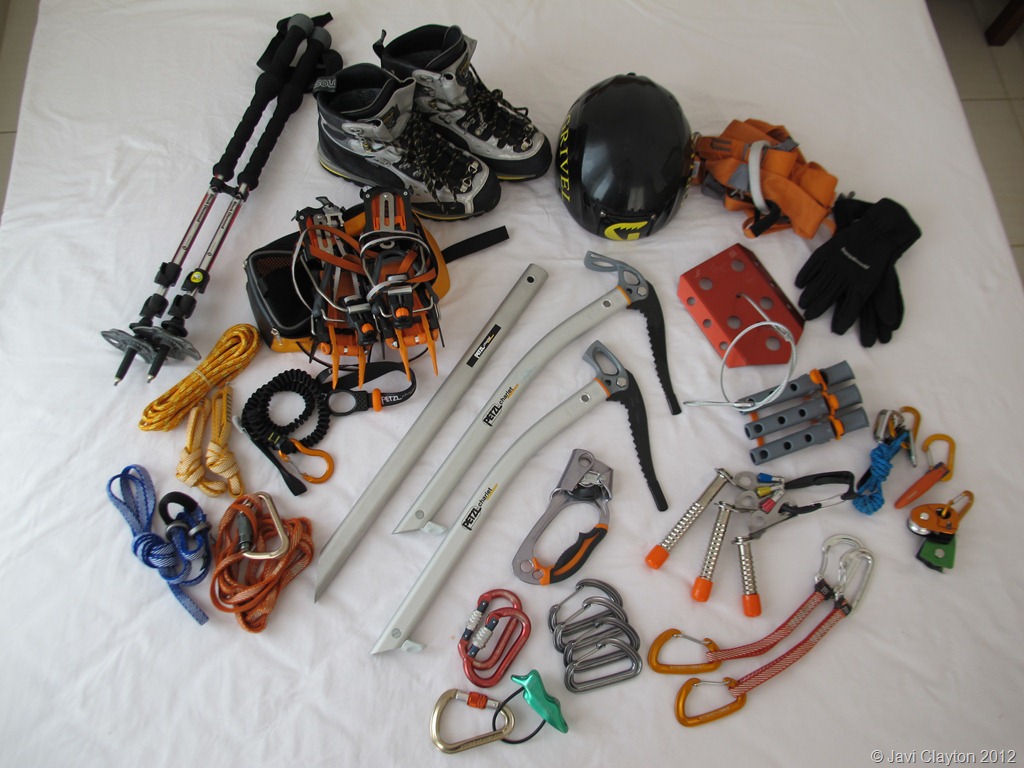
Figure of 8 descenders are bulky and old fashion, but on icy ropes is the only way to get down. A backup ATC is light and very useful for belaying a second and self recovery. Triblocks are an amazing piece of gear as long as you don’t drop them down the hill… next time get it linked to the carabiner. Keep the gear in the harness to the bare minimum. Simplify the lanyard connecting the jumar to your harness, daisy chains are messy and not useful. The locking carabiner on the lanyard should be big and easy to action with big globes or mitts, such the Petzl Vertigo which is a via ferrata carabiner with an auto-locking mechanism that unlocks quickly and easily for frequent use.

Having spare batteries for the headlamp is not enough… better to have a spare headlamp.

Keep precise tracking of the freeze dried food you are moving between camps, or you might end up with six breakfast and deserts but only three dinners at high camps…

No matter how much your climbing partners complain in the tent, always keep the air flowing

IMG_2431

Khan Tengri 2012 – Description of the expedition logistics (Part 2)

Technical gear

  • Petzl Lynx modular crampons for mixed climbing
  • Petzl Aztarex ice axe adze + Climbin Technology elastic leash
  • BD Couloir light alpine climbing harness
  • Y-shaped lanyard made with 8mm cord
  • Petzl Ascension right hand ascender (jumar) directly attached to one end of the lanyard
  • Auto-locking carabiner attached to one end of the lanyard (big one for easy handling with globes )
  • Two oval shaped light locking carabiners + normal carabiner
  • Petzl Reverso + figure 8 + HMS carabiner
  • Petzl Micro Traxion + compact pulley
  • Petzl Tribloc + prusik


Personal gear

  • Sleeping bag The North Face Inferno -20
  • Sleeping mattresses : Thermarest NeoAir All Season + Thermarest Z Lite + Repair kit
  • Quechua inflatable seat / pillow


Group gear


Accessories

  • Leatherman multi-tool knife
  • Waterproof matches and candle
  • Zip ties
  • Whistle
  • Head torch Petzl Tikka, spare batteries
  • Central Asia guide, topographic maps, climbing book
  • Praying flags
  • Waterproof bag
  • Pee bottle 1L
  • 2x700ml insulated water bottle Zefal Antartica
  • Water bladder for backpack


Electronics

  • Digital Camera Canon G12, spare battery, charger, 8GB SDHC memory card SanDisk Ultra, spare 4GB SDHC SanDisk, micro tripod, cleaning set
  • Helmet digital video camera Cam Sports HD, 16GB micro SDHC memory card SanDisk Ultra, spare 4GB micro SDHC
  • 16GB memory stick
  • 2GB MP3 player Ipod Suffle , micro speaker, USB charge cable (same for both)
  • Pedometer
  • Pulse oximeter
  • Nokia N95 mobile phone, charger
  • USB charger for iPod, speaker, video camera, pulse oximeter (same for all)
  • USB data cable
  • GPS Garmin 62s with scanned topo maps and birdseye satellite imagery, spare batteries
  • SPOT Satellite GPS Messenger, spare batteries Energizer Ultimate Lithium
  • Suunto Core watch with altimeter/barometer, spare battery
  • Lithium batteries Energizer Ultimate for radio


Food supplements

  • Sea to Summit aluminum pan and isolated mug
  • Isostar glucose gels and tablets. Gu electrolyte drink tablets and Elete natural electrolyte concentrate
  • Aptonia 35g protein bars


First Aid Kit


Toiletries and personal care


IMG_1529IMG_1538IMG_1549IMG_1550IMG_1552IMG_1553IMG_1554

Khan Tengri 2012 – Description of the expedition logistics

Typically a 7000m mountains of these characteristics is climbed with no support from above basecamp for a period of approximately four weeks. This means that climbers spend all time moving from basecamp to higher points to build endurance and transport gear a and food required to do a final push up to the summit. Climbers on high altitude expedition can opt for three different styles of climbing:

Alpine – were climbers move all the way up with absolutely all gear required to summit, and they take everything down leaving no trace of this activity, witch is consider the most pure and demanding way of climbing.

Heavy expedition – were climbers move through a number of high altitude camps that are already set up by third parties to facilitate the progression carry only personal gear. The route is normally prepared with fixed lines, aluminum ladders, bamboo markers, etc. Sherpas and High Altitude Porters are typically the ones doing the hard work while climbers focus only on moving up without the hassle of carrying heavy loads and setting up the camps.

Capsule – Is a combination of both, were climbers work on setting up camps, cashing food and gear, and leaving the route ready for a summit push where alpine style techniques can be used from higher camps. Normally lower camps are dismantled and taken up as the team moves higher


In all these three scenarios, climbers normally spend half of their time in the mountain going up and down to assess the conditions of the mountain and preparing the body for the stress of the extreme conditions and high altitude. This process is known as acclimatizing.

In our case we chose a very ambition strategy. Acclimatizing by climbing alpine style for ten days in Jetim Bel Mountain Range, a remote area of the country full of virgin peaks ranging 4000 to 4800m and never climbed before by humans, and moving from there right away to Khan Tengri Base Camp in the North Inylchek Glacier to attack the mountain on capsule style.


Description of the approach route, basecamp logistics, climbing route and climbing strategy

The base camps on the Northern and Southern Inylchek glaciers respectively are generally accessible by helicopter. “Generally” means the weather will be the main decisive factor to leave the Heli base at Maidadir, but I believe the rhythm of business for the company operating the flight is also determining .

In the north side of Khan Tengri there are actually two basecamps, one in the Kyrgyzstan side and the other in Kazakhstan. They are about 1km away from each other, a very pleasant walk trough the glacier on rest days when you want to socialize or trade with your foreign basecamp. The Kyrgyzstan camp (4005m) is sensibly smaller and colorful, and I would personally define it as boutique style, while the one in Kazakhstan is big, chaotic, gray and military style. However the gray camp is very well provisioned with a huge mess tent featuring bar with alcoholic drinks and DJ mixer, small shop were to buy soft drinks, candy and home made marmalade, as well as Banya, the Kazakh version of a sauna. Our beautiful Kyrgyz camp had huge yellow tents were you can easily stand up, an almost new mess tent with separate quicken, shower tent with hot water for 10$, and a small toilet tent located far away from the camp and with the best views you can imagine. All tents including the toilet are set on top of wooden platforms that you have to adjust regularly to cope with the physics of the glacier. The mess tent in the gray Kazakh camp was sitting right on the icy and rocky glacier surface.

Both camps have easy access to the first slopes on both easy North climbing routes.


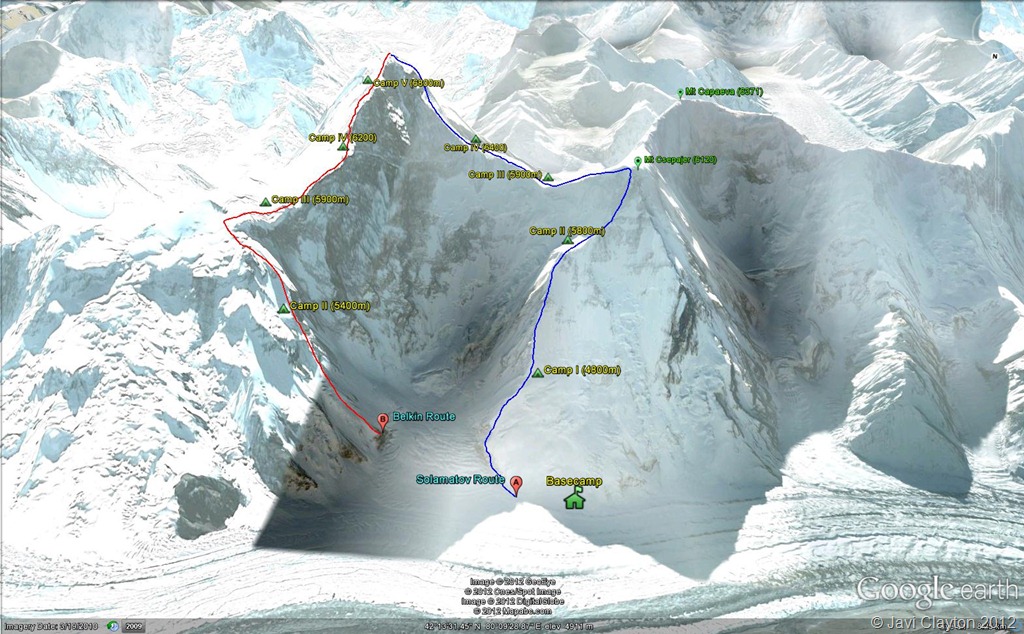
Khan Tengri was first climbed by Ukrainian alpinist M. Pogrebetskiy in 1931, from the south side which is now known as Classic Route. Since then 21 routes on four aspects of the mountain have been explored, but possibilities for new routes has not yet been exhausted. Khan Tengri can be climbed from either South or North Inylchek Glaciers, on which separate base camps are located. The “northern normal route” is more difficult than the “southern normal route”, but it is much less exposed to avalanches. It has eight different routes opened up to date, but we were looking  to climb either Solomatov Route via the north east Chapaev Ridge, which take us to the summit via the West Ridge, or the Belkin Route going through the East Buttress to the North Ridge. Both routes are Russian Grade 5b and were first climbed in 1974 and 75 respectively.

The route is to be chosen based on the conditions but most climbers chose the first one which is considered the Normal Route, and that is what we decided to do. This route follows snow slopes and the NE ridge to Camp 1 (4500m). The ridge continues in a spectacular position with a couple of rocky steps to Camp 2 (5400m) situated in a glacial basin below the final summit slopes. After traversing the summit of Chapayev an easy descent leads to Camp 3 (5800m) on a col below the West ridge of Khan Tengri. This is the site of Camp 4 (6400) on the now unsafe Semenvski Glacier route from the south. It is now normal to make summit bids from Camp 3. The ascent is initially on snow slopes that soon turn into steep broken ground that gradually gets steeper as progress is made up the pyramid’s face. Much of the route now consists of fixed line, although of variable quality.


google-earth-5


This was the initial strategy

  • Phase one: Base Camp (BC) > Camp1 (C1) > sleep BC > Camp2 (C2) > Sleep C1 > BC > Rest
  • Summit push: BC > sleep C1 > sleep C2 > sleep Camp3 (C3) > summit day > sleep C2 > BC


This was what we eventually did

  • Phase one: BC > C1 > sleep BC > Cashing at interim camp between C1 and C2 > Sleep C1 > BC > Rest
  • Summit push: BC > sleep C1 > sleep C2 > abort and down to BC


This is how we provisioned ourselves during the climb

My climbing partner and I teamed up to carry all required stuff for two men, but we considered sharing with other team members if required

  • Climbing day 1 (BC > C1)
    • 1 tent
    • 1 stove, 1 set of pans
    • 4 gas cylinders
    • Freeze dried food: 12 breakfast, 12 dinner, 6 desert
    • Lunch pack for two days two men
    • 4 chocolate bars, sweets and energy gels and tablets
    • Personal and technical gear (no ropes)
  • Climbing day 2 (BC > Cashing at interim camp between C1 and C2 > Sleep C1)
    • Additional freeze dried food up to cash point: 2 dinner, 2 desert
    • Additional 2 gas cylinders up to C1 + additional 2 gas cylinders up to cash point
    • 2 toilet rolls
    • Lunch pack for four days two men
    • 20 chocolate bars, 8 teabags, nuts, sweets and energy gels and tablets
    • Personal and technical gear (reduced by half after assessing the route) + high altitude gear
  • Climbing day 3 (C1 > C2)
    • 1 tent
    • 1 stove, 1 set of pans
    • 6 gas cylinders
    • Freeze dried food: 8 breakfast, 8 dinner, 4 desert
    • Lunch pack for four days two men
    • 16 chocolate bars, 6 teabags, nuts, sweets and energy gels and tablets
    • Personal and technical gear + high altitude gear

I don’t measure a man’s success by how high he climbs but how high he bounces when he hits bottom (George S. Patton)

It’s two weeks exactly from the day we decided to abort our summit push to Khan Tengri and abandon the expedition… Two weeks of mixed feelings, but today I only feel the need for climbing something bigger. I have resumed training and I’m already working on the plan phase for the ultimate challenge. This year is going to be amazing 🙂

Two weeks back I was exhausted, melting snow at 5500m to drink and prepare some food before it gets dark. I felt quite tired but happy to have plenty of time on the following day to recover at Camp2 before doing a summit push up to Camp3, followed by our summit day. I was trying to get everything organized before hitting my sleeping bag when I got the worst news: weather forecasts declared the following day too dangerous for us to stay at high altitude. One more snow storm was expected to leave one meter of snow on high camps, making the descent in case of difficulties extremely dangerous considering the size of our team and all expedition gear to be carried down the mountain. We could not believe such thing while staring at the beautiful sunset… we so much regretted not having alternative forecasts from other providers. But we could not think on any other thing than escaping from the avalanches down to secure heights. Retreating to Camp2 to retry our summit push was not an option considering our countdown to take the helicopter back home had already started.

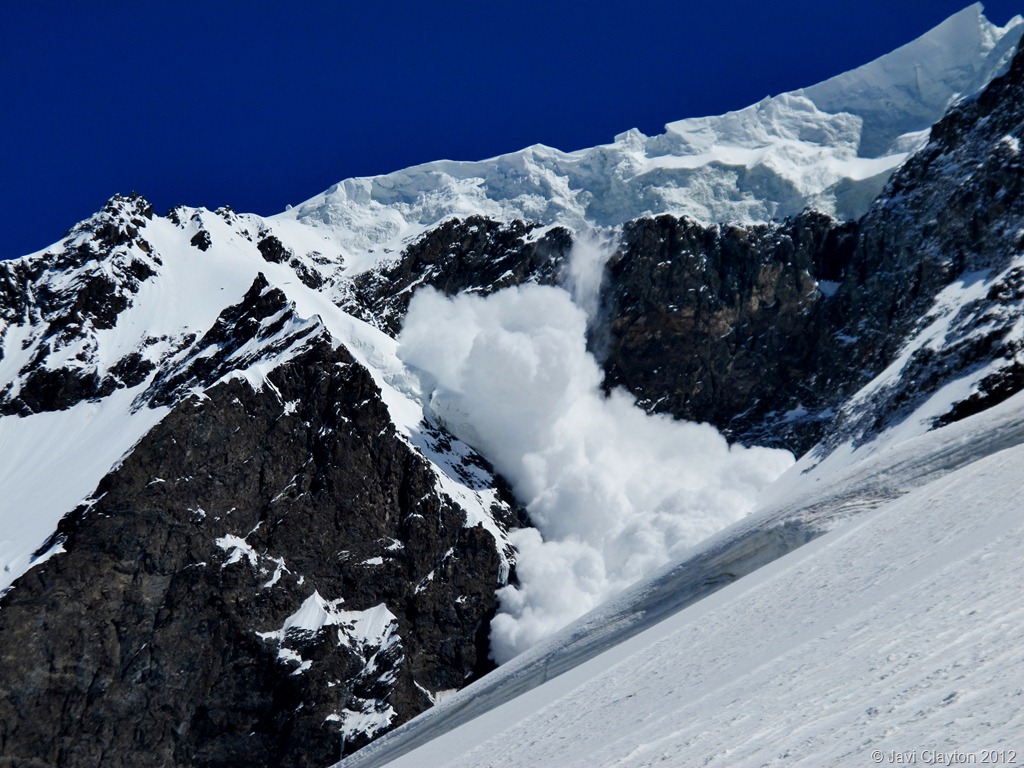
Avalanches…. I have never in my life seen so many in such a short period of time. They are one of the most beautiful phenomenon you can contemplate up in the mountains…. a dire need for the mountain of releasing the most powerful forces one can see in a natural environment. During our first night on high camps, four days back up to 4500m, the weather turned from a lovely sunny day into a stormy night leaving about 30 cm of snow, followed by a hot and cloudy descent that could scare the most experienced climber. That morning we decided to cancel our plans for moving from Camp1 to Camp2, and instead we went down to Base Camp to supply ourselves with the extra food, gas and gear required for our summit push. Going down that morning on melting snow slopes while listening to the power of avalanches was a worrying start of our expedition. Right after our descent, a climber from other team was partially avalanched, and the staff at BC told us about a similar incident that happened some days prior our arrival. We were climbing a mountain which main cause of fatality is avalanches, you can read that in the climbing books, and you can tell when you have your camera full of photos of these beautiful collapses.

Last night in the mountain, when we already decided to cancel the expedition, I was very worried in my tent thinking on the huge load to take down in my backpack the following day, under adverse weather conditions, and through the rocky steps that I´ve never done before with 30+kg going down. I was not feeling sick, but altitude and the stress of our decision played games with me that night, so I could barely have proper sleep, making things more difficult for our retirement. Next morning I woke up lazy and grumpy. Weather was OK and other teams were already dismantling the camp. I felt very dizzy, most probably as result of CO2 intoxication while sharing a sealed tent with two climbing partners…that slowed me a lot on preparing for the descent. I must confess I was concerned about making it safe through the rocky steps with such dizziness. Three young Kazahs left their tent there and started moving up to Camp3. I just hope they are safe today… My friend Jose, who was climbing Peak Bodeba from the south Khan Tengri Base Camp (we were on the North one), just told me a group of three climbers were avalanched while sleeping, and one of them was trapped in the tent and died… I can’t thing on anything more painful than having to escape down the mountain with almost no gear, and knowing that you are abandoning your climbing buddy buried in her tent underneath a field of snow and ice blocks…

This is how this story ends, knowing that we did the best for us, even if we felt like giving up easily… but now I can plan for bigger adventures since I learnt loads of things on the field, and I had once again the bittersweet taste of challenging myself and mother nature in a real mountain.


IMG_2580